
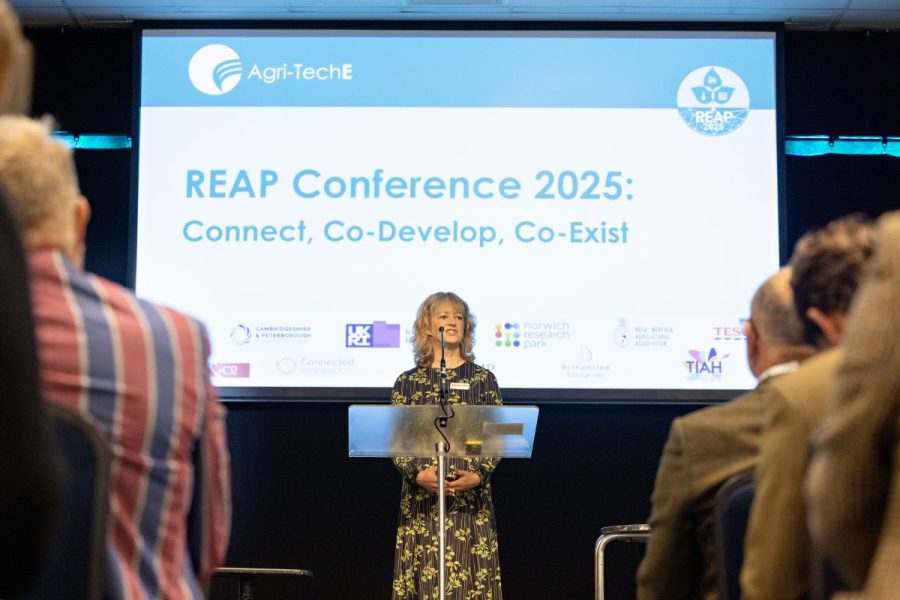
Renowned as the event to attend to find out the latest innovative technological developments fast approaching British food production, CPM attended Agri-TechE’s REAP conference in Peterborough.
“What’s nice about creating energy from soil is it’s something that can be done continuously.” JAKUB DZIEGIELOWSKI
By Janine Adamson
Celebrating its 12th year in November, Agri-TechE’s revered REAP conference has gained a reputation for not only providing leadership insights into agricultural innovation, but for shining a spotlight on upcoming entrepreneurial talent.
Alongside a jam-packed speaker programme that included Minette Batters and Defra’s Harley Stoddart, the conference revealed eight start-ups during a showcase which for many, has become a firm event favourite.
One of these, Aeropod, promises to help regenerate agricultural soils, explained engineer and founder, Lu Afolayan.
Described as ‘climate-responsive soil aeration capsules’, the technology was developed in response to the fact that around 40% of the earth’s soil has been degraded. Rather than allow this trend to continue, Aeropod wants to support farmers to regenerate land where extreme weather and prolonged waterlogging has accelerated compaction and prevented machinery use, explained Lu.
BREAKING THROUGH
How the capsules work is, they’re triggered when soil reaches a critical level of compaction and moisture, breaking through to aerate and enrich the ground. This restores oxygen flow, and while fully biodegrading, the capsules release material that supports healthy biology. “It’s quite literally groundbreaking,” she said.
The aeropod capsules are planted during drilling and should work all season, added Lu. “The simple process ensures savings on costs such as diesel, labour and machinery.”
During the next year, on-farm UK trials will take place to collect data to support claims such as the precise aeration from Aeropod can increase crop yields by up to 30%. “Aeropod was created with farmers in the first place, and we want to keep that going,” said Lu.
POWERING UP
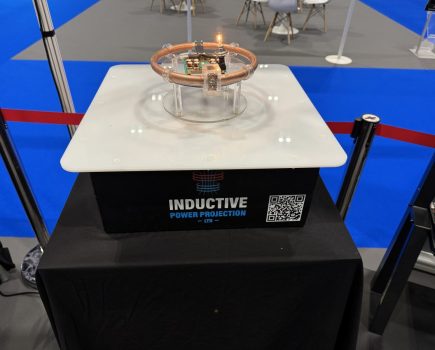
Continuing with the theme of soil, Jakub Dziegielowski, founder of Bactery, outlined his innovative device which is based on harnessing the power of soil bacteria to generate electricity.
In this case, a six-inch box filled with soil captures the electrons released by it. “What’s nice about creating energy from soil is it’s something that can be done continuously, day or night, making this technology far less dependent on weather.
“It’s also inexpensive, requires no maintenance, and makes power delivery to remote and hard to access locations a viable option.”
The ‘battery’ device has a lifespan of around 30 years and is designed to sit quietly in the ground, offering a low-profile alternative to above-ground renewable energy sources that depend on the wind or sunlight, explained Jakub.
Currently, the first generation device is capable of generating 0.2 watts/m3, meaning in a year, a single unit can produce the energy equivalent of 10 AA batteries. “In our labs, we’re actively working to improve this, with systems in the pipeline that are six times more powerful, and are on track to reach levels where soil could compete with grid-like energy.”
Jakub believes Bactery could offer a long-term, cost-effective solution for powering sensors scattered across a farm. “Often these sensor and IoT-based technologies can be expensive, with a large proportion of the cost attributed to powering them.
“Compared with what’s currently available – conventional batteries and solar panels – our solution is much more durable and far less expensive,” he added.
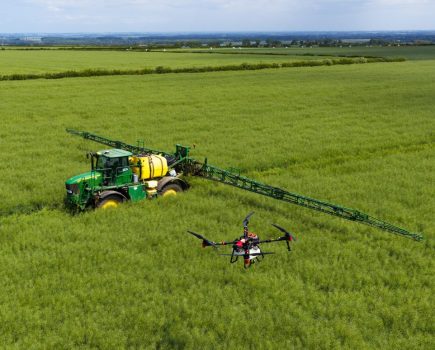
From below ground to above it, Kim Hein of SwarmOps shared how he’s hoping to accelerate the adoption of drone technology in the UK. With 25 years’ experience of sugarcane farming in South Africa – including around a decade of drone spraying – he believes the knowledge he’s gained is translatable to the UK market as regulatory constraints begin to ease.
“If we look at some of the challenges we’re facing at the moment such as soil compaction – every time we have a tractor in a field it might not seem like a massive thing, but compaction increases and soil damage continues, limiting crop root growth and impacting yields,” said Kim.
“Drones change that completely – we’re floating above the ground and don’t have to touch the soil meaning better conditions. But it’s not just about soil, drones are unlocking greater precision through variable rate application, placing fertiliser and pesticides exactly where we want them.”
So what does the company do? In short, SwarmOps offers drones that do more than fly – they map, spray, spread and seed, carrying up to 60 litres of liquid per arm, explained Kim. The drones also work in conjunction with mapping systems.
“The drone looks after itself in terms of its battery capacity, marks its endpoint in the field, returns home for a change of batteries and a refill of the tank. You simply re-click the task and resume, and off it goes again; an almost completely automated process.”
Perhaps critically, SwarmOps is one of the few UK companies authorised by the Civil Aviation Authority (CAA) for UAV crop spraying. As such, their drones are already being used for pest and disease control, fertiliser distribution, and cover crop seeding.
NEXT GENERATION
Kim believes there’s an even wider benefit beyond the field. “We’re trying to get a new generation of youngsters into farming, at a time when they’re losing interest. I’ve seen that drones can entice the youth back in because they’re exciting, fun and involve data,” he said.
Looking to the future of weed control, Dr Nadia Radzman, a biologist at the Sainsbury Laboratory at Cambridge University, discussed her work that’s researching the use of peptides as bioherbicides.
While one established application of peptides is to stabilise crop yield when applied prior to stress, Nadia believes they also have potential to assist weed control. “Peptides are tiny proteins that are good ‘on and off switches’ to control how plants grow and develop,” she explained.
Nadia likened what’s required in crop science to the development of insulin – an agent that’s effective and precise at controlling blood sugar across all humans.
“But in this situation, we’ve developed a way for peptides to induce extreme stress on a weed, which is co-delivered with a chemical RNAi spray that protects the crop by making it ‘blind’ to the bioherbicide. This has the potential to be an effective post-emergence treatment; the protectant also helps the crop to be resilient to stress,” she said.
Nadia added that at the moment, peptides are expensive to deliver at scale, so she’s looking at how to utilise them at a reduced cost. “The goal is to match the current price of glyphosate, which is relatively inexpensive.”
This article was taken from the latest issue of CPM. Read the article in full here.
For more articles like this, subscribe here.
Sign up for Crop Production Magazine’s FREE e-newsletter here.