
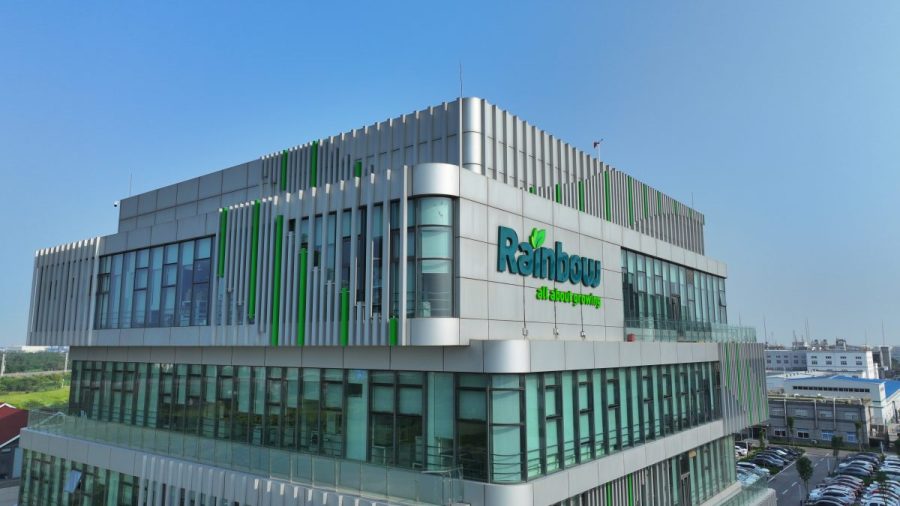
Long-established behind the scenes, Rainbow Agro is now stepping into the spotlight in the UK and Ireland. With manufacturing, regulation and local support at its core, CPM explores what the business really offers British growers.
“For UK growers, the Rainbow name may be new – but the principles behind it are familiar.” SIMON MCMUNN
By Charlotte Cunningham
For UK growers, the crop protection market can often feel crowded with new names and changing brands. Occasionally, however, businesses emerge in the UK whose presence on farm predates its visibility on the label…
Such is the case for Rainbow. While the name is only now beginning to surface in the UK and Ireland, the business behind it has spent the past 25 years manufacturing active ingredients and formulated crop protection products that have already made their way onto farms – in some regions, operating under partners’ brands; in others, with the Rainbow brand front and centre.
Now, with a growing European base and a clear intention to build a long-term presence in the UK, Rainbow is stepping out from behind the scenes. To understand what that means for British agriculture, it helps to start at the beginning.
Rainbow Agro was founded in 2000 in China by six chemical engineers, initially as a manufacturing business. In its early years, the focus was simple – build production capacity, invest in plant and supply active ingredients into domestic and export markets. As Rainbow’s Paul Miao explains, that was very much a reflection of the time. “At the beginning we were just a manufacturer,” he says. “China was developing very quickly and production was the obvious place to start.”
But it didn’t take long for the leadership to recognise that every market served presents a new challenge, as each region and geography is distinct. This has driven Rainbow to deliver flexible solutions for every customer, whether they are industrial companies, distributors, or farmers.
Alongside continued investment in factories, Rainbow began putting significant resource into overseas registrations, laying the foundations for a business able to operate directly in international markets rather than purely behind the scenes.
This is how Rainbow consolidated its Business Platform – bringing together the strengths of a global, full-spectrum company with the dedication and professionalism of local teams to ensure high performance and efficient service delivery. The platform spans R&D, synthesis, formulation, state-of-the-art supply chain and logistics, regulatory affairs, and beyond, allowing the company to serve growers around the world, efficiently.
Over the years that followed, Rainbow’s footprint expanded steadily. The business built strong positions across Asia, Latin America and Africa, gaining experience in a wide range of cropping systems and regulatory environments.
Simon McMunn of AgTIgrow, who now works closely with Rainbow in the UK, believes that philosophy remains central to understanding the business. “This isn’t a company that comes into a market for one opportunity and then walks away,” he says. “Rainbow is prepared to defend active ingredients where other manufacturers may decide it’s no longer worth the effort.”
As regulatory pressure has intensified globally, that willingness to invest has become increasingly relevant. In Europe in particular, the cost and complexity of maintaining registrations has led some suppliers to retreat. Rainbow has taken a different view, he points out. With a registration team of more than 200 professionals worldwide, the company has built strong local expertise, enabling rapid and compliant execution of all required registrations.
More recently, Rainbow’s European ambitions took clearer form with the acquisition of a Spanish business based near Barcelona. The site now acts as the company’s European hub, supporting regulatory, commercial and technical activity across multiple countries, including the UK and Ireland.
Luis Escauriaza, who joined Rainbow following the acquisition, says the move was about far more than geography. “The idea was to create a proper European platform,” he explains. “Not just selling into Europe but building a business here that understands local markets and works closely with farmers and partners.”
From this base, Rainbow has established activity across a growing number of EU states, supported by small local teams and long-standing distribution partners. The structure is intentionally lean – a contrast, staff say, to the heavier hierarchies seen elsewhere in the industry. As the youngest company among the global Top 10 in the crop protection industry, it continues to preserve a start-up mindset, reflected in agile operations and fast, effective decision-making.
That difference was immediately apparent to Szabi (Szabolcs) Munkácsi, portfolio development manager for parts of Central Europe, when he joined the company. “The biggest surprise for me was how fast decisions can be made,” he says. “If there’s a good idea, you can speak directly with the leadership team and make it happen.”
Rainbow remains privately owned, with a relatively flat management structure. According to Paul, that makes a significant difference to how the business operates day to day. “One of our core values is rapid response,” he explains. “Customer inquiries are answered within 12 hours as a standard – setting the pace for how customers experience Rainbow differently.”
It’s a culture reflected in the workforce itself, which is relatively young and commercially focused. “Putting Rainbow’s business platform at the service of customers – whether partners or farmers – is how we grow,” he adds.
For UK growers, much of Rainbow’s relevance comes back to manufacturing – and the standards applied on the factory floor. Those who have visited the company’s facilities describe highly automated plants designed around consistency, traceability and control. Individual active ingredients are produced on dedicated lines, with systems designed specifically to minimise the risk of cross-contamination.
Szabi recalls questioning this early on. “We asked how cross-contamination is handled, because in many companies it’s always a concern,” he says. “They just laughed and said, ‘We don’t take that risk.’ When a new product is produced, a separate automated production line is built for it.”
It’s an approach that requires significant investment, but one Rainbow believes is essential – particularly in markets with strict regulatory oversight. Packaging and labelling receive the same attention. From container design to the records that sit behind each label, the focus is on ensuring what arrives on farm is exactly what was intended.
In practical terms, Rainbow’s emphasis on quality speaks directly to the realities of UK farming. With assurance schemes, residue limits and supply chain scrutiny all intensifying, confidence in what is being applied has never mattered more.
Simon draws on his wider industry experience to underline the point. “You can have the best label in the world, but if what’s inside the can isn’t exactly what it should be, you’re creating risk,” he says. “Residue issues, crop safety, operator safety – in the UK, that simply isn’t acceptable.”
Rainbow’s view is that disciplined manufacturing reduces those risks, while still allowing products to be offered at a price point that works in the current economic climate. Brand recognition is at an early stage, even though many of the active ingredients in its portfolio are already familiar.
“There’s a good chance a UK grower has already used a product that came out of a Rainbow factory without realising it,” notes Simon. “The aim now is that when they see the Rainbow name, they understand what it represents.”
Rainbow already has over a dozen of products registered for use in the UK, with further registrations planned over the coming seasons, subject to regulatory approval. The portfolio includes fungicides, herbicides and plant growth regulators based on established active ingredients.
Importantly, the route to market will be familiar. “Growers will be able to buy Rainbow products through the same distribution routes they already use,” explains Simon. “Whether that’s national distributors, buying groups or independent agronomy, there won’t be any barriers.”
Advice and recommendation will continue to sit with agronomists, supported by Rainbow’s technical data and manufacturing expertise. “Those advisors are the experts in the field,” he adds. “Our role is to make sure they’re fully backed up on product performance and technical detail.”
A quarter of a century after its foundation, Rainbow is entering the UK and Ireland to continue contributing value across the agricultural chain – standing alongside each partner, providing support at critical moments, and integrating productive, commercial, and human expertise.
As part of building its profile in the UK, Rainbow has begun engaging more directly with the industry, including through attendance at key events. The business made its first appearance at LAMMA earlier this year, using the opportunity to introduce itself to growers, agronomists and distributors and to start conversations about its longer-term plans for the UK market.
For UK agriculture, Rainbow aims to be recognised as much for quality and reliability as for value. If its growing presence builds the same on-farm confidence it has earned elsewhere, its name may soon feel as familiar as the chemistry behind it.
This article was taken from the latest issue of CPM. Read the article in full here.
For more articles like this, subscribe here.
Sign up for Crop Production Magazine’s FREE e-newsletter here.