
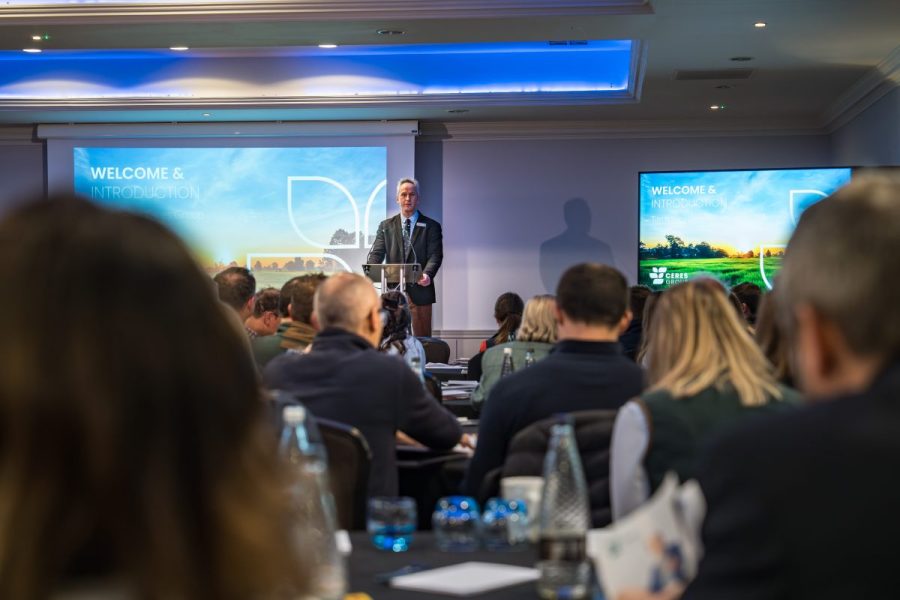
Balancing the economics in arable farming can prove challenging, but Ceres Research’s agristrategy conference provided some pointers on what to focus on to help drive improved returns. CPM reports from the event.
“Realising there is opportunity is the first port of call.” CHARLIE IRELAND
By Mike Abram
A downward slide in commodity prices plus poor yields during the past couple of seasons are contributing to a difficult economic outlook for arable farmers, particularly following the removal of the Basic Payment Scheme (BPS) and continued uncertainty regarding the future of key environmental funding options.
But while arable farmers have been forecast to face the ‘bumpiest ride’ of any agricultural sector, there have been opportunities, if growers focused on what they could influence in the future, rather than worrying about the past – a message suggested by Charlie Ireland, during the inaugural Ceres Research agristrategy conference.
“In the middle of difficulty, lies opportunity,” he continued. “But realising there is opportunity is the first port of call.”
He was especially optimistic about the role of technology, suggesting agri-tech was going to be the biggest revolution in agriculture (see box). “We have to embrace the technology that’s coming in a way that we haven’t previously.”
In particular, he said insight and information would be critical, as the risks of getting it wrong are costly. However, farmers using open platforms powered by artificial intelligence tools to help analyse the data available from their businesses could boost productivity or reduce costs, along with the use of robotics and other new technologies, added Charlie.
Ceres Research – which operates alongside consultancy and farm advisory arm Ceres Rural, and Ceres Property that covers land consultancy, planning and development – provides industry intelligence and analysis, research and development, and technical training events, pointed out Tim Isaac.
“We launched Ceres Research in 2024 to bridge the gap between innovation and on-farm adoption. We feel there’s a lot of data that doesn’t pass the ‘so what’ test, and a lot of agri-tech that doesn’t get onto farm commercially.
“Addressing that issue is the key to driving the industry forward. Our aim is to provide easily accessible data and insights from our team of analysts.”
Presenting data from Harvest 2025, Ceres Research’s Dr Alex Setchfield revealed that perhaps counter to expectation, medium light land held yield better than other soil types in a difficult season, according to analysis of wheat yields from 181 farms benchmarked by the firm. In fact, yields on that soil type were only 5.6% lower than the five-year mean, compared with 10% lower across all soil types.
“In seasons of low rainfall, you’d expect heavier soils that retain moisture would do better,” he said. “But a wet September led to delayed drilling into poor seedbeds, while compaction restricted rooting. On heavy soils, that was compounded by surface capping as the ground dried rapidly into the spring, limiting the penetration of water deeper into soils.
“That meant a shallow root system, limited access to deeper moisture, and more rapid onset of drought stress, which might be why we saw greater yield reductions in heavier soils. Conversely, because medium-light soils have a more open structure, they drained and avoided waterlogging and compaction issues a little better, which led to stronger establishment,” explained Alex.
With reduced soil capping, water could infiltrate more and roots dug deeper to access nitrogen and moisture, potentially explaining the greater yield tolerance, he said.
Another finding from the analysis was a positive correlation between the number of break crops in the rotation with both first and second winter wheat yields. Digging into the data further suggests first wheat yields are highest following oilseed rape, said Ceres Rural’s Jock Willmott. “That surprises me, so there’s a win in having an quantity of OSR in the rotation.”
Consequently, that’s one potential solution he believes can mitigate some of the current financial pressures, along with building complementary rotations and improving soil health.
He also challenged mindsets that concentrate solely on reducing costs rather than also improving productivity, arguing that fixating on stagnant UK average wheat yields can foster a negative attitude and create a narrative of set-yield outcomes that focus on reducing spend.
In reality, there’s significant potential for yield improvements, with data indicating almost a doubling in average yield between the highest and lowest performing farms every year in every crop, he commented.
Comparing the financial impact of aiming for small yield uplifts (0.25t/ha) versus cost savings of £30/ha (see table), he highlighted that there’s more to gain from yield improvements. “Saving £30/ha on a wheat crop, which should be achievable, improves margins by 13%, whereas improving yield by 0.25t/ha increases it by nearly 20%.
“If we drive output and save, it’s nearly 30% improvement. It still doesn’t make wheat super profitable, but there’s a lot of this we can achieve in-house through better conversations and closer relationships with the people we work with, without waiting for new technology to help us,” he argued.
| First wheat (feed) | Second wheat (milling) | Winter feed barley | OSR | Winter beans | |
| Yield (£/ha) | 8.4 | 8.1 | 7.4 | 3.2 | 3.2 |
| Variable costs (£/ha) | 650 | 720 | 550 | 540 | 300 |
| Fixed costs (£/ha) | 550 | 550 | 550 | 550 | 550 |
| Cost/t (£/t) | 143 | 157 | 149 | 341 | 266 |
| Price/t (Nov 2026) | 170 | 190 | 150 | 430 | 230 |
| ‘Margin’ per 50ha of crop | 11,400 | 13,450 | 500 | 14,300 | -5,700 |
| Budget | 11,400 | 13,450 | 500 | 14,300 | -5,700 |
| Save £30/ha in variable costs (% increase) | 12,900 (13%) | 14,950 (11%) | 2,000 (x3) | 15,800 (10%) | -4,200 (26%) |
| Increase yield by 0.25t/ha (% increase) | 13,525 (19%) | 15,825 (18%) | 2,375 (x3) | 19,675 (38%) | 17,325 (50%) |
| Both (% increase) | 15,025 (32%) | 17,325 (29%) | 3,875 (x6) | 21,175 (48%) | -1,325 (77%) |
| Source: Ceres Rural | |||||
For higher price crops such OSR, percentage gains can be even greater, which could be used to help prioritise where to deploy resources, added Jock.
He then said he forecasts a reduction in wheat intensification, rather than a return to wheat-wheat-OSR style approaches, with a maximum of two wheat crops in a five-year rotation, or even just one when there are difficult grassweeds to contend with.
Ultimately, the crucial factor to consider when building profitable rotations is that crops should be complementary, rather than building around one very profitable crop to the detriment of all others in the rotation, stressed Jock.
Equally, he suggested that despite challenges in management, introducing livestock into arable rotations is beneficial. “This year, land that had muck or a history of it, generally didn’t fall off a cliff; organic matter helps to buffer drought, holds onto more water and makes land work easier,” he noted.
Building soil organic matter levels through the use of livestock or cropping at a sustainable cost is one of two metrics Jock suggested as a proxy for whether a rotation is successful during a 5-10 year period.
The other is being able to drill cereals 10-14 days earlier, as data suggests those crops yield better and are more resilient to the impact of climate change, he said.
Later in the conference, Ceres Rural’s George Badger highlighted that AHDB analysis suggests a £165/t wheat price is only worth around £119/t when inflation is factored in. “That explains why things feel so tight right now,” he commented.
The analysis also shows than wheat variable costs approaching £600/ha in the UK are much higher than in other countries – more than double those in Australia, Argentina and Ukraine, and £100-180/ha more than in European countries like Germany, Denmark and France.
Using data from Ceres Research’s benchmarked farms and ADAS’s Yield Enhancement Network, George said there’s no strong correlation between higher spending on inputs and achieving higher yields, suggesting that increased spending isn’t a guaranteed pathway to profitability.
He argued that more important is skilled crop management, particularly tailoring applications to seasonal conditions and crop potential. He pointed out that the source of advice can create significant differences in costs for a similar yield outcomes, suggesting that growers should evaluate whether using pre-mixed co-formulations is always necessary when in some circumstances it’s possible to mix alternative off-patent products. “You lose the convenience of one can and perhaps a better formulation, but there are considerable savings – as high as 60% – if you buy products individually, because of generic competition,” he said.
Perhaps controversially, he also questioned whether in some cases multiple actives were even required. “An analogy would be that you have a headache, do you need to take both paracetamol and ibuprofen, or would one do the job?”
More farmers and sprayer operators are undertaking BASIS training which could help to make challenging input use easier, he noted.
George also highlighted that higher yielding crops can have lower greenhouse gas emissions intensity, possible through, for example, the use of organic manures rather than bagged nitrogen.
“These calculations aren’t usually done by many farms voluntarily,” he said. “Where they are being calculated, usually because a customer is asking for it, this is opening up potential extra revenues by monetising reductions.”
Both George and environmental schemes advisor Chloe Timberlake pointed to emerging opportunities for additional income through accessing supply chain premiums or payments for carbon reductions, biodiversity improvements, and implementing new practices.
“These aren’t widely available, and are geographically constrained,” admitted Chloe. “But keep an eye on them because I see this element of funding increasing in the coming months and years.”
This article was taken from the latest issue of CPM. Read the article in full here.
For more articles like this, subscribe here.
Sign up for Crop Production Magazine’s FREE e-newsletter here.