
A new study has found that beaver-created wetlands are home to more pollinators than human-created equivalents, and as work continues to boost beaver populations, landowners are being urged to embrace the semiaquatic rodent. CPM finds out more.
“Beaver wetlands are very dynamic with different vegetative diversity to human created ponds.” PATRICK COOK
By Janine Adamson
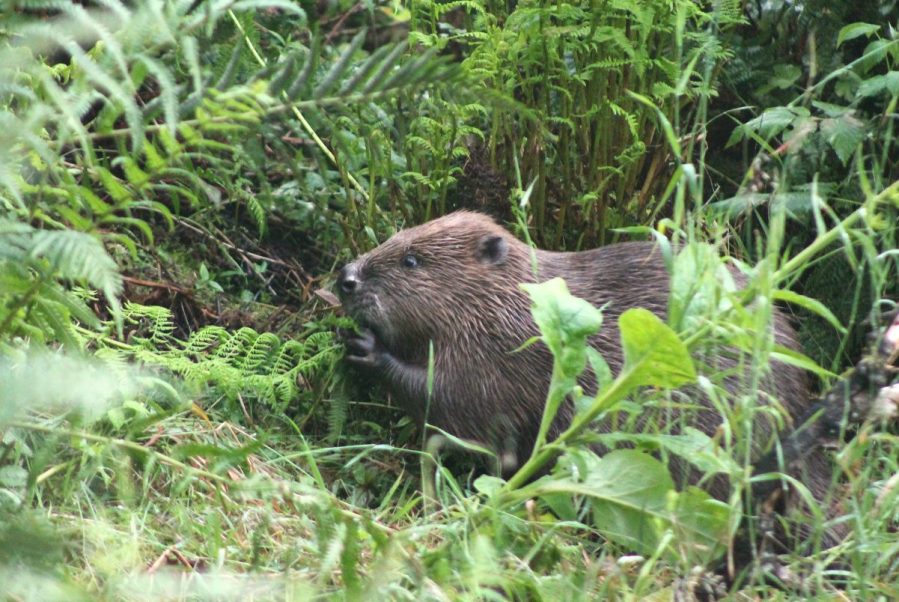
Hunted to extinction centuries ago, the Eurasian beaver is slowly being reintroduced across Scotland, England and Wales in a bid to reap the unique ecosystem benefits that this curious water-dwelling species can generate.
By coppicing trees, damming small watercourses, and digging ‘canal’ systems, beavers can sculpt landscapes that benefit both wildlife and people. And now, academic research has quantified this further – providing data that shows beaver-created wetlands not only provide a home for other wildlife, but they’re more successful at it than humans, too.
The work, conducted by researchers at the University of Stirling, compared pollinators found around wetlands made by beavers with those located around human-created ponds. This was carried out by counting species, as well as individuals of bees, butterflies, hoverflies and day-flying moths.
The researchers also recorded interactions between these groups and flowers, with the pollinator surveys repeated six times from May-August at Bamff Wildland, a rewilding estate in Perthshire, and two neighbouring private farms.
Study lead, Patrick Cook, is a researcher at the University of Stirling and a senior ecologist at Butterfly Conservation. He says simply put, beaver wetlands support more pollinators.
“The beaver-created areas showed a 29% increase in hoverfly species, 119% more hoverfly individuals, and 45% more butterflies than those that were artificially created,” he explains.
“In reality, the two are completely different environments. If you compare directly, beaver wetlands are very dynamic with different vegetative diversity, often retaining more water. However, unlike man-made ponds, they’ve not been supported through agri-environment schemes.”
And it’s this point that instigated the research in the first place, points out Patrick. “As beavers are legally reintroduced, they’ll naturally inhabit new areas including farmland. But, there’s no financial incentive to have beaver wetlands on farms, leaving them at risk.
“Following this research, we’re arguing that if we want beaver wetlands on farmland, and to benefit from the ecosystem services that they provide, then farmers should be supported and financially rewarded accordingly,” states Patrick.
Taking a pragmatic stance, he acknowledges there could be negative connotations associated with beavers and subsequent conservation efforts. “We expect there to be a level of conflict as they’re re-introduced, this is why we want to support farmers through improved knowledge transfer so they can fully embrace beavers as a species.”
Emily Bowen of Beaver Trust agrees that raising awareness ahead of their return is critical in achieving landowner buy-in. “Beavers are fantastic ecological engineers with the ability to dramatically transform landscapes. However, the impact they have is often site-specific – they don’t always create a dam if water is already available to make them feel safe from predation,” she says.
“The main fear is that beavers flood farmland. While they can cause changes and raise water levels, these are risks that can usually be managed, and tend to be in already vulnerable areas. Equally, a study of beaver impact on woodland in Scotland found that the majority of beaver foraging occurs within 10-20m of freshwater.”
Emily adds that the Beaver Trust proactively works with landowners to help mitigate risks, and in worst case scenarios, can track and relocate beavers to alternative sites. “This is the last resort though, because in reality, another beaver could move straight into that habitat.
“Instead, the aim should be to create a balance between growers and beavers, enabling both to live together and co-exist comfortably.”
Patrick points out that while they’re exclusively herbaceous animals with a varied diet, beavers don’t consume all trees and plants. “In the winter they’ll graze on the likes of aspen, birch and willow, which can all re-grow. Then in the summer, depending on location, they forage for herbaceous grasses and flower species.
“Specific trees with ornamental or sentimental value can be protected from beaver damage using strong chicken wire, or by applying a specific painted grit.”
While there have been instances of beavers eating crops, this tends to be in localised areas near to the water’s edge, he adds. “It isn’t that common and can be mitigated by creating a buffer around the beaver wetland.”
Beaver Trust wants growers to focus on the wider benefits that beavers can deliver that scope beyond boosting pollinator numbers and greater foliage diversity. “Research indicates that beaver dams can improve water quality by reducing pesticide run-off and slowing pollutants from moving downstream,” says Emily.
Patrick adds: “As per last year’s drought conditions, having water-retaining wetlands, such as those made by beavers, is becoming increasingly important. But to gain the benefits, landowners have to allow these habitats to flourish.
“Beavers are cool, intriguing and impressive animals; you have to respect what they can create given their small size. And, they do it all for free.”
When Tom Bowser was initially approached to actively ‘rehome’ beavers at his farm Argaty in central Scotland, he says he couldn’t say no. The first private landowner in Scotland to legally release beavers back into the wild, Tom has now rehomed 20 beavers to-date.
“Being an upland farm we knew it was very low risk, but in honesty, they’ve caused next to no issues yet have brought a wealth of benefits,” he says.
Prior to the arrival of the beavers, Tom raises that flooding was a problem. “But now, water has to work a lot harder to escape the land. In fact, we’ve had just one flood since the introduction of the beavers, which was into the farmyard.
“They’re really saving us, and helping us financially too. We now offer beaver watching tours and wetland walks; they’ve become a valuable part of our eco-tourism business,” he explains.
In terms of next steps, Patrick and his colleagues at the University of Stirling hope to continue their research, using their findings to lobby Scottish government and drive change. In terms of wider conservation efforts, the Beaver Trust is a founding member of the Riverscapes Partnership, alongside the Rivers Trust, National Trust and Woodland Trust.
Together, the coalition launched the ‘making space for water’ campaign – a call on Westminster to support a connected network of nature-rich, multi-functional river corridors across England.
This article was taken from the latest issue of CPM. Read the article in full here.
For more articles like this, subscribe here.
Sign up for Crop Production Magazine’s FREE e-newsletter here.