
Adding a mounted tine model to form a fleet of four drills has extended the crop establishment choices open to one Suffolk farm, helping to match workload and conditions. CPM finds out how this stacks up and why, in only its first season, it sowed almost every hectare.
“I think it could be a very good drill on lighter land, and a good one at slightly slower speed on heavier land like ours.” NIGEL CRESSWELL
By Martin Rickatson
There’s a school of thought that suggests in an ideal world, a farm would have a drill to match every situation which can occur within and without the business’s control: varied soil types and stone contents, dry or damp conditions, chopped or baled straw, and of course different crop types.
However, from direct through min-till to full-till, whether single/double disc, tine or Suffolk coultered, the perfect drill to match every variable on any one farm arguably doesn’t exist.
Investing in multiple drills is, of course, a fantasy scenario for many farms, particularly in the current climate of low returns and rising machinery prices. Yet investment in a full new fleet or splashing out on an all-singing, all-dancing drill aren’t necessarily the only approaches.
For Suffolk-based AW Fane Farms near Woodbridge, supplementing an existing well-worked fleet of three with a relatively simple tine-based fourth drill has helped stay ahead of the autumn workload for a team of two operators covering 300ha (750ac) – while retaining options for different situations.
When reassessing his drill fleet ahead of autumn 2025, farm manager John Daniel says he was looking to benefit from the Farm and Equipment Technology Fund (FETF) to help boost crop establishment timeliness and minimise establishment costs. Having ceased sugar beet production three years ago, the business’ crops comprise wheat, barley, oilseed rape and combining peas or beans.
Despite a long-established min-till regime, the medium clay ground can be challenging to establish on, particularly in extremes of wet or dry, he explains.
For a number of years this has relied on a 4m Väderstad Rapid cultivator drill, supported by a 4m Kuhn power harrow combination for conditions where speed must be sacrificed for more thorough soil-working. Both work on ground that’s been min-tilled, generally by a Sumo Trio leg/disc/press where deep loosening is required, with a pair of 6m Maschio power harrows following up ahead of the Rapid if required. The farm also retains an elderly 4m Massey Ferguson 30 as a bean drill for distributing seed on the soil surface before ploughing-in.
“The Rapid has a high workrate in good conditions, but if it gets wet it has its limitations,” explains tractor operator Nigel Cresswell, who works alongside second driver Rhys Pedrick. “In a wet autumn we’ve tended to switch to the power harrow combination, but although it’s a sure method of crop establishment, it’s also a slow one and can really stretch out our drilling period.
“So, when the last round of the FETF opened, John decided to apply and use it to invest in a mounted tine drill to add to our drilling options, on the basis we’d get on faster in a wider range of conditions, and even directly into stubble should we decide to try some no-till.
“Several neighbours seemed to do well with similar machines, with decent workrates and crops that established well,” he says.
While the market isn’t short of such machines, good experiences with a KRM Bogballe twin-disc fertiliser spreader led to considering a drill from the same importer – although it’s produced by a different manufacturer than the Danish spreader. It was a good dealer show price that then sealed the deal on a KRM Soladrill SM-P.
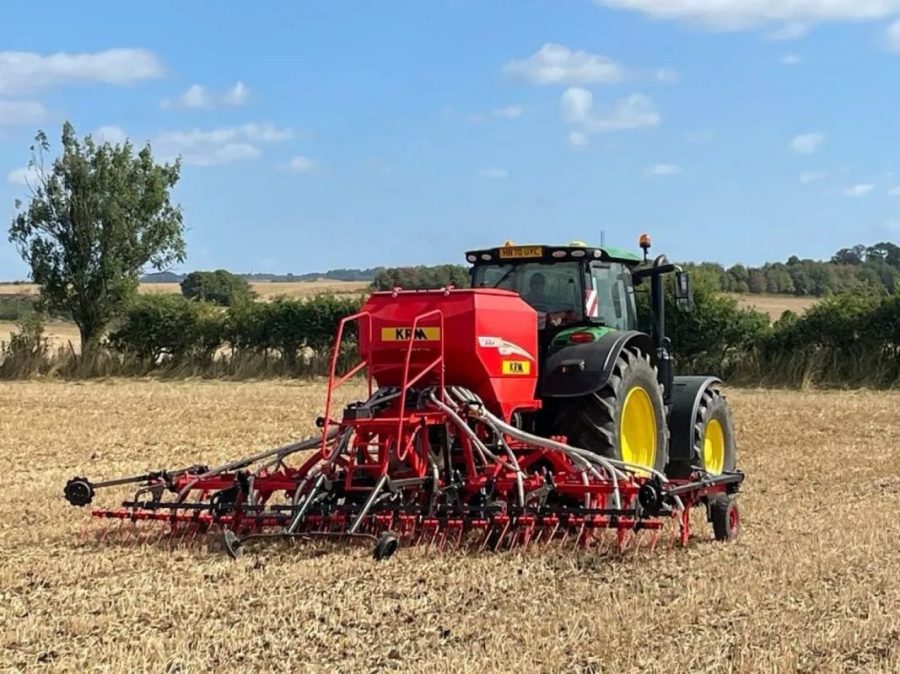
Looking in more detail, the drill is made by Spanish seeder specialist Sola, which KRM has been the UK importer for more than two decades. The two companies describe the machine as a ‘new concept’ direct tine drill capable of sowing into ploughed seedbeds or min-tilled land, or planting directly into stubbles. They also state the SM-P is capable of drilling through fully-established cover crops up to 15cm high.
Being tine- rather than disc-coultered, KRM and Sola suggest this negates the need for an overly-heavy build to aid penetration in hard ground, while eliminating the risks in wetter conditions of smearing or leaving open slots with seed exposed.
Available in 4-7m working widths, the drill is built to a close-coupled design to aid weight distribution and traction. A new front left-mounted calibration system enables the desired sowing rate to be set from a single setting, and after seed collection, the recorded weight is entered into the drill’s or tractor’s ISOBUS terminal.
Seed is metered from a 2000-litre pressurised hopper via a stainless steel unit that can be disassembled without tools for cleaning. From here it’s sent to the coulters via external distribution heads – which tramline valves are mounted directly – shutting off two rows apiece as standard, with three optional.
Tines are spaced over four rows with a 40cm stagger, which KRM suggests aids trash flow and the ability to drill directly where desired. The narrow tine tips are angled forward to pull the coulters into the ground and aid soil closure around the seed slots. Then, sowing depth is set centrally using two ratchet adjusters and a parallel linkage, with two front and two rear depth wheels.
“One challenging season can have long-term consequences, and that was a key reason behind adding this drill to our fleet,” highlights Nigel. “The very wet autumn here two years ago set back our drilling plans, and as a result we extended our SFI area of legume mix. But a further driver behind our changes has been an extended cropping area, with 80ha of land added two years ago.
“That came to us in spring rather than the previous autumn as we’d hoped, as wet weather delayed lifting the sugar beet on it. That wet autumn and the land purchase left us playing catch-up, so we decided to reassess our drill fleet to speed-up workrates.”
While it was originally intended to have two drills on the go where possible to cater for different farm areas and soil types, Nigel had to take some time off work last autumn, leaving fellow operator Rhys to take on most of the drilling, exclusively using the KRM Sola SM-P.
“The only crop it didn’t drill was the OSR, which we establish with an air seeder on our Trio,” explains Rhys. “At first it was used on ground worked with the Trio, but during the season we also added a Sumo Vaxio disc/tine/levelling board/press combination to our cultivation equipment, and in future this is likely to be the ideal tool ahead of the drill unless deeper loosening is required.
“The tines are well-spaced and trash flows well through the drill, although we gave it some challenges, including drilling a rotational legume fallow after two years. With no cultivation elements, though – unlike our other two main drills – we’ve found pre-cultivations have to be good on these soils.”
Rhys points out that if pre-cultivations haven’t been great, this can be an issue. “Some of our heaviest land is really ugly and requires further work ahead of the drill. Occasionally I found I had to slow my forward speed to keep consistency, and we also faced some challenges with the wetter conditions of the previous year leaving behind deep tramlines.”
A move to a 6m working width also helped the drill significantly raise the farm’s daily drilling workrates, helping address the fact that Rhys was on his own sowing most of the year’s winter crops.
“KRM and our dealer Ernest Doe helped set up the machine and on the whole we got on ok, but some of the conditions were challenging and there are a few things we’d like to look at ahead of next season. We have a good relationship with KRM and the dealer, so we hope to learn more about how to get the best from it this year, when hopefully we’ll be less pressured and both of us can work together.”
Rhys adds firstly, identifying the correct cultivations for each field is critical – something that drove the farm’s decision to invest in a Sumo Vaxio combination cultivator. “We also have to find a way to reduce compaction from the depth wheels, which was an issue despite the eradicators. And, there were some problems with exposed seed, which we’re hoping the right cultivations might also help to address.”
The 6m drill worked behind a John Deere 6R 155, and while it occasionally struggled, this largely handled the drill ok, although both Nigel and Rhys reckon more power would help achieve the ideal forward speed.
“I think the right speed is essential for the best results with a drill like this,” points out Rhys. “Our aim wasn’t to make another pass – for cost and labour reasons – but some seed remained visible which gave concern. That said, most of our crops look pretty good and the time taken and fuel used for the work was less than it would have been with the other drills.”
He adds that the drill’s build quality is generally good. “We did break a marker arm – although we use GPS, markers are still handy. Calibration is quick and easy once you’re used to it, with a difference of just 1% between required and drilled rate. We work to variable seed rates according to mapping supplied by our agronomist.”
On the flipside, Rhys raises that changing depth via the front and rear wheels that carry the drill in work can mean ‘a lot of hopping in and out of the cab’ to check changes made. “We also found harder ground could be a challenge. We perhaps have more to learn – neighbours have done okay with similar drills.”
Nigel believes that having seen the benefits of light cultivation ahead of drilling since the Vaxio arrived, next autumn it’ll be the pre-pass of choice ahead of the Sola.
“I don’t think we originally appreciated the benefits this has in removing wheelings and evening-out the field surface,” he says. “I’m sure the drill is capable of the breadth of work it’s claimed it can do, from working no-till through to full-till, but in our situation, light cultivations definitely help.
“Some of the legume fallows we’re taking out next year will have been down three years, which I think will present a challenge, as I’m sure some of the roots will be as thick as a thumb. We’ll have to think carefully about how we prepare land ahead of the drill.
“Previously we’ve ploughed in such crops, and we may have to do so again, despite having largely moved away from ploughing. Similar challenges occur where we spray off greened-up land to control blackgrass before drilling.”
Having been drilling for 50 years – from around the time the farm’s Massey Ferguson 30 drill was launched – Nigel says he’s seen a lot of changes. “There’s nothing too radical about the KRM Sola SM-P, aside from the technology that controls it, such as ISOBUS. But it’s undoubtedly a fast way to establish crops in the right conditions, as Rhys showed by drilling all our land with it last autumn.
“The cost of cultivations in a dry year can write off any profit though, and with input prices remaining high, we have to watch what we spend on crop establishment, something I’m sure drove John’s decision to buy it.
“I think it could be a very good drill on lighter land, and a good one at slightly slower speed on heavier land like ours. With some improvements to seed slot closing/covering, I think it has potential,” he concludes.
This article was taken from the latest issue of CPM. Read the article in full here.
For more articles like this, subscribe here.
Sign up for Crop Production Magazine’s FREE e-newsletter here.