
by Andrew Wilson
Frustration in farming can take many forms – weather and politics are a given on that score. As I write this, we’ve just heard the next tranche of SFI is to have lower rewards. All we can hope is there’s some common sense thinking to align stewardship with legislation, and support for aspects like grass margins by watercourses is set at realistic levels.
The tap is slowly being turned off it would appear, particularly on wall-to-wall measures, which is a good thing in my opinion. I’m a farmer, not a park keeper.
The frustration that has more of real effect on us is markets. Pretty much every commodity that we produce has prices in the doldrums, both currently and in the medium and longer term – a significant demotivator when it comes to going the extra mile.
Movement is late and slow, cashflow not exactly flush, and crop state in store deteriorating. The unseen consequence of this looks like a very busy March for us.
We have an odd field or two slowly drying up, but many that won’t take a wheel for a while yet which is impacting things like cover crop desiccation, muck spreading and base fertiliser applications. We set our contracts up to facilitate workload, cashflow and achieving the objective, but managing the inevitable snowball of work all these delays create isn’t much fun.
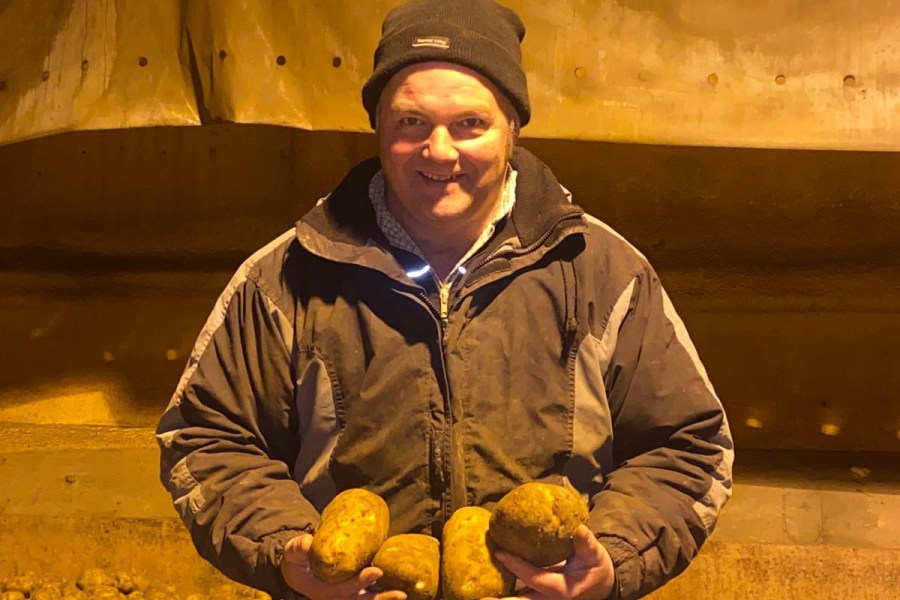
We’d normally crate up about 40% of our potato sets in February for chitting, but the high physiological age of seed tells me to hold off this time to avoid sprouts getting away, which all adds to the work peak. That fridge idea I mentioned last time may get implemented yet!
There’s always a positive if you look hard enough, and always a better way to do everything. Cereals might be uninspiring to say the least but we keep tweaking how we do what we do and even after a very wet winter crops look well, even if prices don’t.
Undoubtedly this is in part to surprisingly high SNS readings, which are probably due to the under-utilised fertiliser applied last year, despite me cutting rates back. This leads me to consider our nutrition programme and the value extracted for the cost of fertiliser. Are we correctly utilising muck to best effect? Can we tweak timings, methods or products to better effect?
A wise man told me 30 years ago to get out of the farm gate and learn something, and his words haven’t left me. I’m quite a social animal and enjoy interacting with others with similar missions, having been part of various farming groups over the years. This started with YFC but in more recent times, has encompassed AHDB Monitor and Strategic Farms, ag discussion groups and more environmentally-based things like Sustainable Landscapes.
While on the subject of being social, the 29 January marked the end of ‘Thursday night club’ as we’ve known it for 30-odd years, when Tony the proprietor of a local hostelry retired. A diverse group of us from all walks of life meet for a pint and natter and to escape from the realities of life for an hour or two. The value of talking nonsense and taking the mickey isn’t to be underestimated in these times, and there’s no better place to keep such skills polished than in the pub. I recommend such therapy to anyone.
In recent years we’ve begun to import more nutrition in the form of broiler muck mostly, but also cattle FYM and new to us this time, compost. Some of this is motivated by a will to continue to maintain or increase production, but mostly to increase soil resilience via organic matter and its role in crop health. It’s a work in progress, and as ever there’s more than one way to skin the proverbial cat, but it’s quite exciting trying new things.
Of late, many carbon-based schemes seem to have come to my attention. Most require large amounts of our data but only reward sequestration or change to our practices in some way. Invariably it’s easier to show perceived improvements from a low baseline than an already high one – it seems there’s no reward for being ahead of the curve. Most of these platforms are 10 years late to the party to actually benefit farmers to a decent level, in my opinion.
The merry go round of machinery never seems to stop turning. There are a lot of policy changing auctions on at the moment, and no doubt we all face similar but different conundrums. My tractor fleet has seen expansion rather than replacements in recent years, but we’re at a point where average age and hours are elevated to where we need to tweak things, before the ability to keep up diminishes too much.
New prices are in the telephone number category, but we’re looking at changing two 20-year-old machines for one three-year-old currently, alongside a few role changes to keep things fluid and workable for us all. I find that it’s best to not calculate the cost in terms of how many tonnes of wheat it equates to.
Back to being social – I’ve been a part of the ploughing match scene in these parts for more than 30 years now. In an increasingly non-inversion world I think it’s important to maintain and pass on traditional skills, and so to that end I’m having a class change. I’ve bought a 1940s trailer plough and look forward to learning how best to work it from some of the most experienced hands at our match on 22 March.
This article was taken from the latest issue of CPM. Read the article in full here.
For more articles like this, subscribe here.
Sign up for Crop Production Magazine’s FREE e-newsletter here.