
After two demanding seasons that tested both confidence and cashflow, improved autumn conditions have offered a welcome reset for many growers. But with volatile markets, unpredictable weather and evolving disease pressure still very much in play, uncertainties remain. CPM explores for this month’s Common Ground.
“If we’re going to grow a crop, let’s do it well.” – DAVID FELCE
By Charlotte Cunningham
For many growers, this season has arrived with a sense of cautious relief. After several campaigns marked by delayed drilling, disrupted harvests and fragile establishment, simply having crops in the ground on time and developing well has felt like a step in the right direction.
Drilling windows have been more forgiving, early development has been stronger, and in many cases crops are carrying more momentum coming out of winter than they have done for some time. That said, underlying pressures remain firmly in place: margins remain tight, input choices demand close attention, and every major decision continues to feel finely balanced.
Against this backdrop, questions around risk, resilience and return on investment are once again front of mind. With fewer buffers in the system and less room for error, growers are having to think more carefully than ever about where to commit spend, where to hold back, and how best to protect the yield potential they’ve worked hard to establish.
To explore these issues, Cambridgeshire grower, Russ McKenzie; neighbouring farmer, David Felce; and BASF cereal fungicide technical specialist, Jared Bonner, came together at BASF’s Common Ground conference. Between them, they represented three perspectives on the same challenge – how to protect yield and profitability in a climate where certainty is increasingly hard to come by.
Building from a stronger start
Russ, who farms near Huntingdon, began by reflecting on how much difference the past few months have made to confidence and planning. He said after several disrupted autumns, this season has provided something many growers have been missing – a solid platform. “Everyone would say it’s been a lot easier this autumn than we’ve had for a couple of years; crops are well established.”
That stronger start has allowed him to focus more deliberately on quality and market positioning, particularly in milling wheat. Having increased the area of premium crops in recent seasons, Russ said he’s worked hard to secure contracts early and reduce exposure to volatile markets.
“We’ve grown more milling wheat the past couple of years and locked into some good premium markets,” he explained. “Looking where milling markets are now, I’d be worried if I hadn’t done that.”
At the same time, he stressed that committing to premiums doesn’t mean abandoning flexibility. Maintaining a mix of outlets, including seed and specialist crops, has helped to spread risk and keep options open.
While David’s farming system looks rather different, the underlying principles are similar. Operating a small business that’s expanded through collaboration with neighbouring farms, he said he’s focused on building resilience through shared resources and careful land use.
Alongside arable production, David has also concentrated on making better use of areas that don’t justify high input spend. By balancing intensive cropping with habitat and environmental schemes, he aims to maximise overall return rather than pushing every hectare to its limit.
“If we’re going to grow a crop, let’s do it well,” he said. “Otherwise, it’s about finding a better use for that land.”
Jared agreed, acknowledging that many farming operations are rightly focused on maximising the early crop potential they’ve established. “Crops have gone in well, and growers are looking to make the most of that,” he noted.
Learning from hindsight
When discussion turned to risk management, Russ highlighted one of farming’s most familiar frustrations – the clarity that only arrives once the season is over. “You review trial results in hindsight and think, ‘If only we’d known this at the time,’” he said. “We don’t have that power during the season.”
To close that gap, he’s invested heavily in on-farm trials, now in their fifth year. These compare untreated areas with different nutrition and fungicide strategies, helping to build a long-term picture of how crops and individual varieties respond under varying conditions.
“We have untreated plots, nutrition-only plots, half-field rate fungicide, full-field rate fungicide, and overlaid across each variety and cultivation method,” he explained. “It’s about building a library of knowledge.”
He said the aim isn’t to chase perfect answers, but to understand how different seasons demand varying responses. “We’re seeing something different every year as well as some consistent patterns.”
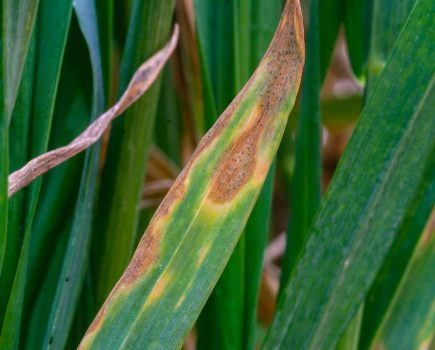
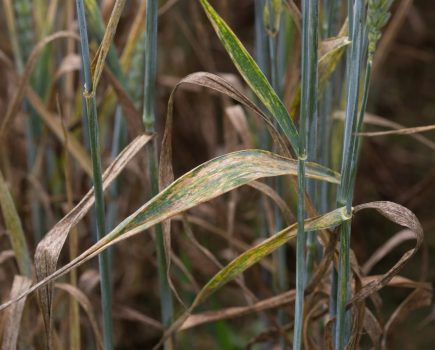
Disease pressure, particularly from rust, has been central to those learnings, he highlighted. “Yellow rust can spring out of nowhere; once it’s in and if you don’t control it early, you’re on the back foot.”
He added that yield responses in some seasons have been dramatic, underlining the value of timely intervention. “In some years we’ve seen 7t/ha purely from rust control on susceptible varieties.”
Jared seconded the importance of timeliness and a programmed approach when it comes to yellow rust control. “In the right conditions, yellow rust can cycle in 10 days or less, compared to septoria, which is cycling every 21-28 days.
”Thankfully we have tools available to keep yellow rust at bay but that as Russ says, it requires a different approach to septoria.”.
Jared advises monitoring yellow rust susceptible varieties closely. Where active yellow rust is seen ahead of T0 or T1, he suggests growers consider including a yellow rust eradicant in the tank T0.5 or T1.5 top ups can also be an option if conditions are particularly favourable for rusts.
Fundamentals and knowledge sharing
David agreed that managing risk starts with strong foundations and disciplined spending. “For me, it’s about the building blocks,” he said. “Proven actives, proven strategies – actions that deliver year in, year out.”
He cautioned against spreading budgets too thinly across unproven inputs, particularly when margins are under pressure. “You can spend a lot on ‘other stuff’ and end up cutting back on what’s really doing the heavy lifting.”
Water availability is another limiting factor on his farm, which is situated in a rain shadow. “We can literally watch the rain split, so we often run out of moisture,” he explained.
Last season also highlighted the limits of crop protection under extreme stress. “We had two weeks of 30°C,” he said. “At that point, it doesn’t matter what fungicide you’ve used.”
As a result, he’s placed greater emphasis on realistic yield targets and long-term benchmarking. “You have to be honest about what your land can do.”
All three panellists emphasised the value of collaboration and open exchange David noted that some of the scientific work that he’s been shown over his career lacks practical relevance. “I saw a lot of very clever work that had no real on-farm use. We have to stay grounded in what actually works.”
He added that context remains critical. “There isn’t one size fits all. Soil, climate and rotation all matter.”
Russ agreed, saying many of his best ideas have come from informal conversations rather than formal presentations. “Someone might say something over a coffee and you think, ‘Could that work here?’”
Resistance and responsibility
Fungicide resistance formed another key part of the conversation, particularly in light of recent shifts in sensitivity that have sharpened industry focus on long-term stewardship.
Having followed many actives from development through to commercial use, Jared believes growers are increasingly aware that protecting chemistry is no longer optional. “We’ve spent years bringing these products to market. If we don’t look after them properly, we lose them – and once they’re gone, they’re gone.”
For Jared, that starts with programme design rather than individual product choice. “It’s about building balanced programmes that use different modes of action, that protect key timings, and that don’t rely too heavily on any one group,” he explained. “That’s what gives you both performance now and longevity for the future.”
He pointed to the development of newer BASF actives as an example of how innovation is responding to these pressures. “With molecules like Revysol (mefentrifluconazole), we’ve been able to introduce something genuinely unique to the market -greater flexibility, strong performance on septoria (even resistant strains), and broad‑spectrum disease control, all while helping to to protect other higher resistance risk fungicides.”
“When you look at products like Revystar (mefentrifluconazole + fluxapyroxad), which combines Revysol with Xemium, you’re getting both curative and protective activity working together,” he added. “That gives growers a really strong platform at key timings, along with a key tool for resistance management.”
Russ agreed, “for me, there’s even more of an argument for using Revystar this year in the right position and right variety – harnessing it’s strengths and using its ability to protect other chemistry but also understanding what it’s weaknesses are.” He also acknowledged that thinking in terms of whole programmes has become more important than ever. “You can’t just look at each spray in isolation anymore. You have to think about what you’re doing across the season, and how that fits with the risks you’re facing.”
His own experience with shifting disease pressure has reinforced that message. “We’ve seen varieties change quite quickly in terms of their strengths and weaknesses. One year yellow rust isn’t really an issue, the next it suddenly is. If you’re not building that into your programme, you can be caught out.”
For him, having access to robust chemistry provides confidence when conditions turn challenging. “Knowing you have something reliable in the tank makes a big difference,” he said. “It gives you breathing space when the weather or disease pressure doesn’t play ball.” David added that timing remains one of the most critical – and most misunderstood – aspects of fungicide performance. “We still talk a lot about T1 and T2 as fixed points,” he said. “But in reality, growth stages move, varieties behave differently, and seasons don’t follow neat rules.”
Protecting leaf area at the right moment is what really matters, he continued. “That’s where yield is built, and that’s where strong actives like Revysol really earn their keep.”
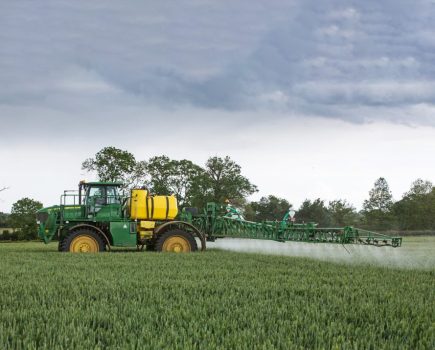
The panel agreed that timing, along with application technique were also critical for effective performance “Nozzle choice, forward speed, water volume, coverage – that’s down to us” added Russ.
Jared believes this is where integrated thinking becomes essential.
Reasons for optimism
Looking ahead, Russ pointed to crop potential: “I just hope for balanced weather.” While David reflected on resilience. “You wouldn’t be here if you weren’t resilient,” he said. “But it’s stretching it.”
Meanwhile, Jared drew on long-term perspective. “I’ve been in agriculture for 30 years, through highs and lows, but we always seem to come through.”
He also highlighted cultural change. “Farming is becoming more forward-thinking and more open to technology,” he said. “That’s encouraging.”
As the session closed, one message stood out – while uncertainty remains unavoidable, growers are becoming better equipped to navigate it through evidence, collaboration and realism.
Through detailed on-farm trials, careful programme design, honest yield assessment and open discussion with peers, the panel demonstrated that modern risk management is less about avoiding danger altogether, and more about understanding it clearly enough to make confident, informed decisions.
In an industry where margins are tight and pressure is constant, that shared learning may be one of the most valuable inputs of all.
This article was taken from the latest issue of CPM. Read the article in full here.
For more articles like this, subscribe here.
Sign up for Crop Production Magazine’s FREE e-newsletter here.