
In the wake of significant resistance concerns, growers are urged to revisit glyphosate stewardship guidelines to ensure the herbicide has a long-term, sustainable future. CPM explores the factors involved in maximising glyphosate’s performance.
“Most poor control isn’t down to one obvious mistake; it’s usually a series of small compromises.” ROGER BRADBURY
By Janine Adamson
Glyphosate – an integral active that’s been in existence for around 50 years, and despite recent concerns regarding resistant Italian ryegrass, experts stress it continues to be a highly effective, non-selective herbicide.
That’s because in theory, every glyphosate application starts with high potential performance. However, in practical use, the potential for glyphosate to perform to a theoretical maximum is steadily influenced – and often reduced – by a series of decisions and conditions between filling the sprayer and hitting the target, suggests Bayer’s Roger Bradbury.
He says although each factor in isolation may reduce performance only slightly, together, these small losses can accumulate, leaving applications underperforming despite appearing ‘correct’ on paper. “Most poor control isn’t down to one obvious mistake; it’s usually a series of small compromises. When they stack up, you don’t get the result you expected,” he comments.
While water quality is recognised as the foundation of performance, because glyphosate’s efficacy is shaped by multiple interacting factors, growers are being urged to consider the bigger picture when it comes to stewardship. These factors are categorised into three key areas:
- Environmental: weed growth stage, plant stress, canopy architecture, and prevailing weather
- Chemical: product choice, dose rate, surfactant loading, mix partners and rainfastness
- Application: timing, water volume, nozzle choice, boom height and water quality
Roger highlights that plant stress – whether that’s drought or waterlogging – will impact glyphosate’s uptake and mobilisation within the plant. “Once it’s in the target weed, it has to be mobilised to the site of action at the meristems and root tips in order to deliver efficacy. Plant stress affects this movement and therefore the accumulation of the active where it’s required.”
Grower, David Felce of Midloe Grange Farm in Cambridgeshire, is a sprayer operator and has been involved in writing spray application training for NRoSo. He agrees with Roger and adds that target growth stage and spray delivery must align. “Small, actively growing weeds are far more susceptible than stressed or stem-extending ones.
“Plants in stem extension won’t take glyphosate down to the roots where it’s required to work, so you’ll have poor results, even if everything else is right. That means timing is critical.”
According to David, cover crop destruction presents another conundrum. “Cover crops can be large and overwintered and there’s a strong likelihood that you have grassweeds underneath that canopy. The challenge here is not only taking out the cover crop species – which we know aren’t all equally susceptible to glyphosate – but also reaching those smaller grassweeds that are being shaded beneath.
“To overcome this, higher water volumes generally give a better chance of covering that depth of canopy. Conversely, if you’re coming in after a winter cultivation ahead of spring drilling, weeds may be smaller, so I’d go with a lower water volume to improve work rates and increase the loading of glyphosate versus the water in the tank.”
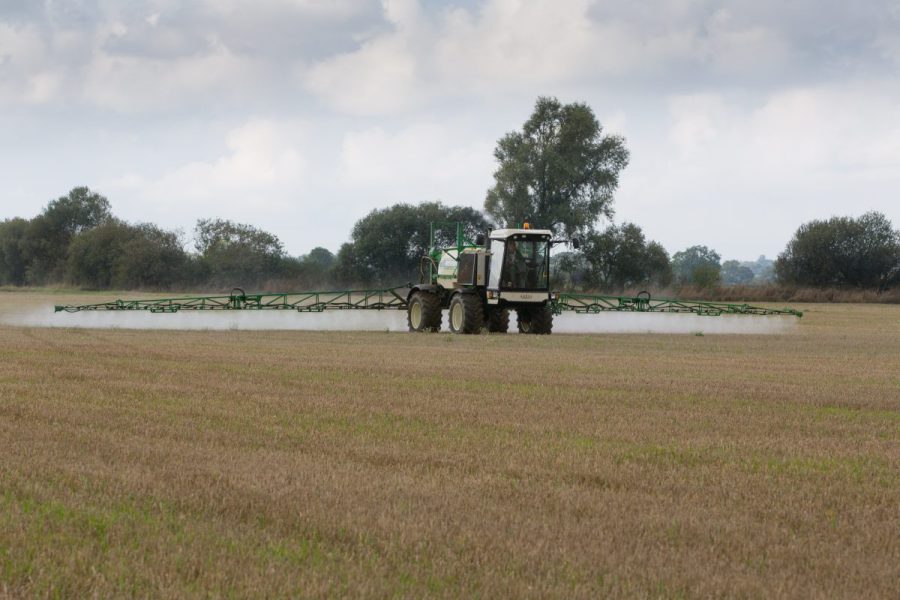
Segueing into application practice, David raises that nozzle choice also has a key role in glyphosate’s efficacy. “In a large canopy situation, a coarser droplet with more weight will help to carry the herbicide through the canopy’s depth. Then for smaller targets, it has to be a finer droplet to ensure adequate coverage.”
According to De Sangosse’s Rob Suckling, water quality, specifically water hardness is one of the most consistently overlooked risks to glyphosate performance. To explain further, he reminds that pH and water hardness are two distinct factors.
“pH is a measure of acidity, while water hardness is the concentration of calcium and magnesium ions in the water which carry a positive charge, known as cations.”
Considering the national picture, Rob says there’s a strong correlation between the hard water areas and highly productive combinable cropping regions. “These are the locations where we’re using a greater amount of agro-chemicals, including glyphosate, to control weeds in arable crops. This means the effect of water hardness is linked to areas of high herbicide use.”
But, how hard is hard? How long is a piece of string, muses Rob. “Typically, it’s the point where the performance of agro-chemical products can be affected by hardness; which tends to be around 250-300ppp. As water gets harder, the greater the impact can be, with a reduction in efficacy by 20-30% if left unaddressed.”
However, adding a water conditioner to the tank ensures the herbicide active remains in a biologically-available form. In particular, ‘true’ water conditioners such as X-Change contain sequestrants and chelating agents, explains Rob.
“Add those into the spray tank before the herbicide and they act sacrificially, forming irreversible bonds with the calcium ions. This means when you add glyphosate to the spray water, it’s free to move through the spray solution unaffected; water conditioners are essentially very large magnets which attract calcium ions.”
This is different to how ammonium sulphate works though, he adds. “This behaves more like a water softener to compete with the calcium ions; sometimes it wins, sometimes it doesn’t. So rather than mitigate water hardness, you only reduce its impact.”
Rob strongly advises against using high rates of pure citric acid, which has been gaining increasing media coverage. “Over-acidifying the solution will likely lead to worse efficacy than if you didn’t treat the water at all. It’s well-known that glyphosate uptake is reduced when the pH drops below pH 3, so don’t fall into this trap. A formulated, true water conditioner is inexpensive and engineered to do the job correctly.”
To test for water hardness, a TDS (total dissolved solids) meter can be used to provide a digital reading (available from De Sangosse). This also helps to indicate the required dose of water conditioner, which Rob stresses is another significant risk.
“Using a conditioner occasionally, or at a guessed rate, should be avoided. Because water hardness varies depending on the water source and how it’s stored, testing is important to ensure conditioning is not only correct, but consistent. After all, you can’t manage what you can’t measure.”
ADAS’s John Cussans highlights the reality that despite glyphosate being available for decades, it’s never been inevitable that there’d be a case of resistance in the UK. “It’s not a matter of time or exposure, instead we’re seeing the adoption of agronomy practices that are high risk across a series of individual farms.
“What you do on your farm in terms of managing weeds is what’s driving the selection for resistance; it’s not a big picture of exposure. This means it’s never been more important that we focus on coordinating the stewardship elements to cement the effectiveness of glyphosate for the future.”
He adds that of the handful of cases reported, all share a combination of factors coming together to drive risk. “They’re primarily systems where there’s a high reliance on glyphosate for weed control in total. So where there’s low or reduced cultivations, low disturbance crop establishment, and long durations of stubble post-harvest prior to spring cropping.
“If we want to make positive changes within our farming systems to embrace nature, we require a greater uptake of the basic glyphosate stewardship principles and bring those to the fore,” stresses John.
This means minimising survivors and maximising efficacy, he urges. “Perhaps this means going back on with additional weed control methods that weren’t planned, or using alternatives to glyphosate such as adopting mechanical weeding or reintroducing cultivations, also maximising the effectiveness of in-crop herbicides.
“For every field, the success of glyphosate applications must be monitored. If, despite undertaking best practice, there’s a picture emerging of appropriate doses not having the effect they should have, you must respond and react. It’s not too late to take action to prevent this from continuing.”
The real impact is felt by the individual farmer once resistant ryegrass has been confirmed, he says. “This means a whole series of self-imposed restrictions to protect the industry, which will come at a significant financial cost to the grower involved.”
On those farms experiencing glyphosate-resistant ryegrass, the following actions are encouraged:
- Re-introduction of mechanical weeding
- Maximising in-crop herbicide effectiveness
- Preventing individual plants from growing too large between crops
- No straw movement off farm
- Ring-fencing harvest equipment to the individual farm
- Transparency with immediate neighbours is important
To conclude, Roger comments that although it’s relatively easy to turn a weed brown in the field, the narrative is much bigger than that. “It’s more difficult to deliver long-term and effective weed control, and that’s what we’re trying to achieve with glyphosate.”
This content was originally shared during a seminar at CropTec.
This article was taken from the latest issue of CPM. Read the article in full here.
For more articles like this, subscribe here.
Sign up for Crop Production Magazine’s FREE e-newsletter here.