
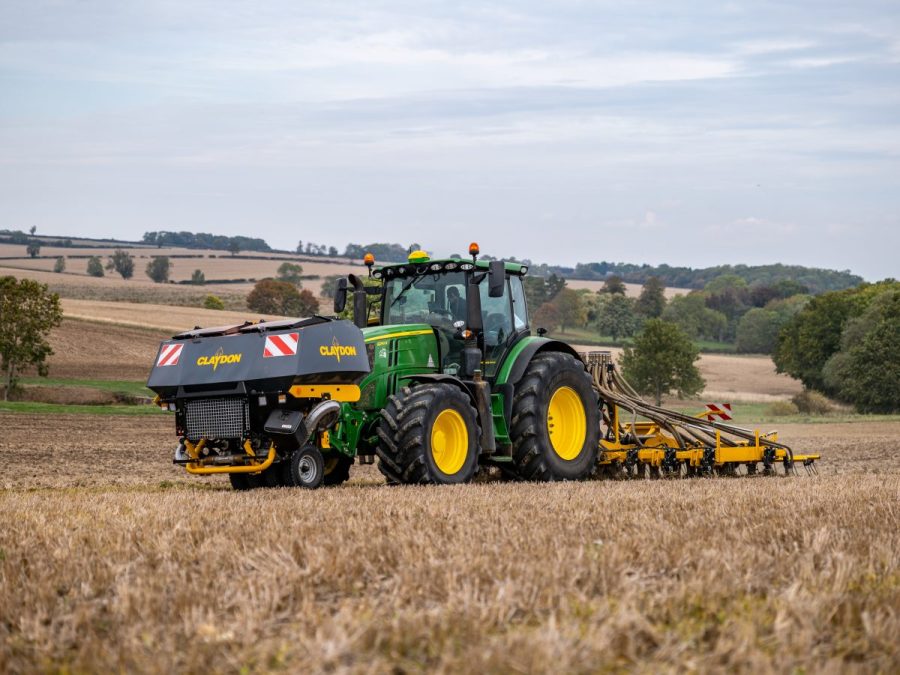
Moving from traditional plough-based crop establishment to direct drilling has brought major agronomic and economic benefits to a North Buckinghamshire business. CPM finds out more…
“At harvest the results spoke for themselves.” RICK DAVIES
By Charlotte Cunningham
During the past decade, direct drilling has become an increasingly important tool for arable businesses seeking to reduce establishment costs, protect soil structure and improve resilience to increasingly variable weather. While interest in low-disturbance systems continues to grow, many growers remain cautious about changing long-established cultivation practices, particularly where consistent yields and soil workability are priorities.
At Newton Lodge Farms in North Buckinghamshire, the move away from traditional plough-based establishment has evolved into a long-term strategy that now underpins agronomic, operational and machinery decisions. What began as a trial of an alternative drilling system has developed into a whole-farm approach focused on consistency, efficiency and soil improvement.
CRITICAL KIT
More than 10 years on from first making the change, direct drilling is now central to how the business operates. Farmer, Rick Davies, says the system has become firmly embedded in day-to-day management.
Rick farms 550ha in partnership with his father, Mike, and mother, Christine. Cropping on the farm is predominantly wheat, with 85% going for milling. Spring beans are also part of the rotation, with spring barley and spring oats included to help manage blackgrass.
Soils are predominantly sandy clay loam, running to gravel with limestone over outcrops and heavy silt on the flood plain. Rick says this variation in soil type presents both opportunities and challenges for establishment, making consistency and trafficability key considerations when planning cultivations and drilling.
The business first moved toward direct drilling in 2012, following the purchase of a 3m Claydon Hybrid drill from Claydon Drills. At the time, the primary aim was to establish oilseed rape, but interest soon grew in using the system more widely. “That year we thought we’d have a go at drilling some wheat in a field with the same soil types throughout,” he explains.
To assess the system fairly, the field was divided in two. “On one half we used our old system, Flat-Lift, plough, press, power harrow and then drill with a Massey 30. The other half we drilled straight into stubble with the Claydon, then rolled.”
The difference in establishment was quickly apparent, he reflects. “The Claydon-drilled crop emerged within a week and looked really well; at harvest the results spoke for themselves. The Claydon achieved 12.1t/ha, the conventional system did 12.04t/ha, so literally the same yield.”
With no yield penalty and clear operational advantages, confidence in the system grew rapidly, he adds. “From that point I thought ‘this is for us; this is going to work.’ The next year we Claydon-drilled the whole farm and have never looked back.”
In the early stages of the transition, direct drilling placed greater demands on available power. Rick was operating a 200hp John Deere 7530 with the 3m Hybrid. “When we began direct drilling, our 200hp John Deere 7530 sometimes struggled to pull the Hybrid uphill at 7.5-8km/h,” he recalls.
Over time, however, improvements in soil structure reduced draft requirements and improved work rates. By 2017, Rick had moved to a wider Hybrid and noticed a significant change on the same land.
“In 2017 when I was using the John Deere with a new 4.8m Hybrid, on that same field I remember going up it and thinking I’m doing 9km/h here, pulling a drill that’s 1.8m wider, with the same tractor. I thought ‘this is incredible’ – the way the soil’s changed, we’re not bringing up big lumps or aggregates, the soil is structuring itself.”
The Claydon system works by cultivating narrow strips using leading tines, into which following A-shares place the seed. Wider uncultivated areas between the rows remain undisturbed, helping to support machinery and maintain surface strength.
“The wider uncultivated areas between the rows provide excellent support for following machinery,” explains Rick. “When it comes to trafficking, in the spring the ground’s firm because the soil isn’t being moved to depth and it travels a lot earlier.”
Another feature of the establishment system at Newton Lodge Farms is the decision to not operate fixed tramlines. “I drill at an angle every year. Alternately, one year 20o one way, the next year 20o the other.”
This approach helps to level previous wheelings and spread traffic pressure more evenly across the field, he adds. “So we level the tramlines and end up with a green tramline which traffics better in the spring, the wheels are cleaner, I don’t get the rutting.”
Rick believes this has contributed to more consistent establishment, particularly on headlands. “Headlands account for 17% of our fields – 78ha across the farm – so it’s imperative to achieve wall-to-wall cropping.”
After several seasons working successfully with mounted drills, Rick began considering toolbar systems and front-mounted hoppers. The opportunity came in 2024, when Claydon introduced the Evolution Twin Front Hopper and Evolution Drill Toolbar. Visibility, residue handling and ease of calibration were key attractions.
“There’s no hopper so you can see everything under the drill, the leading disc works well in cover crops or trash, the front hopper is easy to fill, and calibration is easier. But it’s the balance of the tractor that I really like.”
The business is now in its second season using a 2200-litre Twin Front Hopper and 6m Drill Toolbar on a 280hp John Deere 6250R, fitted with 800-section rear and 710 front tyres. “Because it’s almost 2t lighter, I can then let the tyres down and run them at a more even pressure.”
Rick adds that the front-mounted hopper provides additional options when establishing crops and companion species. “Its 55/45 split allows me to drill wheat at 160hg/ha from one side and peas at 10kg/ha as an SFI companion crop from the other side, down the same pipe. It’s great having that flexibility.”
In spring 2025, the system was used to place seed at different depths and positions. Rick drilled barley at around 6cm and SAM3 grass cover on the surface through different pipes onto splash plates; additional applications have included slug pellets alongside seed and fertiliser, he comments.
After more than a decade of operating the Claydon system, Rick is clear about the advantages it’s delivered across the business. “The Claydon System provides so many benefits. We’re really impressed with the output of the machine, the workability of the soil, the increase in organic matter, no yield drop, reduction in labour units and fuel savings and general crop output.”
Fuel use has been reduced significantly compared with the previous plough-based system. “Compared with 33-35 l/ha of fuel for our old plough-based system, we’re using just 10 l/ha to establish and roll the crop.”
Soil organic matter levels have also increased substantially, he explains. “I conducted a blanket organic matter testing across the whole farm in 2016, which was roughly 4.5%, and in 2025, it was up to 6.2%.”
Rick attributes this improvement to a combination of residue retention and organic inputs. “Except for 2025, we haven’t baled any straw so we’ve been putting organic matter back in. We also apply cattle manure, sewage sludge goes on every three years, a significant tonnage of compost has been spread on the home farm, and gypsum has been used on our stiffer soils.”
These practices have contributed to improved soil workability and biological activity, he believes. “They’ve led to easier to work soils, worm numbers are up, headlands are more productive and consistent, and even in an extremely dry year like 2025, we’ve had some okay yields where in the neighbouring area it’s been poor.”
Improvements in soil structure and organic matter have also enhanced the farm’s ability to cope with heavy rainfall. “After a run of wet autumns, 2025 was much better. I couldn’t be happier with how our crops established and look now.”
Despite receiving around 200mm of rain between early October and early December, infiltration remained strong. “We didn’t have a single drain running, because all of the water was absorbed into the soil profile, another benefit of the Claydon System.”
Rick believes this reflects the cumulative impact of long-term soil management. “All our crops are in great shape, and I’m looking forward to seeing how they progress.”
This article was taken from the latest issue of CPM. Read the article in full here.
For more articles like this, subscribe here.
Sign up for Crop Production Magazine’s FREE e-newsletter here.