
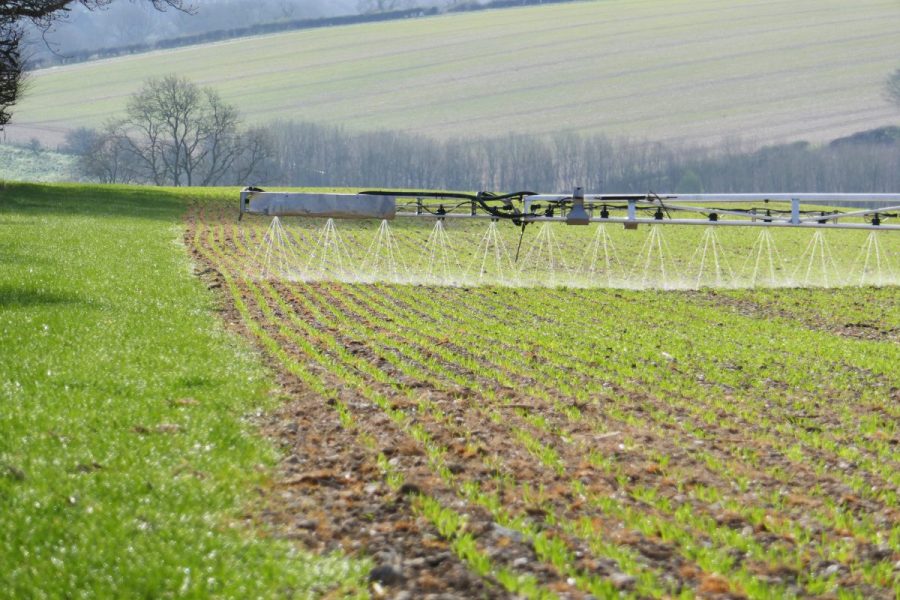
Innovation doesn’t have to mean new product introductions alone, it can also be taking a renewed approach to existing solutions or methodologies. CPM looks at how one agronomy company is combining new with old to tackle the topic of NUE.
“Better scientific understanding of what we already have can improve how we use existing tools.” TOM PERROTT
By Janine Adamson
While innovation is frequently associated with new products or solutions, Agrii’s Tom Perrott is quick to remind that it also refers to ideas. “It’s not always ‘innovative’ technologies that deliver the best results in agriculture, it can also be better scientific understanding of what we already have, to improve how we use those tools,” he explains.
And when it comes to the latest thinking on NUE, he’s been applying this approach to help screen and select specialist nutrition products, to provide a breadth of scientifically-robust options for Agrii’s growers.
To illustrate further, Tom Perrott raises his first example. “While the application of molasses is very much not new, what is different, is we’re now understanding how it actually works in the soil, and how it’s utilised by soil bacteria to cycle nitrogen which can be later taken up by a crop.
“Trials indicate that where additional nitrogen is applied in spring barley – a crop with a short growth cycle – although there’s no yield benefit, when molasses is applied that additional nitrogen in the system is utilised to create more bacteria.
“So molasses feeds and therefore increases the populations of soil micro-organisms, boosting rates of organic nutrients available to growing crops and helping to support the biological cycling of applied inputs.”
This scientific backing is reasoning being the Agrii-Fortis range of liquid carbon additives, he continues, specifically Agrii-Fortis CP (Carbon Protect). “This is a molasses-based high-carbon and high-carbohydrate formulation, helping to improve fertiliser utilisation.”
However, looking ahead to what’s coming through the innovation pipeline, Tom Perrott highlights Beta Plus – a new prilled (granular) molasses product that should be available this spring.
“There are many benefits to prilling a liquid, namely easier handling, transport and application. However, it also means all of the amino acids and components of the molasses are very concentrated and highly loaded,” he explains.
A second example Tom Perrott outlines is Agrii’s understanding of the impact of urease and nitrification inhibitors. “Although effective at mitigating the risk of environmental pollution while increasing NUE, much of the inhibitor technology available at the moment is in fact based on older chemistry.
“Conversely, Agrii-Start Liqui-Safe is unique in that it delivers the inhibitor mechanism for improved NUE and reduced losses, while benefitting the soil biome and biology. As a water-soluble organic compound, it has an excellent environmental footprint.”
Although improving NUE can sometimes result in reducing the amount of applied nitrogen, Tom Perrott stresses that it must centre around being more targeted, rather than simply cutting back. “This means applying the nutrition that a crop truly requires.
“Consequently, an innovation we’re launching this year is Triplex – bespoke soil-applied liquid starter fertiliser. How this works is, a soil sample is taken from the field pre-planting and a starter fertiliser is then calibrated according to the soil’s nutritional requirements and the crop being planted.
“Growers can order small quantities such as an IBC, but importantly, this takes away all of the guess work when it comes to nutrition. We’re really excited to be launching this; it’s a key step towards helping all growers to optimise their crop nutrient efficiency.”
But where do farmers currently stand this spring? Agrii’s Tom Land believes in most cases, the nutritional scenario should be positive. “Because of extremely arid conditions in 2025, a lot applied nutrition wasn’t fully utilised by last season’s crop, so there should be a decent bank of residual nitrogen in the soil.
“Winter crops that are already established appear to have accessed nitrogen well, and winter conditions so far have been relatively kind, potentially resulting in lower nitrogen losses this season.” he suggests.
In agreement with Tom Perrott, Tom Land believes it’s a combination of old and new methods which often yields the best results. “With residual nitrogen being present, a simple start would be to assess the nitrogen in the growing crop’s canopy – either by counting tillers or by measuring the green area index.
“In doing so, it could be possible to make some savings this season, or to tweak application timings. Although it’s impossible to say for certain, there should be some nitrogen left over from last year, which is particularly evident in crops such as oilseed rape.”
He adds that with current prices, it’s well worth utilising what’s already ‘in the system’, whether that’s in the crop or the soil. “Fertiliser is expensive and its value has to be understood versus yield or outcome.
“An average cereal crop of 500 shoots/m2 could have 5-15kgN in its canopy, but this year, some early-drilled crops could potentially have double that. As for OSR, we’re seeing 50-80kgN in autumn-sown crops already.
“Some growers may be surprised by the nutrition being held in their crops. Afterall, the key to NUE is optimisation, and, factoring in the economics involved in achieving that. There’s no point striving for the unachievable and spending a fortune during the process,” states Tom Land.
Then, he highlights that growers could utilise SOM sampling undertaken for other purposes such as SFI reporting, to help indicate the state of their soils. “Fields with good SOM levels cycle nitrogen better, so if you have that data available to you, use it, as it could help to influence nutritional decision-making.
“Another useful measurement method is SMN plus soil testing, which helps growers to understand the two types of nitrogen within the soil: what’s directly available at the point of sampling, as well as what will become available through the growing period as a result of mineralisation of organic matter. This test should be undertaken before nitrogen is applied, again to help fine-tune rates and timings.”
Tom Land also wants growers to broaden their horizons beyond NUE meaning nitrogen use efficiency, and towards it involving all nutrients. “Don’t take any nutrient in isolation – they all interact with and impact each other. For example, off the back of a dry season, fields can have a higher offtake of potassium.
“So rather than nitrogen, because these two nutrients are intrinsically linked, potassium could be the limiting factor for NUE and yield this spring, meaning it’s well worth measuring and taking subsequent action.”
While there’s admittedly a lot for growers to digest when it comes to a ‘contemporary’ approach to crop nutrition, Tom Land raises that Agrii’s extensive R&D work is what’s driving the company’s agronomic strategy.
“We’re constantly trialling new sources of N,P&K and alternative tools to unlock their potential, comparing against conventional approaches. We also calculate the associated financials, to understand whether they stack up or not on-farm.”
Tom Perrott concludes: “Often growers are looking for a silver bullet to answer many of their problems, but actually, they could be trying these different technologies at a farm-level to help inform their own decision-making. Agrii has already screened them during trials, so having the faith to have a go on-farm, in individual fields, could pay dividends.”