
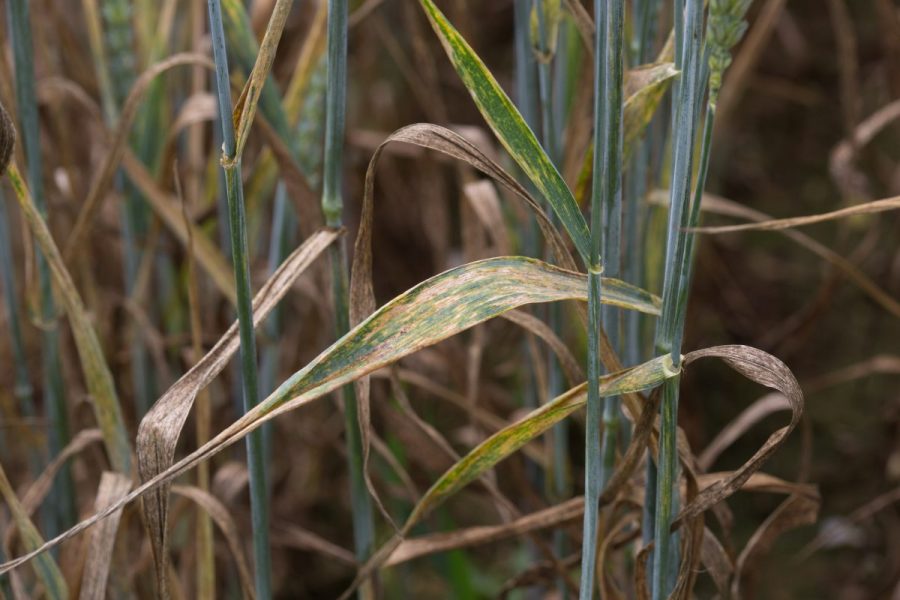
Established research suggests T1 and T2 deliver the greatest return on investment, but with innovative chemistry on the market plus shifts in certain disease pressures, is this still valid? CPM looks at the value of ‘T’ timings across the whole programme.
“Constantly evaluate the performance of each fungicide application – has it worked as expected?” PROFESSOR FIONA BURNETT
By Janine Adamson
According to historical industry research, when comparing the economic value of each ‘T’ timing, T0 delivers a much smaller yield response, if at all, compared with later applications. However, since this work was conducted, times have changed… dramatically.
On the plus side, modern varieties feature robust genetics with improved disease resistance scores, albeit, recent Yr15 breakdown aside. Innovation has also been taking place in crop protection, with a raft of new fungicides coming to the market, as well as a steady increase in non-synthetic disease control introductions.
Conversely, poor grain prices, a highly variable Harvest 2025, and a reduction in funding from environmental schemes, means on average, the coffers are somewhat depleted. This sparks the question – is investment in fungicide programmes as simple as that historical research would suggest?
Independent consultant, Professor Fiona Burnett, says scrutinising fungicide economics has never been more critical. “We’re at a place where we have to really think about each crop on a per-field basis. Last year, economising on a T0 was not the right decision, and while this may steer thoughts this season given the Yr15 breakdown, T0 should never be used as a blanket spray.
“It all depends on whether the crop is a susceptible variety (according to the revised Recommended List resistance ratings), whether the field has a history of yellow rust pressure, and general conditions, which will all inform the level of risk and therefore decision on T0.
“Ultimately, we could hypothesis around the value of spray timings, but really, it’s down to watching the season, evaluating the crop that’s in front of you, and reacting accordingly,” she urges.
That said, Fiona recognises the trend is moving towards front-loading programmes. “T0 is about prevention, particularly from a yellow rust-perspective. Equally, T1s are becoming more sophisticated with greater stacking, which is required for both disease control, and resistance management.
“This does make economical-sense – front-load and judge risk early to avoid having unnecessary intermediary sprays and going in repeatedly. It’s the likes of a T1.5 or T4 that don’t have a huge margin, and tend to be applied to firefight,” she explains.
In agreement, Niab’s Dr Aoife O’Driscoll raises that current chemistry is more protectant and less curative compared with when the ‘T’ timings were first devised. Furthermore, what’s involved in growing a crop has changed dramatically during recent years.
“In some ways, we’re using 2026 fungicides with a 2010 mentality, which includes looking at each application timing in terms of yield response alone. Instead, we should question what each spray delivers across the whole system, whether that’s risk management, inoculum reduction, even holistic aspects such as general peace of mind,” she says.
This means overall messaging regarding fungicides may have to change too, believes Aoife. “We can’t always measure the impact of front-loading, including T0, so we have to find new metrics to quantify. Exactly how we achieve that, remains an open question.
“But if we can move away from binary thinking – where we’re guided by a growth stage – we can start to think more broadly about what we’re actually trying to achieve with a fungicide, and how we might realise that.”
And as always, there remains an element of ‘watch and see’, suggests Fiona. “Constantly evaluate the performance of each fungicide application – has it worked as expected? This will influence future sprays, as if successful, is an opportunity to sensibly tweak a later dose to make an incremental gain.
“Unless in an extreme scenario such as last year’s drought, this won’t mean slashing applications by half. Instead, it’s fine-tuning the dose of certain products in a balanced way, which again, assists resistance management.”
UPL’s Tom Wheelhouse believes given the threat of septoria hasn’t gone away, the T timings exist for a reason. “We don’t have effective curative chemistry for septoria, it remains ‘the’ most yield robbing disease. That’s why the onus is on being proactive with fungicide programmes and maximising preventative product choices.
“It costs a lot of money if you’re on the back foot, both in the product then required and through a hit on yield,” he stresses.
Tom agrees with Fiona that no two years are the same and the days of blanket recommendations are over. “Just because a fungicide programme worked last year certainly doesn’t mean it will work again this season. Yes from a sprayer operator’s point of view it’s a pest to have different fields requiring different tank mixes and timings, but this is how any potential savings could be made,” he says.
INNOVATIVE SOLUTIONS
Scientific understanding has also moved on significantly since T0 was dismissed as low priority, adds Tom. “An elicitor product like laminarin, for example, when applied at T0 is about protecting the plant early doors and creating resilience against septoria.
“Its activity is prolonged too – supporting later fungicide applications and allowing a little flexibility. Importantly, it isn’t just about carrying a crop through to T1, it supports beyond that and plays its own role throughout a plant’s life cycle,” he explains.
Meanwhile, Fiona warns against being ‘gung-ho’ with products in the alternative plant health sphere in a bid to save money. “This is an exciting, emerging area but is again something that should be scrutinised. Equally, if there’s good evidence that a crop requires feeding, then fine.
“I think this raises the importance of evaluating the economics of all crop inputs as a collective, whether that’s fungicides, herbicides, biostimulants or nutrition. Of course fertiliser, regardless of type, will require the greatest investment.”
Tom agrees: “Other inputs could be tweaked for a more significant gain than immediately jumping to slashing fungicides to the detriment to the crop.” While Aoife reminds that labour and machinery also contribute considerably to the cost of production, so in balance, too much time is spent questioning the value of fungicides.
Subsequently, Fiona encourages growers to have an open, honest conversation with their agronomist if they have concerns. “You’d like to think this wouldn’t be the case, but if all field recommendations are the same, that should be questioned.
“Also, to achieve any potential incremental savings, is it time to accept a crop won’t be totally clean? While even traces of yellow rust are unlikely to be tolerated, for less aggressive diseases – mildew, septoria in some cases – is a little actually okay?
“This could be the year of more crop walking, more conversations, and more tweaking,” she comments.
One agronomist already operating by this approach is Yorkshire-based Richard Boldan of Edaphos Agronomy. He says while current crops have a lot of potential, he’ll be assessing on a field-by-field, farm-by-farm, margin-led basis.
“I’m having a lot of discussions regarding input costs and on the whole, growers want to spend as little as possible. But, there’s a significant quantity of varieties in the ground that are now susceptible to yellow rust.
“Luckily, the chemistry to control yellow rust is cost-effective so it’s worth hitting susceptible crops hard and early to prevent ingress. That said, some varieties have maintained good resistance and you can’t beat decent genetics, so it’s far from a blanket spray,” he explains.
However, while not a primary concern now, he remains wary about septoria. “It’s the most expensive disease to control and the fungicides required this season will all depend on the level of risk. If it’s a repeat of 2024, then the newer chemistry will be justified, while if it’s like last season, it just won’t be worth it,” he concludes.
This article was taken from the latest issue of CPM. Read the article in full here.
For more articles like this, subscribe here.
Sign up for Crop Production Magazine’s FREE e-newsletter here.