

With a host of geopolitical events and external factors creating uncertainty in the fertiliser market, growers are being encouraged to avoid holding back and to press on with orders. However, could the technical and financial benefits of urease inhibitors help to ease the pressure? CPM explores for this month’s Common Ground.
“Why wouldn’t you want to save money, protect soil-based nutrients and help environmental recovery?” RUSSELL DAVISON
By Janine Adamson
Global fertiliser prices are projected to end 2025 up 21% from last year, according to the World Bank’s Commodity Markets Outlook report released on 29 October. The work also shares that prices have risen almost every month this year, averaging 30% higher in the third quarter than the same period in 2024.
At a UK level, a combination of poor results from Harvest 2025, continued low grain prices, plus a hike in input costs across the board, means due to cashflow difficulties, demand for fertiliser has been somewhat muted, claim experts.
But with continued global political unrest and logistical pressures, potential supply constraints could be looming. However, despite this bleak outlook, positive steps can be taken to ensure the fertiliser that is applied, is utilised fully, and maximises return on investment.
To discuss this further, CPM hosts COFCO’s fertiliser sales manager, Russell Davison; North Essex grower, Steve Crayston; and BASF business development manager, Andrew Clune. Steve farms 1000ha across medium to heavy land with winter wheat established by direct drilling.
Current fertiliser outlook
To open up the discussion, Russell shared his thoughts on the fertiliser market, explaining that with continued global unrest, pricing hasn’t really recovered. “When the conflict kicked off in the Middle East with Israel and Iran, at the time I think many of us questioned what that had to do with fertiliser in the UK. But, it had an immediate impact particularly on urea, where Iran is a significant exporter.
“Ultimately, we’re in a very unstable geopolitical situation, whether that’s in the Middle East or Russia-Ukraine; when you look at things from a break-even ratio point of view, we’re at relatively high levels compared to where we were this time last year.
“This has coincided at the same time as poor, uninspiring grain prices. So it’s understandable from a cash flow-perspective that some farmers have been holding off, but I think we’re all very mindful after last spring following the experiences we had with transport and logistics.”
He added that from a purely pricing perspective, unfortunately, there’s unlikely to be a downturn ahead of applications. “The key message is that there doesn’t appear to be an awful lot of potential for downside in the price, yet potential supply chain issues should remain front of mind.”
Steve pointed out that the annual schedule for farm income has shifted recently due to the reduction in BPS. “Traditionally, many tended to purchase their fertiliser with a delivery in the late-autumn, early-winter, for January payment.
This coincided with the larger payments from BPS and similar, but now they’ve gone. This means growers are having to re-juggle their cashflow and potentially when they might purchase fertiliser.”
In response, Russell added that potential unknowns in cropping rotations – such as inclement autumns leading to a rise in spring cropping – can contribute further to growers delaying their fertiliser orders, thus adding pressure on supply.
Conversely, Andrew raised that buying early has an added benefit in terms of budget planning. “At least you know where you are and have a good understanding of your cost of production. If you leave it to chance it might be higher, or lower, but by planning in advance you have a benchmark to work from.”
Urease inhibitors
With discussion migrating to another somewhat political factor, Andrew highlighted that the voluntary stewardship programme governing the use of urea-based fertilisers has now been in place for around 18 months.
The guidelines – monitored as a Red Tractor farm assurance standard – were instigated to help limit ammonia emissions from urea fertilisers and reduce their contribution to both air pollution and ecological damage.
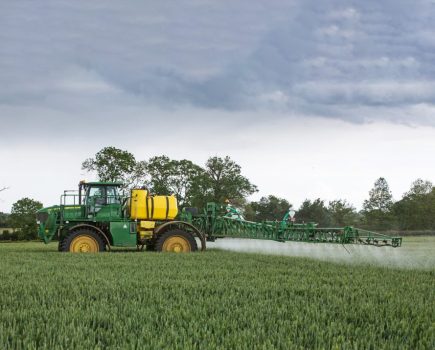
Applicable for any fertiliser containing more than 1% of urea nitrogen, untreated solid urea/liquid UAN fertiliser can only be applied between 15 January to 31 March each year, otherwise a urease inhibitor must be used (see box).
“The primary contributor to ammonia emissions in the UK is agriculture – we’re 88% of that with roughly a quarter of all UK ammonia emissions coming from fertiliser applications,” said Andrew.
“The reason behind this is that urea can lose on average around 20% of nitrogen through volatilisation, and in poor conditions this increases to 80%, so that’s when its warm and dry with just enough moisture to break down the granule.”
Steve shared that he’s happily on board with using inhibitors across the farm. “Last year, the vast majority of our applications – even if they were before the end of March – went on with an inhibitor. Although, because we’ve not done our own trials on farm, I’m interested to know what the financial returns look like.”
In response, Andrew said that comparing the cost per kilo of nitrogen, urea plus Limus is less than ammonium nitrate. “It’s better value and through the 80+ trials that we’ve conducted, we always see that Limus-treated urea is very similar, if not slightly further ahead, in terms of yield performance too.
“We regularly see around a 5% uplift from using treated urea over untreated urea. There’s a cost to it, yes, but you get more nitrogen being retained in the soil.”
The bigger picture
With environmental health at the head of the global political agenda, Andrew reminded that Defra continues to monitor its status, including emissions.
“They’re also surveying fertiliser manufacturers and looking at the volumes of urea they’ve sold versus the volumes of inhibitors or inhibited urea. There are real-world consequences if best practice isn’t adhered to. The reality is, if you’re using urea, you should be using a treated urea.
“And the environment aside, it’s better to keep nitrogen where it should be for a longer period of time, so it’s beneficial to the crop and therefore the grower. As such, urease inhibitors aren’t only good for the environment, they make agronomic and economic sense too.”
Steve shared that he believes sometimes it’s a case of having limited time to make a decision regarding fertiliser purchases. “There’s a lot of pressure to lock an order in quickly, it would help if heat was reduced on those interactions a little. Perhaps the best way to proceed is if uninhibited urea wasn’t available to UK farmers, admittedly that’s a tall order.”
Russell pointed out that either way, hard policy may be looming around the corner. “If the government sees ammonia emissions reducing because of the use of inhibitors, there’s a fait accompli – let’s treat everything and emissions will come down even further.
“Equally, I understand the frustration with pressurising sales phone calls, but it can be difficult when the markets are volatile. However, growers can request to have their urea treated with an inhibitor after the order has been placed, it’s flexible. If it hasn’t been delivered, there’s no problem.”
Steve said a major flaw with all legislation or stewardship is that it’s often calendar-based. “Cropping doesn’t work to a set date; we should be trying to work with nature as best as we can regardless.”
The future
According to Russell, to reap the full benefits of urease inhibitors, the industry has to promote the environmental benefits in conjunction with potential gross margin gains. “On the whole, most farmers are concerned with preserving the environment, and the overall impact of our industry on it.
“But products such as Limus are more than that, they’re offering bottom line benefits compared with ammonium nitrate.”
Andrew highlighted that there’s more in the product pipeline too. “BASF has nitrification inhibitors coming to market in the next few years, which will have a significant impact on the carbon footprint of production, although will also rely heavily on adoption.
“But, if you break it down in terms of what you’re really doing, you’re trying to protect the environment and prevent nitrates or phosphorus from going into rivers. Taking that a step further, you’re trying to stop nutrients from leaving your farm. Why would you want that to happen when you pay for them?
“Remember those headline figures – 20% can be lost on average in a good year, 80% in a bad year.”
Russell agreed: “Why wouldn’t you want to save money, protect soil-based nutrients and help environmental recovery?”
This article was taken from the latest issue of CPM. Read the article in full here.
For more articles like this, subscribe here.
Sign up for Crop Production Magazine’s FREE e-newsletter here.