
Aside from getting to grips with the nuances of new product launches, growers and agronomists also have a continuous stream of label extensions and guidance adjustments to contend with. CPM shares some of the key updates.
“This gives farmers more flexibility in how they use Proclus or Bandur in a herbicide programme.” JAMIE OAKLEY
By Janine Adamson
Both agronomy and practical crop management are at the mercy of frequent change, particularly when it comes to what ag-chem inputs can and can’t be applied, how, at what time, to which crops, and in what order in the tank-mix. It’s not a simple job.
And while there’s always a steady flow of new information to take on-board, keeping abreast of current regulation is not only essential for crop and human safety, but is also legally mandatory.
Equally, it could be perceived that often, label changes to existing products create more of a headache than not. However, two recent tweaks should in theory, make life a little easier in the future.
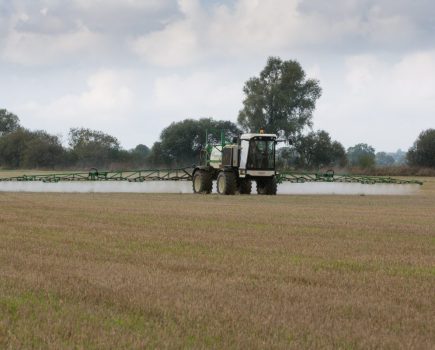
For the first, post-emergence applications of alconifen are now permitted. As such, growers can apply Proclus or Bandur (both aclonifen) at 0.4 l/ha in winter wheat and winter barley post-emergence, up to the 4-leaf stage.
Since approval in 2020, these herbicides were only permitted for application pre-emergence, points out Bayer’s Jamie Oakley. “But this update gives farmers more flexibility in how they use these products in a herbicide programme. Current data also indicates that splitting the dose can help to improve the longevity of protection without compromising initial weed control.”
Jamie adds that the maximum total dose of Proclus or Bandur per season is 1.4 l/ha. In wheat, this can be applied in total at pre-em, or, split with 1.0 l/ha at pre-em followed by 0.4 l/ha post-em, he says.
In barley, 1.0 l/ha is the maximum dose at pre-em, but this can now be followed by 0.4 l/ha at post-em to deal with difficult weed populations.
“If you haven’t used either product at pre-em, you can still apply 0.4 l/ha as part of the tank-mix for the follow-up application,” advises Jamie. “A follow-up is becoming increasingly important.”
He points out that improved broadleaf weed control may be one advantage of a post-em application. “Aclonifen has good innate activity against many broadleaf weeds, but they tend to emerge a little later than the typical pre-em timing.”
Both herbicides also have a wider label which includes winter beans. “This is to simplify things for farmers and store managers, so it’s easier to plan and use herbicides in the field. Winter beans are a good example where Proclus or Bandur could be deployed in cereals and beans in the same autumn,” he comments.
The second key update for growers and agronomists involves lifting restrictions on Iblon (isoflucypram), that limited its use to one application every two years. The change follows the successful submission and evaluation of data submitted by Bayer, and means growers can utilise Vimoy (Iblon)’s broad-spectrum efficacy now.
For other Iblon-containing products such as Jessico Fusion (Iblon+ Inatreq (fenpicoxamid)), Plaxium (Iblon+ prothioconazole+ fluopyram), Caley, Ipresso, Resilis, Milteo, Scorpio or Vivalis (all Iblon+ prothioconazole), the previous restriction limiting use to one application every two years will be lifted for the 2026 season, meaning these products can be applied to approved crops grown in the same field in successive years.
The decision was announced at the same time that CRD also granted a label extension allowing for Vimoy to be used on barley, thereby expanding options for the 2026 cropping season.
Nils Bauer, managing director of Bayer Crop Science, says the news is an excellent opportunity to unleash the ‘full potential’ of Iblon. “This is very good for GB growers, many of whom have come to appreciate the broad-spectrum performance of Iblon, and its ability to improve yield through extended crop greening even where disease pressure is low, as it’ll extend crop protection to successive crops grown in the same field.”
This article was taken from the latest issue of CPM. Read the article in full here.
For more articles like this, subscribe here.
Sign up for Crop Production Magazine’s FREE e-newsletter here.