
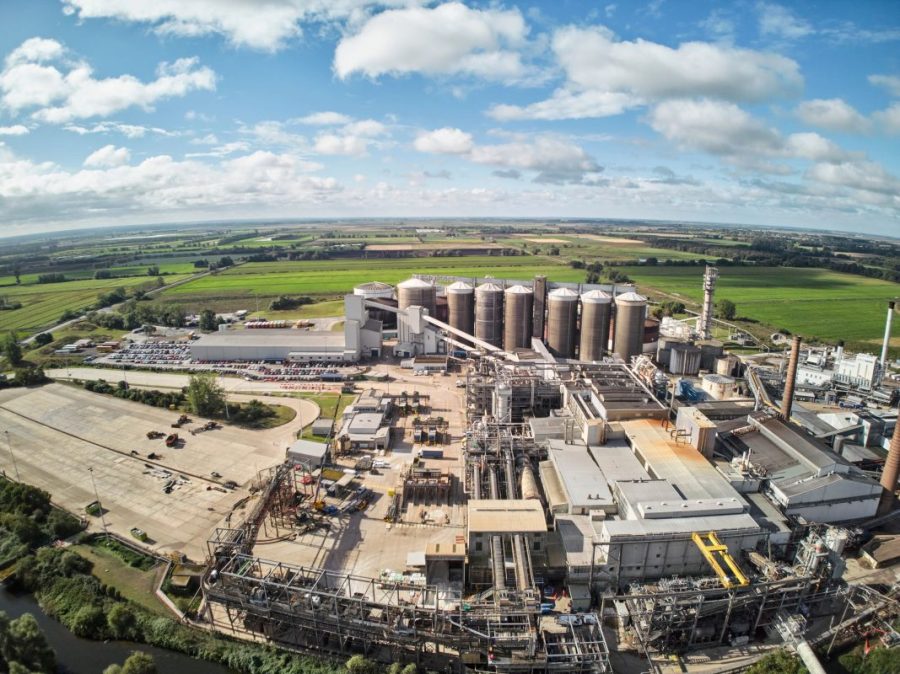
A co-product of the sugar beet manufacturing process, LimeX is steadily gaining a following across the country thanks to its unique benefits, notably its fast, neutralising action. CPM visits the sugar beet factory at Wissington, to learn more about the manufacturing process.
“It’s proven successful because it works quickly rather than waiting years for pH to correct.” CHRIS PEAKE
By Janine Adamson
Not all agricultural liming products are built equal, and in the case of LimeX, it’s how it’s manufactured specifically that enables it to offer its unique qualities, and therefore make a difference quickly on-farm.
But what makes the product so effective at correcting soil pH, and why has the manufacturing process been so pivotal in its success so far? Well, it all starts with a crop of homegrown sugar beet…
A division of British Sugar, LimeX is manufactured at British Sugar’s factories at Newark, Bury St Edmunds, Wissington near Kings Lynn, and Cantley near Norwich, and is a resulting co-product of sugar beet processing, explains LimeX Business Manager, Glenn Carlisle.
The production process begins once a sugar beet intake has been weighed, sampled and unloaded into the factory. This is then de-stoned, washed and cleaned, before being sliced into thin chips known as cossettes, continues Glenn.
“These cossettes are then diffused with hot water to extract the sugar, and purified. It’s during the purification process when we remove the non-sugar from the ‘raw juice’ that the LimeX story really begins.”
CHEMICAL REACTION
For this, milk of lime and CO2 are produced and combined with the raw juice creating a chemical reaction where calcium carbonate crystals and non-sugars are settled out as solids. To complete the process, the solids are pressed using hydraulic force and compressed air to extract water which leaves a dry product – LimeX.
Critically, being a chemical-driven process means the end result is much finer than what growers may associate with conventional agricultural lime, points out Glenn. “This is a key differentiator of LimeX. While competitors are mostly mined rock products which can be coarse and gritty, LimeX is just 0.002-0.015mm in diameter.
“For the grower, this means a product which can act much quicker in the soil – starting to correct pH in just 4-6 weeks. No other agricultural limes are as fine in particle or fast in action; think of it like comparing the speed of dissolving granular sugar versus a sugar cube in a cup of tea.”
This means once applied, the calcium in the lime is more available too, he raises. “This can help to bolster the health of the growing crop to ward off soil-borne diseases such as clubroot and improve soil structure.”
To provide an idea of scale, around 8M tonnes of sugar beet are processed annually by British Sugar, across four processing sites. The output of this is not only 1.2M tonnes of sugar, but also up to 300,000t of LimeX, as well as a host of other co-products such as topsoil, stones, animal feed, bioethanol and renewable energy.
Of course, with the processing of sugar beet comes impurities. However, what doesn’t belong in sugar can in fact be used in LimeX, highlights Glenn. “As such, each tonne of LimeX contains 9kg of phosphate, 8kg of magnesium and 7kg of sulphur. Consequently, a 7.5t/ha application rate of LimeX usually supplies the phosphate requirement of the following cereal crop.
“These ‘free’ added nutrients are another benefit for the grower that’s a consequence of LimeX’s unique manufacturing process,” he says.
A COMPELLING OFFER
According to lime and soil specialist for Agrii, Chris Peake, it hasn’t taken much to convert his growers to LimeX. He says he started working with the product in spring 2025 as a way to help his customers to stay competitive.
“Particularly for large hectarage growers, agricultural lime is starting to increase in cost. What we’ve found is not only is LimeX cost-effective, but growers appreciate its consistency and that it works quickly.”
Chris adds that while he strives to be ‘two crops ahead’ when it comes to lime and maintaining correct pH, he also wants something that breaks down quickly. “Equally, dry or dusty lime is very difficult to spread and can be expensive.
“Because of the benefits of LimeX, we distributed 1000t in the blink of an eye this year. Importantly, it’s not just about its price competitiveness, it’s proven successful because it works quickly rather than waiting for years for pH to correct.
“The added nutrients also help the growing crop, especially sulphur. Every little helps to maximise each pass through a field.”
Although Chris doesn’t believe LimeX will completely replace conventional lime, he believes given the choice, most farmers are quick to make the switch, or start to integrate it into rotations. “We’re certainly pleased with its performance. I can easily see it working side-by-side with traditional liming products.”
Being based in the West Midlands, Chris’ experience also quashes a common misconception, points out Glenn. “Some may believe that LimeX is only available to sugar beet growers or those near to a British Sugar factory. This is incorrect – although the product is stored at and distributed from our factories, it’s available to all, whether that’s mushroom growers in Ireland or vegetable producers in Cornwall.
“While 60% of production does go to those in the beet growing area, our customer base beyond this is growing steadily, particularly as the benefits of LimeX come to the fore. This is supported by our network of approved hauliers to ensure product is delivered on time,” he says.
To illustrate this further, contractor Zander Hughes of Forth Crop Solutions in Fife was first introduced to LimeX through a new customer, who specifically requested the product. With demand accelerating from the off, he’s now distributing LimeX across his region in Scotland.
“We received 3000t into Fife this spring alone – so far, it’s worked remarkably well,” he says. “It’s a cost-effective alternative to conventional ground limestone, but you have the added benefits of a formulation which includes key nutrients.”
He’s also been impressed with the speed of delivery – around a week turnaround from order through to being spread on fields. “Product comes in and out as required with us receiving consistent loads on a regular basis. While we have a storage facility we can use, customer demand has meant we’ve not had to use it.”
Glenn is also eager to stress that LimeX can be used on any crop which has a pH requirement. “We’re keen to move away from its association with sugar beet. Yes, sugar beet is involved in the product’s manufacture, but with a year-round supply, LimeX can be applied to cereals, oilseed rape, potatoes, vegetables and grassland.”
This article was taken from the latest issue of CPM. Read the article in full here.
For more articles like this, subscribe here.
Sign up for Crop Production Magazine’s FREE e-newsletter here.