
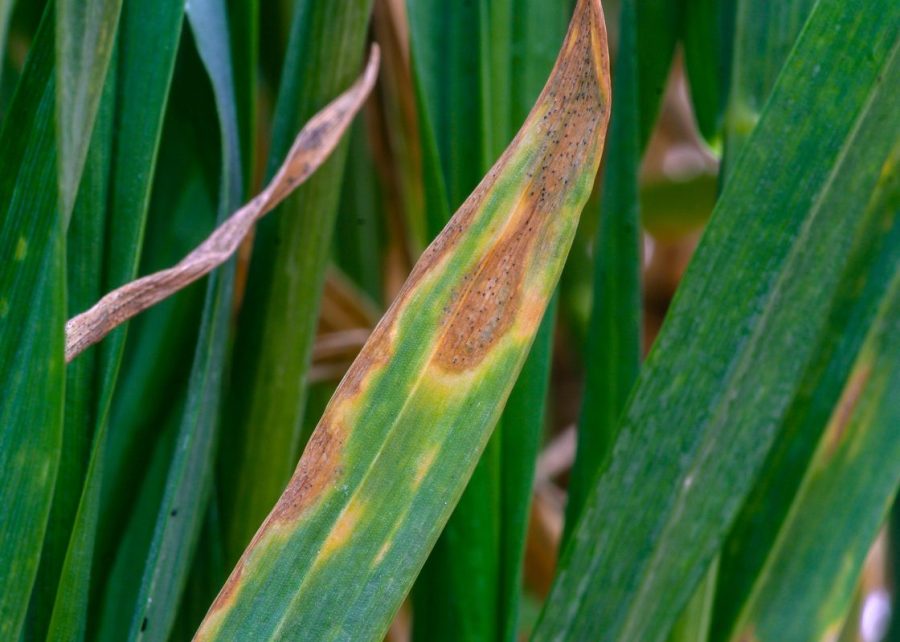
An independent pilot is taking place to help growers identify the value that different biofungicide products can add to winter wheat disease management programmes. CPM shares the details…
“It’s early days and only a few biofungicide products are available for commercial UK wheat crops, but there’s a clear demand from levy payers for robust data.” CATHERINE HARRIES
By Janine Adamson
Undoubtedly an emerging market, biopesticides are piquing interest as a means of both bolstering the agronomic toolbox, and, reducing the environmental impact of crop production.
And while derived from natural substances, unlike other non-synthetic inputs such as biostimulants, biopesticides are categorised as plant protection products, thus requiring an official authorisation for their use.
Just like conventional chemistry, this comes with a requirement for manufacturers to provide proof of efficacy, usually through the submission of trial data during a product’s registration. However, these trials are mostly commercially-driven, and not necessarily reflective of current agricultural practices at a regional level.
Equally, registration trials only have to indicate some activity against a target disease, thus raising the question of how robust and variable the control is from a biofungicide.
NEW PROJECT
Recognising grower demand for more information on biopesticides – specifically independent UK trial data – has led AHDB to fund a new pilot that will investigate the potential of biofungicides in winter wheat for septoria control, explains AHDB project lead, Catherine Harries.
“The idea was first raised a few years ago within AHDB’s fungicide working group, which are the stakeholders behind our established fungicide performance work. Since then, it’s been finding a viable way to move the concept forward,” she says. “We also received comments through the Letterbox on our website – where levy payers are invited to tell AHDB where they believe knowledge gaps are.”
Catherine adds that insights have been gleaned from the former AHDB Horticulture, which invested in biopesticide research through projects such as AMBER and SCEPTREplus.
“Although primarily horticultural crops, SCEPTREplus also considered field crops, for example, assessing the potential of Bacillus amyloliquefaciens (formerly subtilis) strain QST 713. This work has laid a foundation for the arable sector, not only by compiling products, but by developing initial trial approaches and improving understanding of biopesticide application.”
Rather than fully integrate the biofungicide trials within the existing fungicide performance work, Catherine says the two will remain separate. “While both are classified as plant protection products, biofungicides and conventional fungicides are not the same.
“The work will, however, take place at the same sites. This means that the biofungicides will be tested against the same disease pressure as the fungicide performance trials so we can compare the results.”
Looking at the pilot trial in more detail, AHDB has awarded a contract for its delivery to a consortium of organisations comprising SRUC, Niab and ADAS. The group also manages AHDB’s extensive network of fungicide performance trials in wheat, barley and oilseed rape, says Catherine.
Researchers will conduct two years of winter wheat trials (2025/26 and 2026/27) to generate disease and yield data, which should then inform how best to integrate biofungicides within existing crop protection programmes.
Catherine points out that given its economic importance, the work is focusing on septoria control, and will be carried out at three trial sites – Lothian, Hampshire and Herefordshire – based on their historically high rainfall and septoria pressure.
The trial in Lothian is being managed by SRUC, led by overall project lead, Neil Havis. He says the biofungicide products for the pilot have now been finalised, and are all either currently registered, or, near to their market launch so will be available on-farm soon.
“We’ve been working with manufacturers and specialist research companies to create a list of up to seven suitable products to include in the trial. This has included addressing specific criteria, such as the manufacturer being able to provide trial data for septoria control.
“As well as ensuring we’re only trialling appropriate biofungicides, it will also prove an effective comparison point to hopefully validate those manufacturer claims,” he adds.
STEERING GROUP
Neil stresses that absolutely no biostimulants or similar will be included in the trial. Equally, the project’s steering group includes scientists, agronomists and farmers, which he believes is critical for ensuring the work will be on-farm applicable. “This work won’t be controlled by academics alone,” he comments.
The Hampshire trial is being managed by Niab at their Sutton Scotney site, while Herefordshire will be overseen by ADAS at their centre of septoria research. ADAS’ Chloe Francis says each site will feature two locally-relevant winter wheat varieties – one moderately susceptible to septoria, and the other moderately resistant.
For Harvest 2026, LG Astronomer and Graham are being grown at the sites in England, while LG Skyscraper and RGT Hexton have been sown in Scotland.
Then, in terms of conventional fungicides, five control treatments are being used: completely untreated plots (no fungicide at all; for a baseline disease pressure), a typical commercial programme for septoria applied at 25% field application rate, 50%, 75% and 100% rate. These are based on a programme with T1 and T2 timings.
With controls set, up to seven biofungicides will then be assessed, applied alone and in addition to the base fungicide programme at 50% field application rate, explains Chloe. “However, the biofungicides will be applied at the optimum rate and timing according to the manufacturer’s guidance.
“With this trial design we should reveal the percentage control each biofungicide can achieve on its own, as well as understanding how much control each biofungicide adds to the 50% base programme, with the ability to compare this with the 75% and 100% base fungicide programmes,” she continues. “This should give growers the confidence to look at incorporating any promising biofungicides into their own fungicide programmes.”
Neil adds that assessments will involve undertaking the same disease protocol used for standard fungicides. “This includes in-field assessments and measuring green leaf area. Critically, all plots will be taken to yield, with the results presented during AHDB’s winter agronomy conference.”
However, each year of the trial won’t be an exact replication, highlights Neil. “With an August trial start date, we didn’t have the opportunity to consider solutions such as seed treatments. Therefore, we hope to integrate these into year two, which could also allow us to stack the biofungicides for further insights.
“Rather than a direct repeat year-on-year, this is a chance for us to dig deeper into the trial and expand learnings. Longer-term, there’s also potential to carry the project on, given there’s a real grower demand for this type of work,” he comments.
Catherine believes now is the optimum time to be conducting such research. “We’re at the point where there are enough viable biofungicides to screen, and, we should be able to deliver results that offer value to the industry.
“Yes it’s still early days and only a few products are available for commercial UK wheat crops, but there’s a clear demand from levy payers for robust data that reflects realistic on-farm practice.”
She adds that in ways, she’s been surprised by the enthusiasm of the steering group growers towards the pilot. “They’re really keen. However, this is encouraging given fungicide resistance management is a significant talking point, and growers are evidently already playing a proactive role in that discussion.”
She stresses that rather than pitting chemistry versus biology, the pilot is aiming to assess the merit of using biofungicides alongside chemistry. “This should answer the question of whether it’s better to add a biofungicide, or, increase the rate of the standard fungicide programme.”
To conclude, Chloe adds that with EU countries under stricter pesticide regulations than the UK, she believes this is driving demand for biofungicides as growers look to maintain control of challenging plant pathogens.
“There’s much to learn regarding biofungicides, complicated further by some being based on living organisms. Understanding how to manage them within the constraints of conventional spray techniques and machinery will also be a critical factor,” she says.
For those interested in seeing the biofungicide trial pilots in-person, open days will take place during the summer. Information regarding these will be shared on the AHDB, SRUC, ADAS and Niab websites in due course.
This article was taken from the latest issue of CPM. Read the article in full here.
For more articles like this, subscribe here.
Sign up for Crop Production Magazine’s FREE e-newsletter here.