
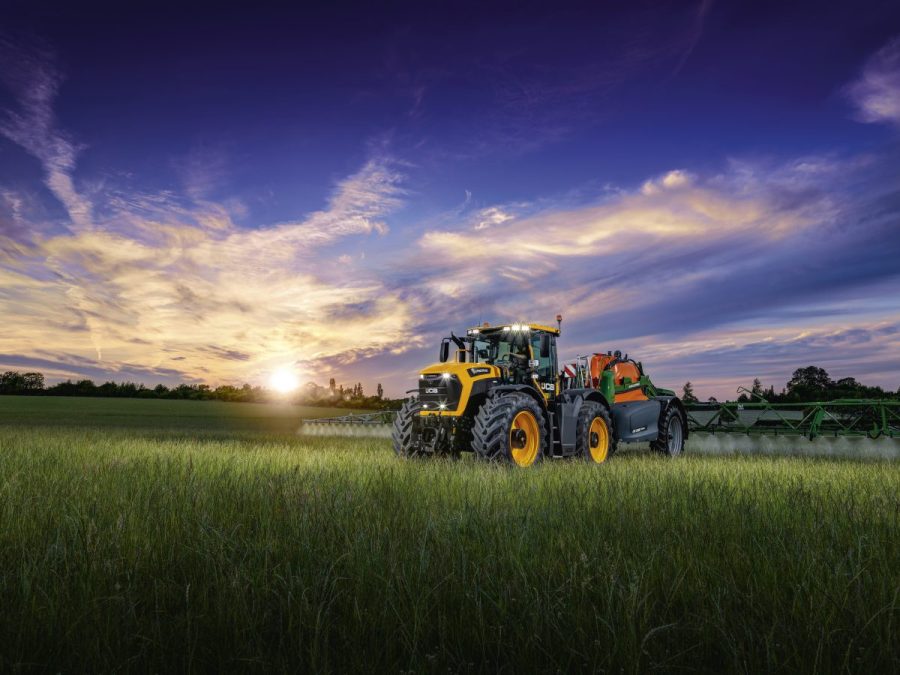
JCB recently unveiled the newest addition to its Fastrac fleet – the 6000 Series – said to take productivity to the next level. CPM takes a closer look at the new design.
“Following five years of development – the largest single investment in tractors ever made by JCB – we’ve launched the 6000 Series.” GREG FITTON
By Janine Adamson
According to JCB’s Greg Fitton, there was an obvious gap in what the Fastrac could previously offer. Up until autumn last year, which coincided with the firm’s 80th birthday, the tractor came in two ranges – the 4000 series catering for 160-240hp requirements, and the 8000 series for 300+ hp.
But with challenges across the industry such as consolidation, pressures on profit margins, shorter weather windows and labour retention issues, the demand for a tractor to fill that void had become ever more necessary, he says.
“And that machine had to be our most versatile, multi-use tractor. One that was fast, safe, comfortable and productive.
“So following five years of development – the largest single investment in tractors ever made by JCB – we’ve launched the 6000 Series. This not only fills the gap in the Fastrac range, but is a true year-round, high-speed tractor aimed at professional users.”
While the firm has entered a new power and performance category, JCB Agriculture’s managing director, John Smith, adds that the new 6000 Series stays true to company’s innovative and ground-breaking Fastrac concept. “The result is an exceptional combination of productivity, efficiency, versatility and operator comfort.
“It should meet the requirements of farmers and contractors through features that create a highly-productive machine with unique capabilities in the field and on the road.”
PRODUCTIVITY AND PERFORMANCE
In fact, with customisable options for a range of applications, the 6000 Series aims to deliver 365 days of productivity without compromise on performance, he adds. This is important, given the firm believes there’s a move towards fewer tractor purchases, but with the expectation that those machines will work more.
So how has the Fastrac developed to culminate in the 6000 Series? Firstly, two new models are available – the 6260 and 6300 – offering power outputs of 284hp and 335hp, respectively. The maximum top speed is 66km/h (41mph), which the firm says is achieved through responsive and efficient power delivery.
Both models run on 600-710mm-wide tyres, with selectable two- and multi-mode four-wheel steering as standard.
Then, housed in a new heavy-duty chassis concept that brings together a front casting and fabricated steel rear section, a 6.7-litre FPT six-cylinder engine delivers peak power at 1850rpm alongside a flat torque curve that rises under heavy load to 1400rpm, generating 1275Nm torque for the Fastrac 6260 and 1400Nm for the 6300.
At least 95% of the maximum torque output is delivered across a 600rpm band from 1200-1800rpm, providing plenty of back-up ‘grunt’ when ploughing or cultivating tougher ground, or when pulling up an on-road incline, proposes the firm.
The chassis casting has also been sculpted to allow the tightest possible front axle steer angle, and is pre-prepared to easily fit front loader brackets.
High output variable-flow hydraulics cater for modern implements with a 205-litre/min pump as standard, plus a second pump option for a total of 410-litre/min for the Fastrac 6300, supplied through a new hydraulic valve block with lever-operated push-in, pull-out couplings. The firm says this should mean quicker and easier hydraulic connection for the operator.
At the rear, an 11,000kg three-point linkage – attached to the back axle to retain full suspension movement under load – and four-speed power take-off cater for all implement types, while the optional 5000kg lift front linkage is complemented by a 1000rpm power take-off with the new feature of a six-spline and 21-spline reversible shaft.
The Fastrac’s unique rear load deck of 5000kg capacity provides a third mounting location for equipment such as sprayers or liquid tanks supplying fertiliser.
When it comes to suspension, the Fastrac’s unique self-levelling advanced suspension for both axles maintains 50:50 weight distribution. Not only does this give the new 6000 Series the highest level of driver comfort and well-being, but also helps to maintain favourable weight distribution and full suspension travel under heavy load.
JCB’s chief engineer, Robin Carter, highlights that this is a USP (unique selling point) of the Fastrac – being the only tractor on the market with full suspension. “The ride comfort is fabulous,” he says.
Another benefit of this is when operating demountable equipment on the rear deck – the hydro-pneumatic system enables the tractor to ‘squat’ as it reverses beneath a parked sprayer or spreader, for easy, effort-free coupling, suggests the firm.
BRAKE POWER
In terms of stopping, the tractor’s large externally-mounted brake discs and four-piston-driven single callipers provide exceptional braking power, with ABS as standard.
“As for maintenance, there’s a new brake pad wear sensor and indicator; it’s all been designed for maximum efficiency,” says Robin. Plus, the new hub-mounted discs are quicker and easier to replace – taking around 3-4 hours, compared with the 3-4 days often required to change a conventional tractor’s internal brake discs.
In the cab, the 12” JCB iCON display can now be complemented by a second 12” unit so more information is visible at any time. There’s also greater flexibility for operators to populate displays with customisable content such as guidance, camera view, ISOBUS and section control, for example.
To save further time, operators can store multiple profiles of control set-ups and tractor and implement settings ready for quick recall when they undertake the same operation again.
JCB LiveLink telematics for remote tractor monitoring and records, and optional ISOBUS electronic implement control, are available. However, a factory-installed satellite guidance option is unique to the Fastrac 6000 Series – providing two NovAtel satellite signal receivers as standard.
The firm’s engineers claim this is an ‘industry-first’ set-up that provides highly accurate low-speed guidance, increased accuracy over undulating terrain, and quicker, more precise acquisition of pre-set waylines. In addition to straight-line and curve guidance, the system now provides a choice of headland turn pathways to increase ease of use through automation, and boost overall productivity.
There’s then optional satellite guidance installation, comprising two receivers for quicker and more precise line acquisition, more accurate tracking over undulating field surfaces, and enabling Twin Steer ultra-precision guidance that steers both axles individually.
The Twin Steer system means the tractor can move crab-wise directly to a field guidance wayline at a headland, or if a correction is required to keep an implement on track, especially across sloping ground.
PRESERVING VALUE
JCB says this is highly effective at maintaining accurately spaced and positioned rows when sowing high-value crops grown in beds, and at eliminating damage during multi-pass operations.
As for the cab in general, being centrally-mounted it offers 360o visibility with a premium heated and ventilated driver’s seat option. There’s also an optional audio pro package for improved sound quality, comprising four speakers and a sub-woofer. The ignition is controlled by a stop-start push button, with the added benefit of auto stop to reduce idle time for improved efficiency.
But, in terms of ‘big ticket’ optional features, these include the central tyre inflation system (CTIS) that provides quick access to optimal field and road pressures at the touch of a button. This enables operators to switch between the most appropriate tyre pressures for field work (maximum traction and flotation) and road travel (slightly higher pressures to cope with high loads and fast speeds, adding stability while minimising wear and tear).
JCB engineers claim CTIS offers reliability, minimal maintenance and a long service life for key components, with the added benefits of optimum tractive performance, soil preservation and improved fuel economy.
This article was taken from the latest issue of CPM. Read the article in full here.
For more articles like this, subscribe here.
Sign up for Crop Production Magazine’s FREE e-newsletter here.