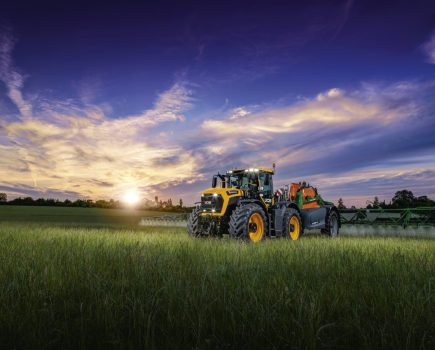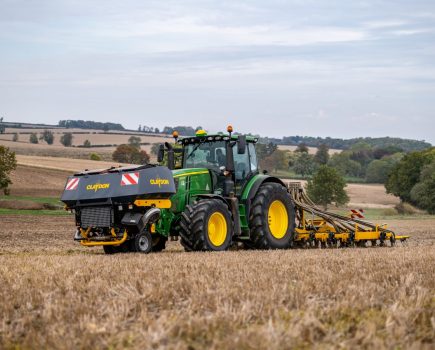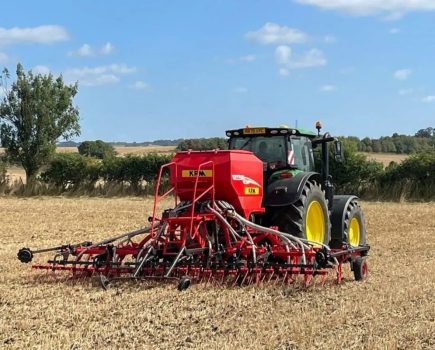


For decades, tractor design was primarily about output, and while that remains highly influential, other productivity elements are increasingly driving the direction of development. CPM examines the alternatives design engineers are adopting to boost arable farm productivity.
“There are potential benefits to be gained from a lightweight battery powered tractor.” FENDT
By Martin Rickatson
Four-wheel drive, quiet cabs, powershift transmissions, electronic linkage and wheelslip controls, rubber tracks – the decade from the mid-1970s to the mid-1980s saw a proliferation of productivity-enhancing technology in tractors.
Arguably the most rapid progress was in power output – with the maximum available at the top of the tree more than doubling – to help large arable businesses cover more ground in less time.
But with the trend towards reduced tillage – in type, depth and passes – tractor manufacturers are increasingly responding to the shifting demands of large-scale arable farms with more than just extra power.
Arable tractor technology developments are being driven by newer concerns ranging from emissions and fuel costs, to soil health and compaction. Then, there are weather window challenges, the growth in farm enterprise sizes, cost, carbon and general environmental benefits of reduced cultivation and chemical use, and difficulties recruiting and retaining skilled operators. Each offers the potential to address some of those challenges.
Solar power
In the early 2010s, Danish brothers Jens and Kristian Warming set out to develop a technology-driven way of reducing the cost and labour requirements of weeding their organic sugar beet crops, combining autonomy and alternative power. Their first prototype was built in 2012, and after securing external investment, in 2018 they launched the FarmDroid v1.0, selling 12 units that year.
In 2019, FarmDroid expanded into Germany, Austria, Switzerland and the Netherlands, selling 38 additional machines, and the product made its first appearance at Agritechnica. By spring 2022, more than 250 FarmDroid robots were operating across 15 European countries, seeding and weeding more than 30 different crops.
The company’s core FD20 model is a fully autonomous, solar-powered precision seeding and weeding robot. Using sub-centimetre RTK steering correction, the machine plants seed and records the placement position of each one. Using as-planted mapping, this latterly enables the same machine to then later be used for not only inter-row weed removal, but also inter-plant weeding.
Although it requires trailering between fields, once set up via field mapping, the FarmDroid is fully independent with four solar panels delivering up to 1.6kWh, equivalent to 20 kWh per day. Surplus energy is stored in lithium batteries that generate enough power for 18-24 hours of daily operation, depending on weather and working conditions. The machine carries on working into the night until the batteries are exhausted, then moves off again in daytime once they’re replenished by sufficient light.
Two electric motors producing 800w jointly propel the FarmDroid FD20 up to a maximum 0.95km/hr, translating into a potential maximum seeding/weeding workrate of 6ha/day.
In March 2022, Lincolnshire-based Opico began selling and supporting FarmDroid in the UK. To help cater for a broader range of soil conditions throughout the growing season, the Danish manufacturer recently introduced A-shares and L-shaped knives to fit to the machine’s inter-row weeding arms.
Where previously the only option had been low-draft weeding wires, the new blades are designed to deal with larger, more mature weeds and to help get closer to the crop without damage.
Opico suggests this is especially valuable when poor weather broadens intervals between hoeing passes, allowing weed growth to get ahead of the crop. The more aggressive action of the new shares also helps to break up capping and surface compaction, particularly in the wheelings, aiding rainfall penetration and providing a flush of mineralised nitrogen for the crop, suggests the firm.
While the initial Farmdroid development was based around seeding and later mechanical weeding with the same machine, the latest development adds spot-spraying ability. As such, the manufacturer and importer aims to extend the FD20’s appeal beyond organic producers to conventional growers looking to reduce herbicide usage, and those looking to apply micronutrients on a field or area basis.
FarmDroid engineers have designed a system that permits both in-row and inter-row product applications, providing targeted doses where required. The system can be configured to apply product to the plants or to the spaces or rows in between, and the manufacturer suggests selective herbicide rates can be cut significantly, with Danish studies pointing to a potential reduction of 94%.
The system also makes possible the use of cheaper non-selective herbicides between the crop rows where necessary, suggests the maker.
Autonomy with diesel-powered electric drives
Other farmers looking to autonomy as an answer to labour-sourcing challenges, but requiring a machine with greater power and traction for deeper work, now have a choice of tractors that require no direct operator but retain diesel engine power for more arduous operation.
As an example, from one manufacturer, AgXeed, there are three designs on offer to cater for different requirements. Imported into the UK by Cambridgeshire-based ASC Autonomy, the three-wheeled, four-wheeled and twin-tracked AgXeed AgBot models are built by the Dutch business that was founded in 2018, beginning commercial production in 2022.
Three-wheeled models are designed primarily for specialist applications, and like their four-wheeled counterparts, are powered by a 75hp Deutz four-cylinder engine. Arguably of more interest to UK arable farmers is the twin-tracked model, the 5.115T2, which features a powerplant of the same make and configuration, but which offers more than double the output, with 156hp of power and 610Nm of torque. Drive to the tracks (or the wheels on electric versions) is via electric motors, and track width is adjustable from 1.9-3.2m.
With regard to implement handling, the AgBot 5.115T2 is largely comparable with other tractors of similar power, with an 8.0t capacity category III rear linkage and a 3.0t category II hitch up front. Up to four double-acting proportional spool valves can be specified, as can a Power Beyond facility, and 85 l/min of oil is available at 210 bar pressure.
As with other robots on the market, the AgXeed models incorporate a multitude of features for maximum autonomous working safety to prevent contact with humans, animals or objects. These include an obstacle detection system combining a LIDAR (light detection and ranging) sensor on top of the machine, plus ultrasonic, radar and contact-sensitive sensors integrated into the safety bumper. These are complemented by visual indicator lights and an audible warning alarm, plus emergency stop buttons around the machine. Boundary geofencing ensures the AgXeed machines cannot leave an operator-set perimeter.
Initial set-up comprises supplier field surveys using GNSS technology, after which the geofences created are uploaded to the new owner’s AgXeed portal account. Partner implements are also uploaded in terms of type, width and other detail. These are then connected virtually to the AgBot in the portal.
Task set-up then consists of selecting a field, choosing an AgBot-implement combination and defining desired process parameters such as working speed, working depth and hydraulic remote valve settings. The operator then selects a desired reference A-B line and the portal then takes over and automatically creates the routing and task, allowing the machine to then be set working.
To underscore manufacturer claims that autonomous tractors are just as capable of complex, high draught tasks as simpler topwork jobs, earlier this year an AgXeed AgBot 5.115T2 working with a Kverneland LO 300/85 five-furrow reversible plough set a driverless ploughing world record.
Balanced with a 1500kg front weight and working for 24 hours, with stops only to refuel, the AgBot ploughed 20.8ha – a task the partner firms suggest would typically require two days with a conventional tractor and plough. Working at 22.5cm (9in) deep, with a furrow width of 40cm (16in), the machine operated at speeds of 5.6-8.0km/h.
Diesel consumption across the 24 hours totalled 382.72 litres, averaging 18.4 l/ha, and is believed to be comparable with, or better than, traditional manned tractors. AgXeed attributes much of this to the efficiency of the AgBot’s diesel-electric drivetrain, plus its path and headland planning abilities.
Natural gas fuelling
For almost 20 years, New Holland parent business, CNH, has pursued what it calls a ‘Clean Energy Leader’ strategy, seeking to develop machines which fit the model of a circular economy where fuel can be derived from on-farm and potentially carbon-neutral sources.
In 2013, following trials with biodiesel and hydrogen fuel cell power, New Holland unveiled a methane-powered version of the T6 series tractor built at its Basildon factory in Essex. Five years later, it announced its intention to put into production a methane version of the top T6.180 model by 2022.
The T6.180 LNG (liquefied natural gas) Methane Power features a modified version of the standard turbocharged and intercooled 6.7-litre FPT six-cylinder engine used in the equivalent diesel T6.180, with no compromise in maximum power (145hp, or 175hp with transport/PTO boost) or torque (740Nm).
The primary difference is in a specific cylinder head for gas injection and spark plug ignition, while ensuring enough gas can be carried to maximise refuelling intervals means several saddle tanks totalling 183 litres capacity (comparable diesel capacity is 230 litres) are integrated around the chassis, supplemented by a front linkage-mounted 270-litre additional tank.
Acknowledging that many modern arable farms require tractors with significantly more than 180hp, in 2024 New Holland announced the expansion of its alternative fuels product portfolio with the debut of the T7.270 CNG (compressed natural gas) Methane Power, built like its T6 sibling at what the firm calls its Alternative Fuels Centre of Excellence – a specialist area of its Basildon factory complex.
Based on the latest ‘T7 with PLM Intelligence’ platform, the larger tractor features many of the same principles and similar technology, such as the 6.7-litre engine, but with peak torque of 1,160Nm and maximum 270hp output under all conditions. The T7’s larger chassis enabled New Holland to maximise on-board gas storage – with a total of 1265 litres (219kg), the T7.270 CNG holds 178% more fuel than the T6.180 Methane Power (455 litres/79kg), considerably increasing productivity and range.
Like its T6.180 Methane Power LNG sibling, the T7.270 Methane Power CNG largely resembles its diesel-powered equivalent, but New Holland engineers made detail changes such as new supports beneath the cab with the battery relocated to the left-hand side, all intended to release space for more gas capacity.
Post-combustion of the methane, exhaust gas passes through a three-way catalyst which ensures sufficient emitted cleanliness without requiring typical exhaust gas recirculation (EGR) or selective catalytic reduction (SCR) treatments. Versus its diesel equivalent, particulate emissions are reduced by 98%, non-methane hydrocarbons by 90%, carbon monoxide by 75%, carbon dioxide by 11% and nitrogen oxides by 62%.
But what are the direct advantages for a potential arable farm buyer? Beyond general pluses including an engine noise reduction, running costs are believed to be up to 30% lower at current fuel prices. Maximum fuel efficiency is said to be achieved at around 1500rpm, so the methane-powered tractor is reckoned best suited to low draught tasks.
Perhaps the greatest potential appeal of methane power, though, is the prospects it offers for release from reliance on external fuel suppliers and exposure to diesel cost variations. There are estimated to be more than 17,000 anaerobic digester/biogas plants now operating in the EU, and a significant number in the UK.
Farm businesses with access to or operating their own anaerobic digestion plants have the possibility to invest in the equipment necessary to tap into the gas they produce as a fuel source, suggests New Holland. Since 2021, it’s been working with Bennamann, a Cornwall-based natural gas power technology business in which its parent, CNH, has invested. Technology developed by the firm allows methane to be collected and processed from AD plants and slurry lagoons for use as fuel, using similar technology to that established in the HGV sector. On-farm fuelling is possible in-situ or via lorry tanker design that enables mobile/in-field deliveries.
Battery-electric drive
Previewed in July issue of CPM following its UK launch this summer, Fendt has taken yet another path to alternative power with the development of its e100 S Vario. Using similar principles to its vineyard-targeted e100 V Vario launched in 2024, the e100 S Vario is acknowledged to have been designed primarily for the utility, amenity and leisure sectors, with size and weight limiting the development of larger battery power packs for heavier-duty tasks.
However, Fendt believes there are potential benefits to be gained from a lightweight battery-powered tractor in certain sectors of mainstream agriculture, especially for those with their own energy production/electricity generation infrastructure.
The tractor’s drivetrain uses Fendt’s established continuously-variable Vario transmission powered by a battery driving an electric motor. In addition to its quiet-running and zero emissions advantages, this permits energy recovery from deceleration or downhill travel, which is used directly to recharge the battery and so extend operating time between charges.
The entire driveline system is again managed by a variation on existing Fendt technology, in this case the brand’s Tractor Management System (TMS), which automatically regulates the motor and transmission to operate the tractor in the most economical manner. The operator sets the target speed, and TMS then continuously adjusts the transmission setting and motor speed for optimised energy consumption.
When the motor comes under load, the load limit control takes over the motor speed and transmission setting. Motor speed automatically rises in response to increased load. As soon as the operating conditions allow, the tractor runs at reduced motor speed.
Maximum power is 68hp in Eco mode and 75hp in Dynamic mode, while up to 90hp is available in Dynamic+ mode, but battery charge limitations mean this can only be sourced for short periods. With a battery capacity of 100 kWh, the tractor is believed capable of 4-7 hours operating time when used in the partial load range, such as for mechanical weed control or planting work. Energy-intensive operations such as trailer transport will reduce this, acknowledges Fendt.
In circumstances where a farm has the facility to generate its own electricity by renewable means, e100 S Vario operation is claimed to be potentially almost CO2 neutral, while the tractor’s running costs are also significantly reduced when compared with a diesel equivalent. With no exhaust gas after-treatment, engine filters or engine oil to service, the cost of maintenance and service parts is also reduced in comparison, suggests the maker.
The more challenging aspects for arable farmers are the machine’s limitations in terms of heavier tasks and its purchase price, but Fendt believes it may well find a place for lighter jobs among users seeking greater energy independence and a way of proving environmental commitment to increasingly demanding produce buyers.
This article was taken from the latest issue of CPM. Read the article in full here.
For more articles like this, subscribe here.
Sign up for Crop Production Magazine’s FREE e-newsletter here.