
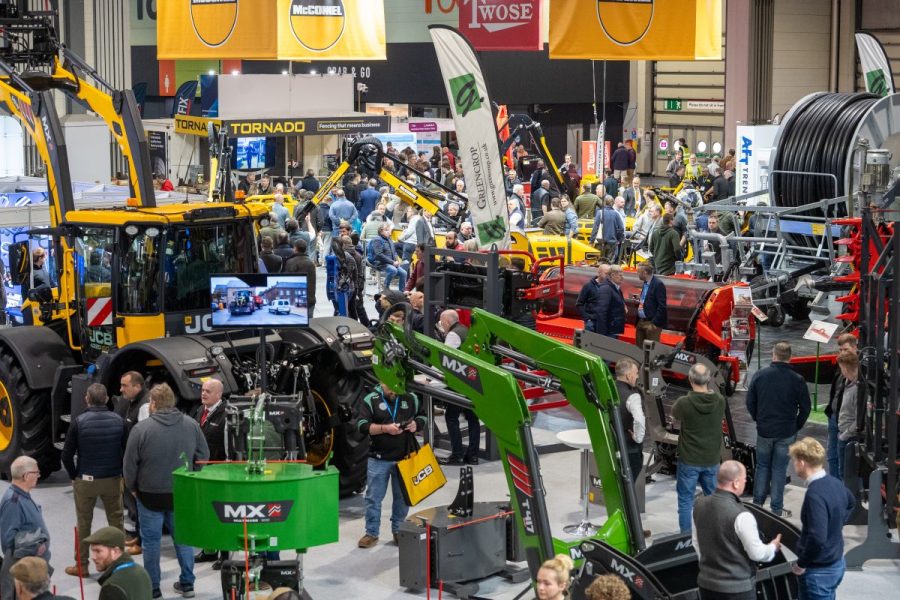
With over 800 stands and more than 45,000 visitors, this year’s LAMMA event has been hailed as the biggest yet. But what had visitors talking in the halls of the NEC? CPM was there to report back…
“Does the industry need to be less Anglo-Saxon in its instinct to own everything?” WILL FOYLE
By Charlotte Cunningham
From the moment the doors opened, it was clear LAMMA 2026 was operating on a different scale.
The familiar walk between halls at the NEC stretched further than usual, footfall was heavier throughout the two days, and the show floor felt consistently busy. Co-located with CropTec and the Low Carbon Agriculture Show, LAMMA spread across more than 12 halls, making it the largest event the show has staged in physical terms.
More than 800 exhibitors were on site, and visitor numbers surpassed 45,000, reflecting both the breadth of the combined shows and the continued draw of a winter machinery event rooted in practical farming.
With major machinery launches, technology updates and a full seminar programme running in parallel, the expanded format created a show that was as much about discussion and decision-making as it was about new kit.
But while walking the halls at LAMMA, surrounded by millions of pounds’ worth of shiny new kit, it can feel almost heretical to talk about restraint. Yet if there was one message cutting through the noise at a booming event, it was this: discipline, not desire, will define the most resilient farm businesses during the next cycle.
A seminar session on fixed costs and machinery policy brought together Matt Ryan of Oxbury Bank, Matt Redman, chair of the NAAC, and Will Foyle of Hutchinsons’ farm business consultancy team to delve deeper into the fundamentals of spending. Between them, they painted a clear picture of an industry operating in mixed conditions – strong in some sectors, subdued in others – but united by one challenge – rising costs that refuse to flex when output or prices fall.
Matt Ryan set the scene from a lender’s perspective. Across Oxbury’s 10,000-plus farming customers, there are few signs of distress, but plenty of variability, he said. “Farming is cyclical and it’s governed by forces largely outside our control.
“What we’re seeing is a fairly mixed bag. Some sectors are having a very good year, others are coming off the back of a tougher period – but there are no real signs of distress. People are getting on.”
Matt Ryan noted that this reality makes understanding cost structures, particularly fixed costs, more important than ever. And yet, as both other panellists acknowledged, many businesses still struggle to define what those fixed costs actually are.
Will challenged the assumption that fixed costs are immovable. He raised that while they may not change directly with scale, they can – and should – be actively managed. Instead, he suggested the problem is visibility. “A lot of farmers don’t really know what their fixed costs are,” he said. “And that can be a little alarming.”
Variable costs are relatively easy – seed, fertiliser and sprays arrive neatly packaged on invoices and can be divided by hectares at the click of a button, he continued. Machinery, however, is another matter entirely. True machinery costs sit across depreciation, finance, insurance, servicing and repairs, fuel use, labour and utilisation – and they rarely reveal themselves in one place.
Will explained that to understand the real cost of a single operation, such as drilling, requires breaking those elements down in detail: how many hours a tractor works across the year; how much value it loses annually; what it costs to maintain; how many hectares the drill actually covers; and what work rates are realistically achieved. Only then can a meaningful cost per hectare be calculated, he said.
Do that properly, and the result can be sobering, warned Will. He then gave an example of a drilling cost of £153/ha, which concealed an uncomfortable truth: around half of that figure was depreciation – a cost that remains largely invisible until a machine is traded years later.
“This is where the industry gets caught out,” he stressed. “We don’t feel depreciation day-to-day, but it’s very real.”
A further complication is that machinery budgets often fail to match the time horizon of the commitment. Hire purchase agreements may run for 3-5 years, warranties for 5-7, yet many businesses still budget on a single-year basis. “People will happily sign a three- or five-year HP agreement,” said Will. “But they don’t always have a budget that looks forward for the same length of time.”
Without a forward-looking view, it becomes impossible to judge whether those commitments remain affordable if cropping changes, margins tighten or support payments fall, he added. That realism must also extend to yield assumptions. “Be realistic is the starting point,” stressed Will. “Nowhere grows 10t/ha wheat every year. If you can only grow eight, make sure your budgets work at eight.”
His parting provocation resonated strongly in a machinery-focused room: does the industry need to be less Anglo-Saxon in its instinct to own everything?
Matt Redman then picked up the theme by examining machinery strategy through a practical lens: do you actually need to own the machine in question?
Using a 400ha arable business as an example, he compared the cost of owning a used combine with employing a contractor. Factoring in depreciation, interest, insurance, labour, fuel and repairs, owning the machine came out at around £164/ha. A contractor, using NAAC pricing survey figures, delivered the same operation for approximately £132/ha.
The difference – £32/ha – equates to a £12,788 saving across the farm. Perhaps more importantly, it removes risk. “Using a contractor makes it far easier to budget,” explained Matt Redman. “There are no hidden costs – no surprise repairs, no depreciation risk, no labour issues.”
If cropped area reduces, for example through SFI participation, contractor costs fall accordingly, while ownership costs don’t.
That’s not to say contractors are always the answer. Matt Redman was careful to stress that flexibility, timeliness and labour utilisation still matter. In tight harvest years, control has a value of its own, and relationships with contractors need to be built, not bought. “We all know how tight labour is,” he added. “Finding someone who can operate that level of technology properly isn’t easy.”
But from a fixed-cost perspective, contracting offers something many businesses sorely need – certainty.
There’s also the wider issue of capital employed. With machinery prices continuing to rise, generating an acceptable return on large sums tied up in iron is becoming increasingly difficult.
“We’re seeing businesses with millions of pounds of capital employed,” said Will. “In some cases, the same work could be done for the same cost without carrying that level of risk.”
The discussion also moved beyond machinery to the broader point that cost control isn’t simply about cutting back. Will argued that productivity is the biggest diluter of fixed costs available – a 25% yield increase spreads the same machinery, labour and finance costs over far more output.
“If you produce more tonnes per hectare, those fixed costs fall very quickly,” he added.
That principle applies equally to variable inputs. Blanket approaches to fertiliser rates, for example, risk spending money for yield that may never materialise. “A lot of people say, ‘I’m growing 10t/ha wheat, so it requires 220kgN/ha,” said Will. “But the question is – have you ever actually grown 10t/ha wheat?”
The panel concluded by stating that the challenge now is to run farming as the business it is: knowing true costs of production, hedging risk, planning machinery investment over 5-7 years, and resisting the temptation to make capital-heavy decisions for emotional rather than economic reasons.
LAMMA will always be a shop window, and rightly so. Innovation matters and it’s what keeps the sector moving and progressing. But as this discussion made clear, the most important machinery decision many businesses will make this year may be deciding not to buy at all – or at least not until the numbers, not the paintwork, stack up.
This article was taken from the latest issue of CPM. Read the article in full here.
For more articles like this, subscribe here.
Sign up for Crop Production Magazine’s FREE e-newsletter here.