
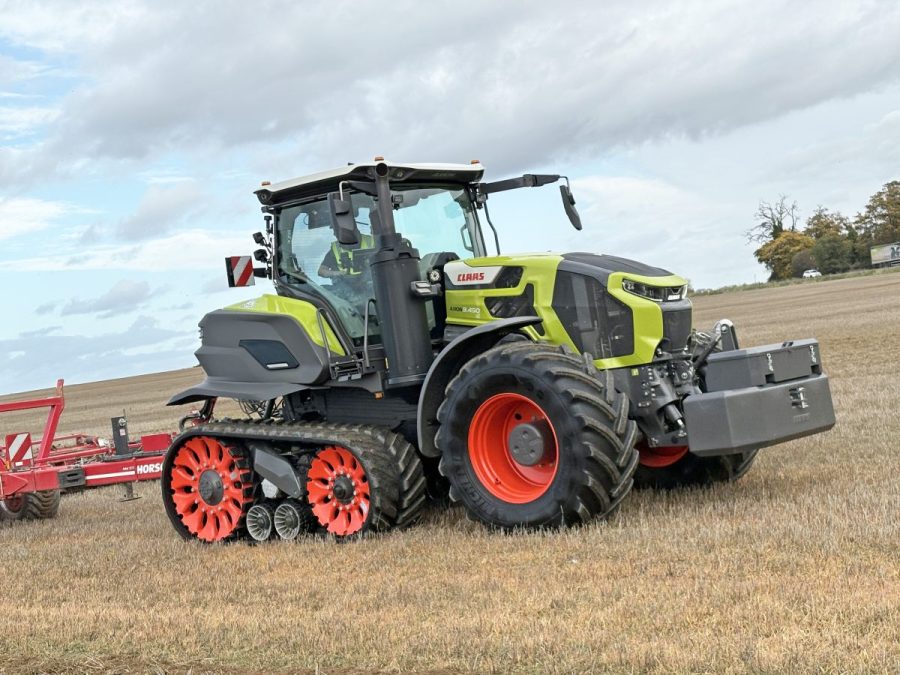
Claas entered the 300+hp conventional tractor sector 15 years ago with its Axion 900. After an interim update and development of a rear track option, there’s now a new Axion 9 range, boldly described as the ‘most important Claas tractor line ever launched’. CPM discovers what’s different.
“This is only the start of where we want to be in conventional high-hp tractors, with further developments in the pipeline.” OLIVER BEEKES
By Martin Rickatson
In tractor manufacturing and marketing, the more powerful the models the fewer contenders there are, and yet, it’s arguable the competition is much tougher. While the sub-100hp market is supplied by a multitude of makers, in the 300-450hp sector there are only a few players, with two shades of green being dominant.
As neither of those is the ‘seed green’ of Claas, the company suggests its latest development is intended to address that.
The German firm has been a full-line wheeled tractor player since 2003, and aside from its largest Xerion models, builds all of its 75-450hp mainline tractors at its Le Mans plant in France, manufacturing 200,000 machines there during the past 22 years.
The site has been subject to significant recent investment, with €6.5m spent this year alone beginning creation of a new 3800m2 ‘multifunctional production facility’ to support planned tractor production expansion during the next decade.
That spend is part of more than €80M invested to date on the site since its acquisition. In addition, a new product test and evaluation centre will, says Claas, speed up development and boost machine reliability, with the aim of growing the contribution tractors make to its overall turnover.
The firm says it wants a significant part of that to come from arable tractors that match customer expectations of its combines and foragers, and meet the demands of tractor operators, who are increasingly influential in purchase decisions, notes Patrick Frawley, Claas UK product manager for large tractors. This, he believes, makes this the most important range Claas has launched in its tractor history.
“When we released the first Axion 900 series in 2011, the 445hp top model was then the world’s largest standard tractor, so we signalled our intentions in this sector,” he says.
“The 2020 introduction of Terra Trac rear-tracked versions of the 930 and flagship 960 helped in getting us onto large farms of customers who perhaps had Claas combines but not tractors, or were completely new to us.
“There are now 80 Terra-Trac 930 and 960 Axion models on UK and Irish farms. With the new Axion 9 series, the standard wheeled tractors and the two Terra Trac models all receive significant upgrades in response to customer comments, and we believe brings to these tractors the premium build they expect from our combines and foragers.”
The demand for more comfort for operators and reduced ownership costs for customers were key feedback drivers behind the Axion 9 design, claims Claas, acknowledging criticisms of its previous cab and continuous demands for cheaper running. This led to the adoption of four ‘design pillars’: efficient performance, uptime and profitability, operator centricity, and assistance and automation.
As before, there are five models, but each gets a slight maximum power tweak to span 326-448hp. Engines continue to come from FPT, whose 8.7-litre Cursor 9 engine features on all models, housed beneath what Claas calls its new ‘visor’ bonnet styling. A fan reverse function is now optional, and wheeled models get more fuel capacity, with a design target that a full tank is sufficient to operate at 90% engine load for 12 hours.
“Engine component upgrades mean the service interval is extended by 25%, from 600 to 750 hours, significantly reducing total cost of ownership,” adds Patrick.
“Complemented by elimination of the initial 100-hour service and other areas where we’ve been able to lengthen service intervals, servicing costs have been cut by 18%. With a 600hr interval, nine services are required over five years/5000hrs, averaging £3.71/hr. With 750hr intervals, only seven services are required, and although the average service cost is slightly higher, the longer interval reduces cost to £3.14/hr.”
The engine drives through a ZF TMG45 continuously-variable transmission, currently used exclusively in the tractor sector by Claas. Transmission filter change is also extended from 600 to 750hrs, with an oil change at 1500hrs, up from 600hrs.
The transmission incorporates the automatic stretch brake feature first introduced on top-end Arion models, with sensors that monitor engine and transmission loads to automatically activate trailer air braking should the gravity force of a trailed implement exceed a pre-determined load on the drivetrain.
An Agritechnica silver innovation award winner, the adaptive driveline management system uses torque sensors throughout the driveline to enable the tractors to automatically govern the engine and transmission pairing for maximum fuel efficiency or workrate.
In ‘Auto Load Anticipation’ mode, the system notes the power requirements and load jumps during a first field pass with, for example, a cultivator. During subsequent passes, engine speed and gear ratios are then automatically adjusted before these load jumps occur.
‘Fuel Optimised Load Control’ ensures the engine is always operated along the curve creating the lowest specific consumption in the partial load range. Conversely, ‘Auto Droop’ is aimed at full load, and ensures maximum possible power is always delivered to the transmission at the work-specific nominal speeds.
‘Hydraulic Flow Adaption’ enables the tractor to recognise whether current oil delivery is sufficient for implement demands, while ‘Engine Boost Management’’ continuously analyses the power actually flowing from engine to the PTO and transmission. If necessary, power is adjusted so permissible torque limits aren’t exceeded at any point in the drivetrain. Interaction between these sub-functions is said to maintain a balance between minimum fuel consumption, maximum power delivery and optimum handling.
The other key change to all Axion 9s is the revised operator accommodation, claimed to be the biggest in its class, with a volume increase of 17% helped by 8% broader width and 6% greater length.
Claas also claims the largest rear window on the market and a 30% wider door threshold to aid entry and exit. Four-point mechanical cab suspension has been retained but completely overhauled, with a new kinematic design that pre-empts motion effects, while sound levels have been reduced to 67 decibels, thanks to better soundproofing and a new transmission casing.
New electronic architecture incorporates all the key operating features into the revised right-hand armrest’s Cebis terminal, with ‘connect’ capability to wirelessly transmit operating data to the Claas connect online portal, and a feed from up to three cameras. The armrest also incorporates a new configurable Electropilot joystick capable of handling up to 38 functions when combined with main CMotion joystick, and the latter now allows users to make incremental speed changes with small left or right movements.
Implement handling capability is largely unchanged, although there’s a new 370 l/min hydraulic package option in addition to the standard 220 l/min, plus new hydraulic lift arm stabilisers. Fully-wheeled and front-wheeled models can be ordered with automatic front axle lubrication and a central tyre inflation, while the 448hp 9.450 and 360hp 9.360 tractors specified with the rear suspended Terra Trac option now benefit from new units featuring multiple enhancements. They include new clear caps for idler and midroller lubricant checks, and enhanced bearings to reduce drag.
Oil change times have also been reduced by 75%, and intervals increased from 600 to 750hrs. New ‘puncture resistant’ belts are made of extra-tough material for those working in very stony soils, while a new drive wheel pad tread profile is said to boost friction performance in wet conditions.
“This is only the start of where we want to be in conventional high-hp tractors, with further developments in the pipeline, such as autonomous operation capability,” states Oliver Beekes, head of tractor sales at Claas UK.
“We recognise the strength of others in this sector, but with these enhancements and established features such as the all-round suspension package of our Terra-Trac models, we believe we have some unique selling points.”
This article was taken from the latest issue of CPM. Read the article in full here.
For more articles like this, subscribe here.
Sign up for Crop Production Magazine’s FREE e-newsletter here.