
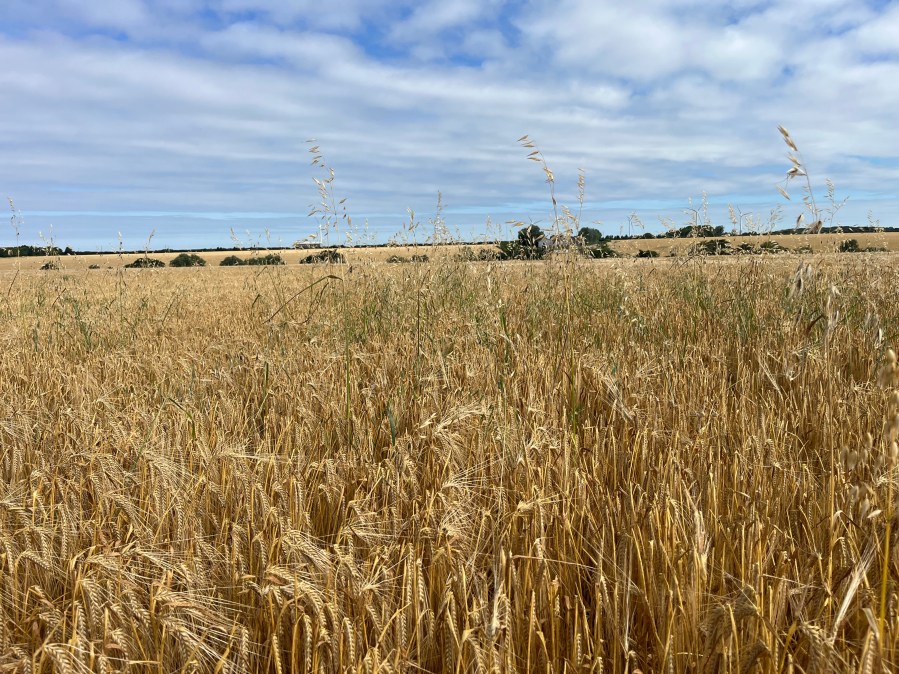
Controlling anticipated wild oat populations in spring cereals before they emerge is key to preventing yield losses, stresses weed expert, Dr Will Smith.
As happened previously with autumn-sown winter cereals, there’s a gradual shift towards using pre-emergence residual herbicides as part of weed control strategies in spring cereals, he highlights.
“Post-emergence herbicides are no longer quite as effective, whether through resistance or inconsistency around application technique or weather, making it difficult to hit the target weed with the active substance.”
Condition dependent
Conversely, the risk of using a pre-emergence residual is that most require moisture to be activated, which is less guaranteed than in the autumn, adds Will. “It’s why the performance of products in the autumn isn’t necessarily replicated in spring conditions due to drier seedbeds.”
He points out that Gowan’s Avadex (tri-allate) is one of the exceptions, in that it’s activated in a slightly different way – entering a gaseous phase rather than solely depending on soil moisture for activity.
That gives higher relative efficacy in dry conditions compared with other actives, says Will. The product can also be applied pre-sowing of spring barley, potentially in mix with glyphosate, and then incorporated by cultivation or with the drill.
Yield impact
While blackgrass and Italian ryegrass remain important targets, wild oats are the most damaging from a yield perspective, even at low populations, reminds Will. “They are one of the most competitive weeds and so have a more direct impact on yield in season than other weeds.
“By removing them pre-emergence, they never have the opportunity to compete with the crop, whereas if you wait 4-6 weeks until the wild oats are 2-3 leaves, even at that young stage, our trials have shown you can be losing as much as 15% in yield.”
Avadex is particularly active against wild oats, he adds, which means growers should get good value from either Avadex Excel, or liquid formulation Avadex Factor.
Agronomic perspective
Rutland-based independent agronomist, Ben Mead of Smart-Ag, typically uses a pre-emergence spray in spring barley, depending on drilling date. “Where it’s been established in February or up to around the middle of March, as long as we have moisture, there’s a benefit from using a pre-emergence,” he says.
His main grass weed target is blackgrass, which he finds after the middle of March is more difficult to control with pre-emergence herbicides. “Applying residual herbicide onto a drying or dry soil doesn’t get the best out of it.”
For wild oats, he uses a combination of either Avadex, especially where he knows he has ACCase resistant wild oats, or a post-emergence treatment of one of the ACCase herbicides, pinoxaden or fenoxaprop-P-ethyl.
“Avadex is better than anything else pre-emergence on wild oats,” he says. “I’ve usually followed up with a post-emergence, but it helps reduce the population.