
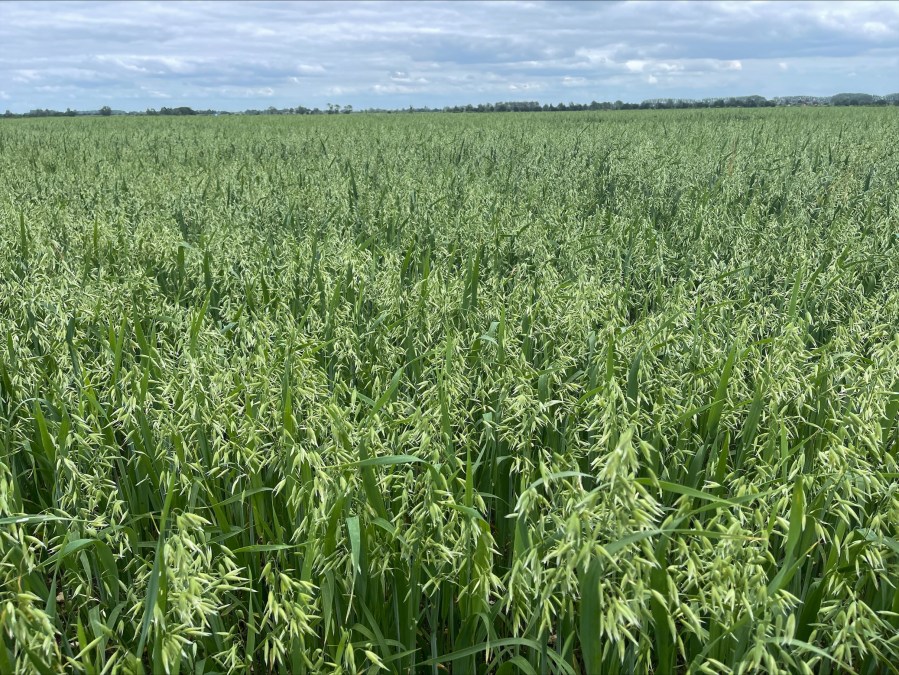
New independent trials conducted last year reveal that spring oats grown with fewer inputs can deliver higher grain quality.
The work showed that for both treated and untreated plots, variety Merlin produced the highest yields, clean samples, and more resilience.
Dominic Amos, research agronomist & natural capital specialist at Cope, says the trial data also indicates that the specific weight of untreated Merlin outperformed treated crops, demonstrating its ability to be grown in lower input systems.
“Merlin has shown consistent performance across a wide range of farming systems, from organic, to low input and conventional programmes. The key difference is that Merlin doesn’t require additional inputs to produce clean, marketable grain, giving growers greater flexibility in how they manage the crop,” he says.
UK trials
The trials took place at Agrii Throws Farm Technology Centre in Essex, and Revesby in Lincolnshire. Growers and agronomists reported that Merlin had:
- The highest treated and untreated yields overall
- Higher grain quality – including the highest specific weight in untreated trials
- Cleaner, lower disease crops without fungicides
- Stronger standing power and earlier maturity
- Better crop health in untreated systems
In the untreated trials, Merlin achieved 120% versus Isabel at 99% of control at Revesby, and 113% versus Isabel at 86% of control at Agrii Throws Farm in Essex.
“With only 8% lodging, Merlin held its position as one of the best-standing varieties,” adds Dominic. “Its earliness also helps it to cope better in spring droughts compared with slower developing varieties.”
Merlin continues to be accepted by all mills across the UK for its high grain quality, including low screenings, which are the lowest of any variety on the Recommended List.
Additionally, Cope samples – tested internally from growers this harvest – show that organic oats in general have a higher average specific weight than conventional oats, with a difference of around 2.5%.
Farm testimonials
Following two contrasting seasons, including the drought-affected 2025, Phil Gordon-Jones of Fir Farm in Cheltenham, says Merlin has delivered reliable yields and resilience in organic conditions.
“We’ve been very happy and surprised with how well Merlin has grown, especially during a season like 2025. In 2024, we had just under 5.5 t/ha, and with drought in 2025 it dropped to 4t/ha – still very good for an organic oat,” comments Phil.
Highlighting grain and straw quality from an organic system, John Cresswell from Northumberland says Merlin stood out for its cleanliness and overall sample quality.
“The crop was exceptionally clean – remarkably so for organic – and the straw quality is the best we’ve ever seen. The grain in store is clean, plump and analysed very well. We’ll definitely grow Merlin again,” he says.
Then in Somerset, Merlin was used flexibly for both forage and grain. Theo Coleman of the AH Warren Trust says the variety consistently outperformed alternatives.
“Merlin established well and performed well even in such an adverse season; it’s a step ahead of Isabel and always my first choice for spring oats. “Merlin served two roles this year: whole-crop for forage, and grain. It was the cleanest crop we’ve grown in a long time – it looked like a conventional crop, not organic,” he concludes.