
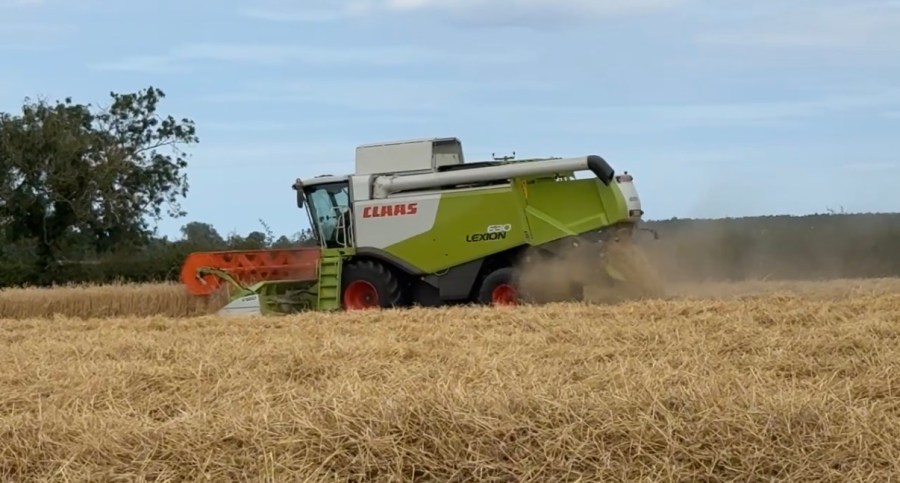
Despite prolonged drought and heat resulting in significant yield losses for most crops this season, there was better news for hybrid rye growers, with many reporting high yields.
That’s according to Philip Marr, renewable biomass consultant for Agrii, who says the agronomic benefits of hybrid rye have been well advertised for many years, however it’s recent times that have brought the crop’s potential into sharper focus.
Philip manages hybrid rye trials at Agrii’s Brotherton iFarm at Knottingley, looking at more than 150 rye varieties during the past 16 years. “SU Karlsson from Saaten Union and Elsoms has topped the trials during the past three consecutive years in both freshweight and biogas yield categories,” he notes.
Although AD is still currently the biggest end market for rye, SU Karlsson has also recorded high grain yields, making it a true dual-use variety suitable for both the grain market too, adds Philip.
“With more biomethane injection and AD plants in development during the next two years, along with changing UK weather patterns, hybrid rye seems ideally positioned for growth as long as market demand crop continues to rise.”
Dundee
Hamish Knottenbelt, arable manager at Peacehill farm near Wormit in Dundee, works with Philip and sees hybrid rye playing a bigger role in the farm’s future. “We currently grow 280ha of hybrid rye, representing just under a third of our total cropping, with a plan to increase that area to 400ha for Harvest 2027.
“It fits neatly into the rotation as either a second cereal or following potatoes – if it’s early enough – and is grown as wholecrop for the farm’s own bio-digester plant.”
A 67ha area of Karlsson was planted around 9 September last year, with the crop growing away well. “The variety ticks all the key boxes – low input costs, good biomass production, high brown rust resistance and a phenomenal ability to find moisture, even when there was virtually no rain between April and July.
“Harvesting occurred between 6-10 July, achieving an average freshweight yield of 51.03t/ha. It looks an exceptionally good variety, and we’ll be substantially increasing our area of it this autumn,” says Hamish.
Northallerton
Over in Northallerton, Wayne Hardy has been growing hybrid rye for grain for six years. Farming 113ha at Hall Farm near Hutton Bonville, he currently grows 30-40ha of rye per year, all supplied to local pig producers for incorporation into rations.
“Hybrid rye is a flexible, reliable, low input, semi-break crop that produces a lot of straw and fits the second cereal slot extremely well, given it has very low susceptibility to take-all.
“We drilled 32ha of Karlsson into a combination of medium-heavy loam soils on the 23-24 September last year. The crop established nicely, wintering well before kicking on again in early March after we’d applied 90kgN/ha of liquid nitrogen with an inhibitor.”
In late April 7kg/ha of Physio-N was applied – a slow release foliar nitrogen treatment designed to help the crop to cope in stress situations, added Wayne. “This proved an excellent strategy following continued hot, dry conditions through May-July and the crop stayed green long enough to give me confidence that it was always hanging onto enough moisture to keep going.
“Cutting on 29 July, the average yield was 9.58t/ha with the drought not impacting negatively on either straw yields or grain quality,” he confirms.
Agrii crop nutrition specialist, John Charlton says Karlsson’s speed of development through autumn and winter enables it to suppress weeds. Equally, with a 7 for resistance to brown rust, it offers proven disease resilience.
“It topped both the AHDB trials plus Agrii’s own trials, and consistently replicates those results in commercial farm situations,” he says.
Exmouth
Farming 140ha just outside of Exmouth at Nutwell Farms Limited, Ben Pritchard is a relative newcomer to hybrid rye. He says adding hybrid rye to the rotation in 2025 has been an excellent decision for the business.
“We direct drilled 36ha of Karlsson into both good quality medium soils and a challenging block of heavy, clay land last autumn, with the final harvest results between the two sites showing very little difference in yield – despite the soil variation.
“Hybrid rye is superb on autumn weed control, it establishes rapidly and is able to outcompete our weed burden. With a two-spray fungicide programme and just two main splits of nitrogen totalling 130-140kgN/ha, there are fewer passes through the crop, promoting soil health and eliminating soil compaction issues.
“The low input levels are obviously critical for maintaining profit margins and given I have other business interests away from the farm, it’s always nice to have one crop I don’t need to worry about,” he comments.
Agrii agronomist Tom Bernhardt currently advises a number of Karlsson growers, including Ben. Working with farmers who predominantly crop on lighter soils, he sees significant opportunities for future growth in the hybrid rye sector with the recent hotter, drier weather a potential catalyst for rotation change.
“Ben’s approach to growing more hybrid rye and dropping wheat from future rotations isn’t an isolated case by any means. The performance of hybrid rye, even on lighter land across several dry years, has been remarkably good when compared to other cereal crops,” says Tom. “The sharp rise in nitrogen costs is also a big factor when you consider that most growers will apply about 100kgN/ha less on hybrid rye than on a comparable area of winter wheat.”
Tom believes one barrier for rye is that many growers see it as purely wholecrop for AD, without necessarily considering other end markets. “The very high protein levels in rye grain exceed anything else in the grain market, so growing it for animal feed has to be worth a look – particularly if a farm is located near commercial pig units that mill and mix their own feed.”