
A Lincolnshire farm has completed its first harvest from what’s believed to be the most northerly commercial olive grove in the world.
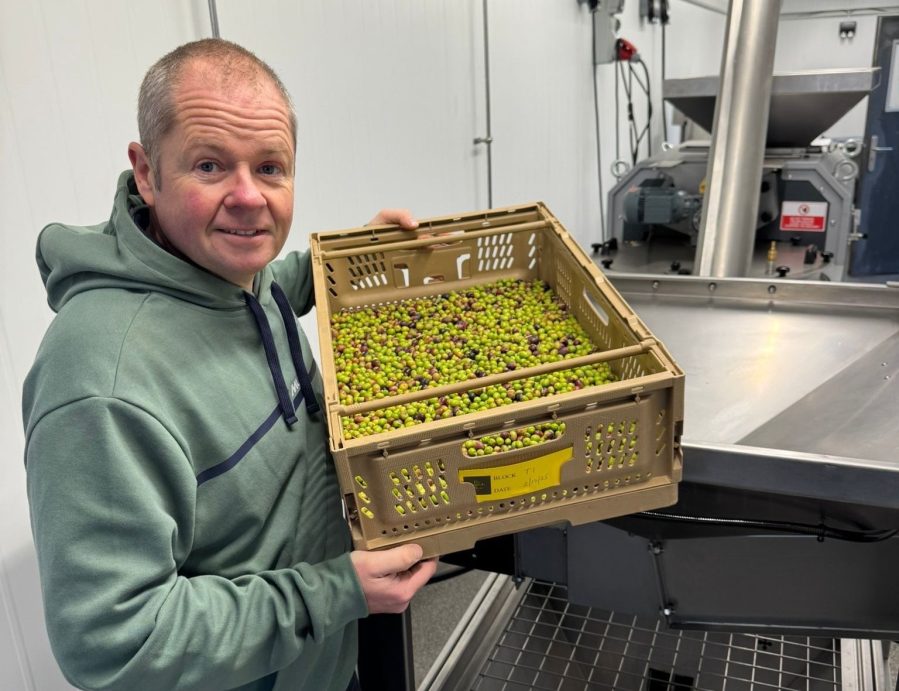
The English Olive Co, near Spalding, has harvested its first fruits from 10ha planted in 2024, and is now processing using the UK’s first on-farm olive press and bottling line. This puts the business on track to produce the first commercially pressed English olive oil.
High quality
The olives were hand-picked by David Hoyles’ family and friends and taken to the press within hours, ensuring they were processed quickly to preserve the highest oil quality, he explains.
“We were pleased to have our first, albeit small, harvest, but it does show that olive trees can flower, fruit and mature on a commercial and field scale in the UK,” says David.
“Unfortunately, the recent frosts and strong winds and rain knocked off some of the olives, and the size of the fruit is smaller than the traditional growing areas of the Mediterranean, but the taste profile of this 2025 crop is fantastic – grassy, fresh, piney, with a very good peppery kick at your throat, due to fantastic polyphenol levels.”
Much potential
He points out that the supply of his English olive oil will be limited in this first year, but as the trees grow and increase in maturity, olive numbers, and hence volume, should also increase year-on-year.
“Following the mild, but wet and cloudy disappointing weather we all experienced in 2024, 2025 has been good for the olives. They flowered in July and the fruit grew well over the summer.
“I was unsure how ripe olives would get in UK climate, but with summer conditions really stretching out into October, they’ve turned a good blushed green colour, and this has helped the flavour profile. It’s a shame that the frost and wind have impacted yield, but we’re still learning and will continue to give the trees our best efforts going forward.”
Futureproofing
David explains that the decision to plant olives came from a desire to futureproof the family farm against shifting weather patterns and rising volatility in traditional crop markets.
“We wanted long-term security in food production. Some of our existing crops were struggling with the hotter, drier conditions, so we looked for alternatives more suited to a warming climate.
“Admittedly, we’ve pushed this to the extreme, but olives fit that brief. They’re resilient, thrive in heat, and allow us to diversify with a crop we can process and market ourselves.”
He believes the move also gives the family greater control over pricing, reducing exposure to commodity volatility, while providing a succession opportunity with multiple generations involved in the project, from orchard management to pressing, branding and marketing.
In terms of production, the olives are grown using low-input farming practices, including water-efficient drip fertigation and no use of insecticides or fungicides.
Scaling up
As the grove matures, production is expected to scale, with the aim of expanding English-grown olive products to meet rising consumer demand for sustainable, local food, adds David.
“When the volume of olives increases, we hope to invest in a self-propelled harvester in place of hand harvesting,” he says.
The English Olive Co will offer limited batches of olive oil for purchase exclusively through its online shop, available while stocks last. For more information, visit www.englisholive.co.uk
Read more about David’s venture in this recent CPM article.