
by Andrew Wilson
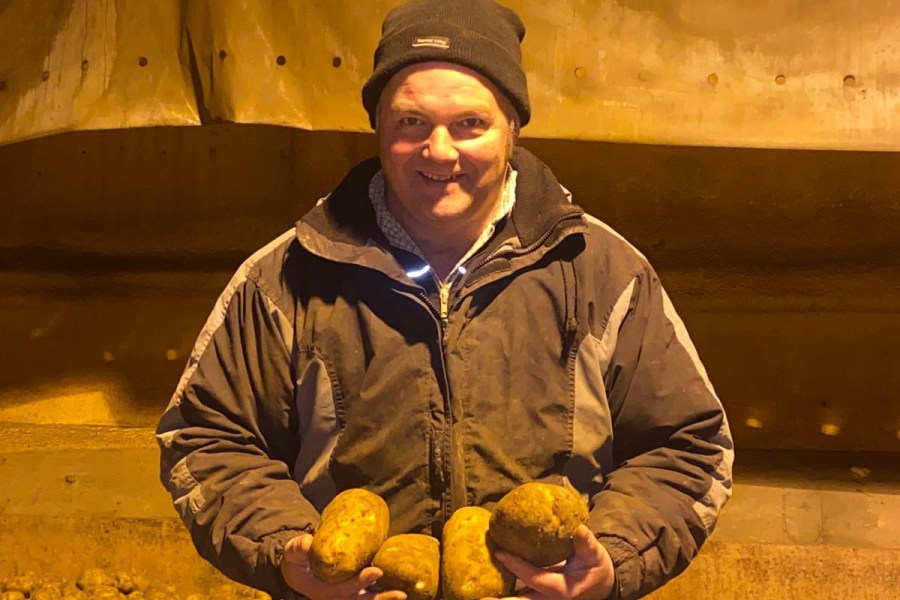
So where did we finish up with our taty harvest this time? 14 days, 6.5 people, 7435 litres of fuel, 3018t, 67ha lifted and very little road brushing required – it could have been worse, that’s for sure. We’re a few percent short of our contract yields, but it’s fair to say our worst crops were better than feared and the best a chunk better than hoped for.
It’s that time of year when I ask ‘why’ a lot and dissect the season. It’s obviously too late to change anything, but what consistently works? What’s always trailing behind? Is it a particular variety? Block of land? Product applied? Method of working?
Like most, we grow different varieties for varying reasons: movement and cashflow, strategic nematode management, financial rewards, storability, market demands, risk management and sometimes just plain old consistency.
I don’t foresee major changes next year, but when I look back over time, we’re always tweaking something. Conserving seedbed moisture has been fundamental in getting any kind of performance this year.
Physical organic matter has again proven its value in retaining moisture through the dry spells, but also in allowing effective percolation during heavy showers, which alongside poor man’s row damming, has all but eliminated ponding in low spots and enhanced tuber quality to boot. That same OM from cover crops and muck has also reduced cultivation and reduced moisture loss this time too.
Biostimulants and foliar nutrition seem to be consistently discouraging rhizoctonia, but what looks more challenging for 2026 is blight control. With our last multi-site gone, resistance management will be more challenging, with alternaria more likely to appear.
As I’ve pointed out before, I’m a simple soul, so let’s strip mancozeb back. First introduced in 1962, part of its makeup included manganese (easily enough replaced), copper – the mainstay of organic blight control, and zinc. Zinc is probably as underrated a nutrient in potato production as calcium used to be, and an important contributor to tuber quality and crop yield.
To that end, we had a trial this season while we still had some mancozeb to use up on the majority of crops, to lessen the risk. I applied the aforementioned nutrients whenever I’d normally apply mancozeb. Did it work? Well, blight pressure was for the most part low this season so it’s difficult to measure. But my gut feeling and common sense tell me that those nutrients were part of the fungicidal effect way back when ag-chems were simpler than today, and were clearly in there for a reason.
Next season will again see a reduced armoury of chemicals at our disposal and undoubtedly higher costs, so will this financial drain and higher risk be mirrored in contract prices in a few weeks? If the background noise and low free market price is anything to go by, then I doubt it. Attention to detail will be as important as it’s ever been.
Cultivar choice and plant breeding will play a more significant part of risk management going forward, but we’ve a long way to convince our markets to break long set habits of using yesterday’s varieties, and it’s hard as a grower to know how we can influence this – we could do with another Delia moment!
As summer predicted, a high physiological age has meant a start to in-store sprout control a month earlier for us than last year. Some varieties are much livelier than others, which is more down to canopy state at the application of maleic hydrazide than anything else.
It’s my belief that the high temperatures last summer did more damage to this season’s results than the lack of rain did. It’s manageable though, and we have a choice of options that I didn’t expect after we lost CIPC a few years ago.
Technology is a funny old thing. I’m old enough to have gone through school and most of college without a computer, but have ridged potato land up via RTK autosteer since 2007. We’ve trialled yield prediction modelling, variable rate fertiliser and seed, made a few pretty pictures mapping that we’ve then never looked at again sometimes, and been frustrated with weather stations and erratic moisture probes.
So, will the new kid on the block that can measure yet more things quicker than ever before be the way forward, or will this dinosaur stick to the good old SMART test of the 1990s? Watch this space…
I remain optimistic about UK potatoes, and as a grower now in my 50th year, I’m still a pup! I’m still willing to invest in infrastructure, mostly in a bid to make it easier to do a better job. In the short-term that means seed facilities, and in the longer term, subject to abstraction rules and the inevitable funds required, modernising our arguably archaic irrigation systems. But to do this, we have to make enough profit to facilitate such investment.
In any case, my earliest memory of rubber-stamping potato bags and sippiting spuds was as a kid in 1984, it’s been a part of me forever. The idea of not being a part of this industry doesn’t excite me – I must enjoy the hassle too much.
Conference season is now in full swing, and after BP2025 last week, I’m looking forward to CUPGRA in a fortnight – there’ always lots to learn and undoubtedly craic to be had. Before that we have three Red Tractor assurance audits for potatoes, combinables and pigs. I just can’t stop enjoying myself, can I?
Have a good one.
This article was taken from the latest issue of CPM. Read the article in full here.
For more articles like this, subscribe here.
Sign up for Crop Production Magazine’s FREE e-newsletter here.