
The long-term impact of frequent droughts has implications beyond hosepipe bans and the suspension of irrigation licences, and can particularly affect root crop growers. CPM reports…
“By working together now, growers have a better chance of challenging licence reforms in the future.” MELVYN KAY
By Andrew Watts
Record dry weather for much of the year has led the National Drought Group – a body comprising industry, experts and the regulator – to warn that unless there’s at least average rainfall this autumn and winter, England must prepare for an ongoing drought in 2026.
To highlight the severity of the situation, the Environment Agency warned that ‘England cannot continue to take water for granted,’ while reiterating its commitment to ‘reduce the use of public water supply per person by 20% by the end of March 2038 to protect the environment and secure drinking supplies’.
A proportion of these intended savings should come from fixing leaky pipes – which account for around 19% of supply-side losses, and the government is working with the water utilities to cut these losses by 50% compared with 2017-18 levels. Households too are under scrutiny to use less water, while agriculture is under pressure to improve its water use efficiency.
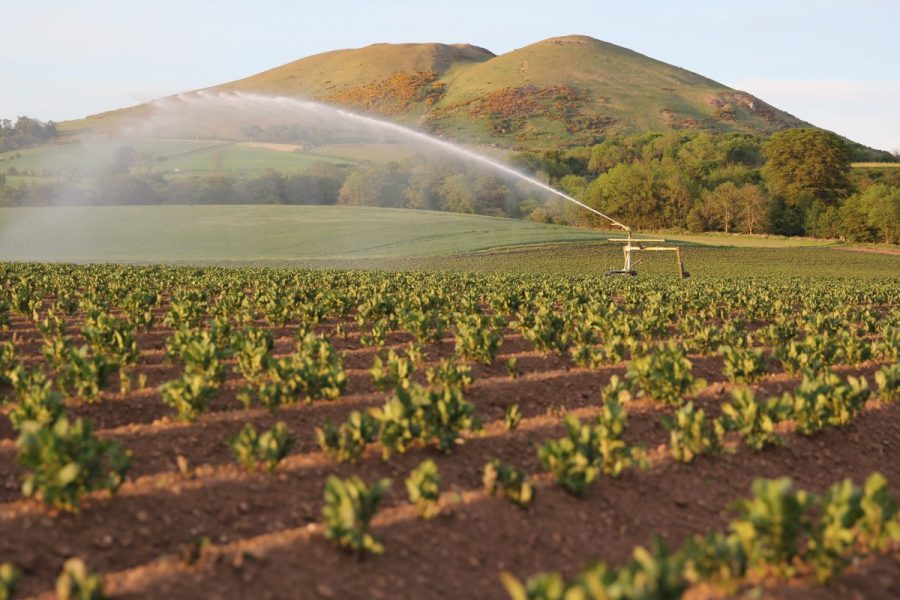
“Most growers could improve water use efficiency by 20-30% without difficulty simply through stemming losses, more targeted application timing and better scheduling,” suggests Eric Anderson, senior agronomist with Scottish Agronomy.
“Importantly, users have to appreciate that the variation around the mean water requirement is greater than the mean itself, so growers should base assumptions on the extremes in demand, not the average,” he adds.
Few would question the need for better resource allocation and greater efficiency; the concern is how it’s achieved and at what cost to those farmers whose livelihoods depend on it.
“The longer-term issue is the environmental destination being set by the Environment Agency (EA),” says Melvyn Kay, executive secretary at the UK Irrigation Association (UKIA).
The EA is modelling a range of scenarios to inform policy intent on ensuring sufficient water availability in 2050 and 2080. It’s already announced plans to cut volumes taken by licenced abstractors by an average of 30%, but actual cuts vary across the country.
“Many of the measures either announced or under consideration should be seen as prudent forward planning. This is reassuring as it means we should avoid a crisis, but those reliant on abstraction to irrigate crops will feel aggrieved at the loss of volume,” comments Melvyn.
To give water users across the regions an understanding of the possible cuts to licences in their area, the EA has set up a website with forecasts of availability where users can see the river flow allowances in their catchment – see environment.data.gov.uk/hydrology/explore
“To be fair to the EA, it’s not claiming to have all the answers. Its forecasts illustrate the potential impact and its severity, but these will be amended as more data is generated, and the model is updated. For some, the impact will be less than feared while for others, it may be worse,” states Melvyn.
To help mitigate the impact on those affected, the EA is supporting a programme of Local Resource Options (LRO) whereby it’s providing a sum of money to fund scoping studies at the catchment level.
“It may be that there’s water available in the catchment that doesn’t appear in the national hydrological assessments, such as floodwater, drainage water or harvested water from roofs and tunnels that can be utilised by growers to improve resilience,” adds Melvyn.
Many of the reforms being implemented mean the process of managing licences is becoming more complicated. For abstractors with no resource planning expertise, the EA in partnership with the NFU, the UKIA and Water for Food, is supporting the creation of Water Abstractor Groups (WAG).
“Some of the larger groups were formed in the early 2000s and have been instrumental in helping to challenge the EA’s assumptions and protect the licence holder’s rights through the collection of valuable data and alternative modelling. Hopefully some of the smaller groups will follow suit.
“By working together now, growers have a better chance of challenging licence reforms in the future, or supporting applications for abstraction. Such data is also useful documentation when applying for a grant, perhaps for a reservoir or other form of storage,” says Melvyn.
Other initiatives are bringing abstraction into the digital age. At a trial on a river in Shropshire, sensors have been installed to give local abstractors real-time data on when water is available. In catchments where there’s large demand, the use of such technology can help ensure that those downstream don’t lose out at the expense of abstractors upstream.
“If you know those upstream will stop irrigating in the afternoon, you can plan your activities accordingly. It’s a neat example of how savvy use of technology and good communication between users is helping to support better planning and greater resource efficiency,” he says.
While the long-term implications of these policy changes are still to play out, growers are being encouraged to consider how the increased risk of drought might impact their business and identify the measures required to mitigate it.
As such, growers should estimate their likely maximum demand for the crops they’re growing and then identify the level of preparedness they consider necessary, suggests Eric.
“Is it a one-in-a-100-year event? Probably not. This would be overly cautious while the cost of building a reservoir for such a situation would be extreme. It’s more likely to be a one-in-10 or one-in-five-year event,” he adds.
“Unfortunately, if you were then to take the average evapotranspiration rate for your crop over the past 25-30 years as a guide for how large your reservoir should be, you’d end up being short of water in many of the years in your one-in-10 or one-in-five scenario.
“Worryingly, the current modelling indicates that these scenarios are likely to be the average in the coming decades, rather than the extreme, meaning storage capacities based on these calculations will leave growers facing a shortfall in most years assuming there are no changes to the cropping area,” he concludes.
This article was taken from the latest issue of CPM. Read the article in full here.
For more articles like this, subscribe here.
Sign up for Crop Production Magazine’s FREE e-newsletter here.