
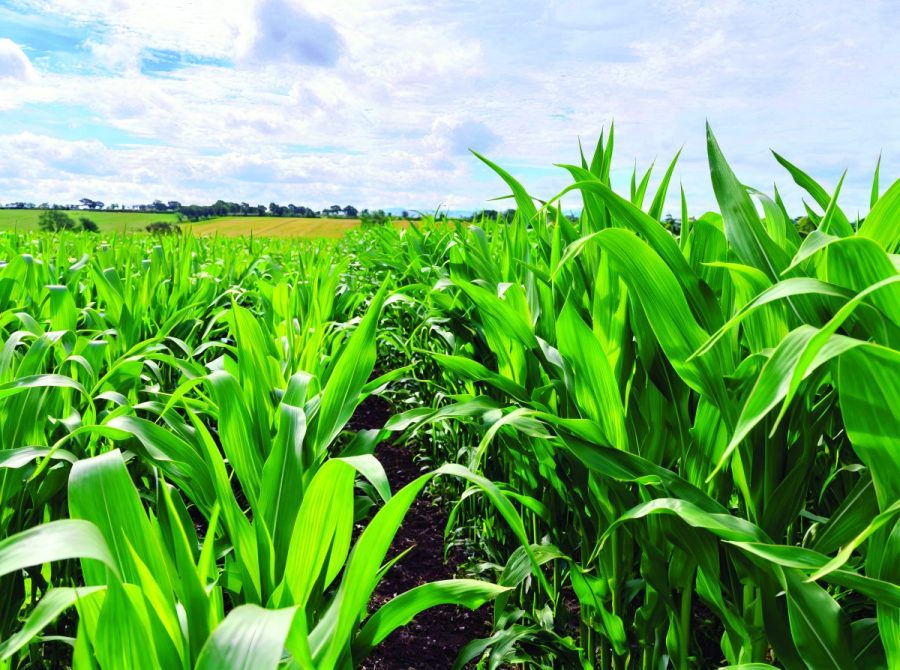
With maize margins attracting attention and AD demand strengthening, CPM explores how soil structure, drilling conditions and early nutrition are proving decisive in converting potential into profit.
“In maize, early vigour sets the trajectory for final biomass.” STUART SUTHERLAND
By Charlotte Cunningham
With continued demand from anaerobic digestion (AD) plants, significant grain import volumes and steady breeding progress delivering earlier-maturing hybrids, maize is becoming an increasingly influential part of arable rotations.
Gross margin comparisons are understandably turning heads – in some scenarios, maize can deliver 2-3 times the margin of alternative spring break crops such as spring oats or spring beans. Add to that its value in spreading workload and its alternative herbicide chemistry – particularly where grassweeds such as blackgrass are under pressure – and the case begins to stack up.
Speaking in a recent Limagrain webinar, The Andersons Centre’s James Webster-Rusk says the market for maize is being driven by growing demand for AD feedstocks, with many plants looking to replenish depleted stocks. “With regard to grain maize, we currently import around 2.5M tonnes a year, so there are opportunities to replace at least some of this with homegrown crops.”
Alongside the commercial drivers, rotational benefits strengthen the argument, he adds. “The different herbicide chemistry used in maize can help with the control of grassweeds including blackgrass. Being spring drilled with a relatively late harvest, it also provides a useful spread of workload.”
On paper, maize looks compelling, but it’s not a forgiving crop – it doesn’t hide establishment errors and rarely compensates for early stress. Where it performs in arable systems, it does so because the fundamentals – particularly in the first six weeks after drilling – have been handled correctly, explains Jim Clark, agronomist at Hutchinsons.
So ahead of the 2026 drilling campaign, how can growers maximise their maize potential this coming season? The starting point is soil structure, says Jim.
Maize has relatively slow early root development compared with cereals, and limited ability to compensate for early restrictions. “Maize is a poor rooter initially. If there’s compaction, whether from livestock, trafficking or previous crops, it requires addressing before drilling. You can’t correct it afterwards.”
Compacted layers restrict vertical rooting, limit access to moisture and reduce nutrient capture. In dry springs, shallow root systems struggle quickly, while in cool conditions, nutrient uptake – particularly phosphate – becomes further constrained.
Targeted subsoiling or soil loosening ahead of drilling can markedly improve early root architecture, suggests Jim, but the aim is structural integrity, not excessive cultivation.
Then once soil structure is right, drilling conditions become critical. Maize germination and early growth are strongly temperature dependent, so while mid-April is often used as a guide for open-grown crops, soil temperature is a far more reliable indicator than the calendar.
“In open ground, we’re looking for soils at 10oC for three consecutive days before drilling,” comments Jim. “Planting into cold soils leads to uneven emergence and weak early vigour.”
Uneven emergence inevitably creates uneven competition within the crop, with later plants rarely catching up. This results in variable cob size and inconsistent maturity – affecting both yield and harvest efficiency.
Cold soils also restrict nutrient availability, particularly phosphate. Where roots are slow and nutrient mobility limited, early biomass accumulation is compromised, says Jim.
In some scenarios, film systems have helped to extend maize into cooler regions by raising soil temperature along the seed row and accelerating emergence. These allow earlier drilling and potentially earlier harvest, but demand precision – consistent depth, accurate placement and firm seed-to-soil contact remain essential. “It’s a system approach,” adds Jim. “Film gives you security, but only if the fundamentals are right.”
As well as the good conditions, nutrient availability is fundamental in the crop’s establishment. Phosphate in particular is critical for maize, yet it is one of the least mobile nutrients in soil.
It’s the key driver of early growth from germination through to the six-leaf stage, says Stuart Sutherland, technical business manager at De Sangosse. “It underpins cell division, root development and energy transfer in the plant. As the core component of ATP – the plant’s energy supply – phosphate is essential for converting sunlight into growth at a stage when demand is high, but uptake is often limited.
“The problem is, phosphate moves only millimetres in soil and become chemically fixed,” Stuart explains. “Up to 80% of applied phosphate can become unavailable within days of application through fixation with calcium, iron or aluminium, meaning total soil phosphate levels rarely reflect what is actually accessible to the crop at emergence.
“Early P stress slows rooting and canopy development. That directly affects final biomass and starch. This is particularly critical as the number of kernels per cob is determined early in the crop’s development. Any phosphate deficiency at this stage creates an unrecoverable yield penalty.
Microgranular starter fertiliser placed within the seed zone delivers phosphate directly to the emerging root. Products such as Primary-P, from De Sangosse, combine phosphate with supporting nutrients including nitrogen, sulphur, zinc and magnesium.
“Applied in furrow at a low dose of around 20kg/ha, Primary-P delivers a highly concentrated, targeted nutrient supply directly to the root zone, ensuring immediate uptake at the point of germination, adds Stuart.
Its protected phosphate technology is designed to reduce fixation, improving bioavailability and increasing phosphate use efficiency during the critical early growth stages. “Primary-P is applied in the seed zone at drilling, it provides young plants the nutrients they require exactly where they need them,” says Jim. “The result is faster emergence, stronger roots, and higher biomass, and it aligns with the Environment Agency nutrient guidance.
“Trials have shown improvements in root length, leaf number and early biomass, translating into higher silage yields and increased methane output in AD systems.
Many contractors now combine drilling, film application, and Primary-P placement in a single pass, improving efficiency, reducing wheelings, and supporting consistent early growth. Hutchinsons demonstration trials across Cumbria have shown visible differences – faster emergence, more vigorous early growth, and measurable step-changes in biomass.
“In our trials this year, plots with Primary-P averaged 2t/ha more dry matter, so a £300-£350/ha margin over cost,” highlights Jim. “For dairy farmers growing maize, that translates to more feed per hectare and higher milk yields of 14%, worth around £1605/ha in 2025. For AD growers, gas yields increased by an average of 18%.”
Turning focus to weeds, and maize brings rotational value through alternative herbicide chemistry and a spring drilling window. In grassweed-challenged systems, that flexibility is significant, suggests Jim. However, maize itself is intolerant of early competition – even modest weed pressure during establishment can reduce biomass and final yield.
Pre-emergence programmes form the foundation of control, particularly in open-grown crops, says Jim. Under film, warm and moist conditions can heighten weed pressure, making robust chemistry essential and post-emergence treatments often required.
But, post-emergence herbicides can impose temporary crop stress and growth checks, warns Jim. Although crops may appear to recover, the pause itself carries a cost. “Maize doesn’t compensate for lost time. If it sits still for a week after spraying, that shows up later,” he adds.
To mitigate the impact of herbicide stress, some growers are incorporating safeners designed to support crop metabolism during the post-emergence period.
Lepton, also from De Sangosse, is based on a zinc-complexed technology and is formulated to stimulate auxin production, support chlorophyll formation, and enhance nutrient translocation following herbicide application.
As Stuart explains, many post-emergence maize herbicides, particularly ALS inhibitors, work by blocking the synthesis of key amino acids required for growth. While maize can normally metabolise these actives, this process is slowed under stress conditions such as cold nights, wet soils or wide temperature fluctuations.
“When metabolism slows, the herbicide remains active in the plant for longer than intended, leading to visible crop effects such as yellowing, purpling and stunting,” he says.
Lepton’s ZC-based technology is designed to support these metabolic process, helping the plant maintain growth by stimulating auxin production, improving nutrient translocation and supporting chlorophyll formation. This helps the crop process the herbicide load more efficiently and reduced the risk of prolonged growth check.
The objective is to maintain photosynthetic activity and root development during what can be a vulnerable growth stage, explains Stuart. “In maize, early vigour sets the trajectory for final biomass. If we reduce the metabolic stress associated with herbicide applications, we help protect to yield potential.”
Field observations suggest that supported crops maintain forward growth rather than entering a visible pause. Agronomically, the principle aligns with the broader establishment strategy of protecting momentum.
As growers start to think about spring and the hope of warmer days, Jim concludes that for those planting maize in the coming months, attention to detail will be key to success. “Maize is sometimes described as straightforward – drill in spring, feed it, control weeds and harvest it. In reality, it magnifies detail.
“Soil structure must allow unrestricted rooting and drilling must coincide with sufficient warmth. Phosphate must be accessible, not simply present in analysis, while weed control must be robust without compromising growth.
“The key is to get it up and away quickly. If early growth is strong and uninterrupted, everything else becomes easier.”
This article was taken from the latest issue of CPM. Read the article in full here.
For more articles like this, subscribe here.
Sign up for Crop Production Magazine’s FREE e-newsletter here.