
With the first isolated detections of pea bruchid emerging this season, the UK pulse sector has acted quickly to prevent the pest gaining a foothold. While the risk remains low, CPM finds out how the industry is moving early to contain the threat and safeguard British peas.
“For peas destined for human consumption, even minor feeding damage can lead to rejection by the processor.” BECKY HOWARD
By Charlotte Cunningham
The UK pea industry has long been recognised for the quality, traceability and consistency of its produce, supplying both domestic processors and export markets where British pulses are trusted for their purity. But maintaining that reputation relies on constant vigilance, and with the first signs of pea bruchid (Bruchus pisorum) identified this year, the industry has moved fast to ensure it doesn’t become established on UK soil.
The detections – two isolated and carefully investigated incidents – have prompted a measured but proactive response led by the PGRO and supported by merchants such as Wherry and Sons. The collective aim is to act now so that the pest remains an exception rather than an issue, explains PGRO’s Becky Howard.
“While this issue has been detected at several sites, we are for the time-being taking the view that the incidents are isolated,” she reassures. “We’ve had two small, contained detections in 2025 but there’s no other evidence of local establishment at this time. Our job now is to make sure it stays that way. This is about raising awareness, not alarm.”
PEA PREDATOR
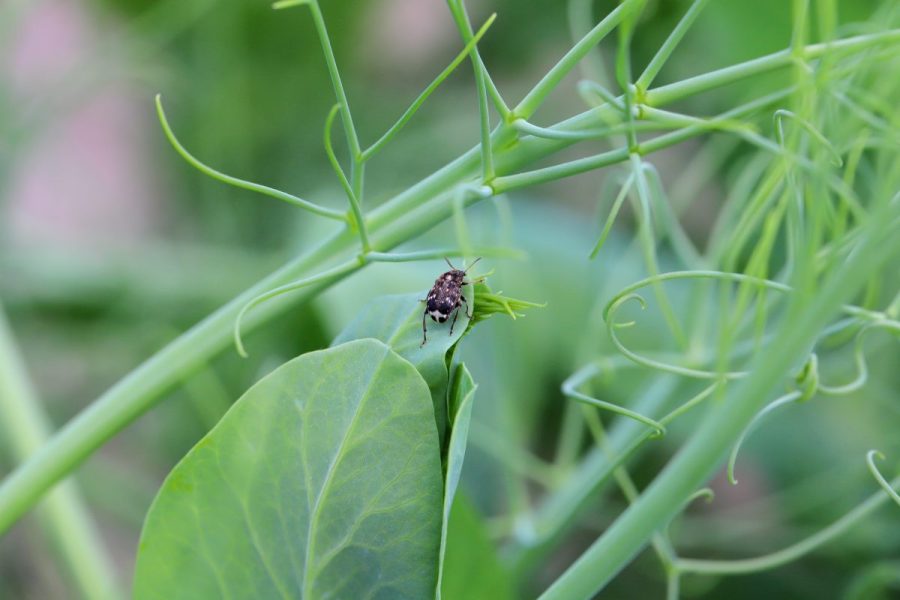
So what exactly is the pea bruchid and why could it be such an issue for UK peas? “The pea bruchid is closely related to the bean bruchid, a familiar challenge for many pulse growers, but it’s a distinct species that targets peas only,” explains Becky. “The adult beetles are small, mottled brown insects that emerge in spring, usually from overwintering habitats such as field margins, hedgerows or – critically – infested seed.
“After emergence, adults must feed on pea flowers before they can reproduce. Once they’ve done so, females lay eggs on newly formed pods.”
The eggs are clearly visible to the naked eye: small, oval, and yellow to orange in colour, she continues. “When they hatch, the larvae immediately burrow through the pod wall into the developing pea beneath.
“They feed within the seed, hidden from view and protected from any external treatment, for several weeks until the crop reaches maturity. In combining peas, larvae complete their development before harvest, pupating and then emerging as adults either just before harvest or during storage.”
Those that don’t emerge remain inside the seed, where they can survive winter, warns Becky. In vining peas, which are harvested fresh, the larvae are present in the peas and the crops are usually harvested before bruchids reach adulthood, meaning the pest cannot persist – but even in that situation, the presence of larvae could affect market perception and product quality.
“The lifecycle of pea bruchid is what makes it so difficult to control once established,” she explains. “Because the larvae are inside the seed, field control must target the adult beetles before egg-laying. Once eggs are laid and larvae are inside, they’re quite well protected. Although we do have more useful insecticides in peas than in beans, with some systemic activity, it’s preferable to control adults prior to egg-laying.”
From a crop protection standpoint, this limits effective intervention to a very short window – typically the period just before and during early pod set, when adults are active and temperatures exceed around 20°C. “That’s why, in countries where the pest is established, control is based on precise monitoring and timing of adult activity,” says Becky. “But the good news for us, is that we’re not yet in that position. We’re focusing on preventing establishment in the first place.”
Damage from pea bruchid feeding is primarily quality-related. As larvae consume tissue inside the pea they create holes and cavities that reduce both the visual appearance and structural integrity of the seed. “For peas destined for human consumption, even minor feeding damage can lead to rejection by the processor,” she explains. “In seed crops, larval damage can reduce germination rates, and in high infestations, yield loss is possible through reduced seed weight and viability.
“Peas are smaller than beans, so the same level of larval feeding has a proportionally greater effect. That’s why we must take it seriously now, even though the current risk is low.”
As mentioned earlier, the current incidents are being treated as isolated. Two detections – one near Cambridgeshire, the other in Lincolnshire – are the only confirmed cases, with the possibility that these originate from contaminated seed. “This is the first year we’ve seen any evidence of live beetles emerging from UK crops,” points out Becky. “It gives us a clear opportunity to act before it spreads.”
An immediate recommendation from industry is a five-mile voluntary exclusion zone around each affected site where peas shouldn’t be grown next season. This is supported by an additional five-mile ’amber zone’, where growers are asked to notify PGRO if they’re growing peas so that monitoring can continue.
“We can’t enforce restrictions,” comments Becky. “But we can advise – and the principle is simple. By not planting peas right next to where beetles may have overwintered, we remove their host plant and reduce the risk of an overwintering generation being able to find a site to reproduce in 2026. It’s a tried and tested approach.”
VIGILENCE REQUIRED
Monitoring forms the second pillar of the response. Growers within 10 miles of either site are being encouraged to check crops regularly for signs of egg-laying or adult presence. Eggs can be spotted on pods using the naked eye, while sweep-netting can detect adults during flowering. “Monitoring doesn’t have to be complicated,” she notes. “It’s about knowing what to look for and reporting any suspected sightings. The PGRO website has detailed photos and guidance to help growers and agronomists identify the pest accurately.”
The UK’s strategy mirrors the successful approach taken in New Zealand several years ago, where early action and coordinated industry engagement contained pea bruchid before it became widespread.
“Although they were supported by regulation, New Zealand is a great example of how to do this right,” suggests Becky. “They treated it as an industry issue, not an individual farm problem. Everyone – from seed suppliers to merchants – worked together to stop its spread. That’s exactly what we’re doing here.”
Seed quality and integrity sit at the heart of prevention. Because the pest can overwinter inside dry seed, movement of infested lots poses the greatest risk of further spread. Existing import regulations already require that seed be free of live insects, but Becky stresses that every stage of the chain has a role to play in enforcing this.
“If imported seed arrives containing live beetles, it shouldn’t be planted,” she says firmly. “It must be reported, and it must be treated. Fumigation is highly effective, as is freezing under controlled conditions which kills any larvae or adults present. The key is to intercept any contaminated seed before it reaches the field.”
For the 2026 season, PGRO will be working closely with importers, merchants and certification bodies to ensure that all seed used for planting in the UK is verified pest-free. “Seed hygiene is the foundation of this,” she says. “If we keep the pest out of seed, we prevent movement and establishment altogether.”
While PGRO’s role is to lead the research and technical coordination, the trade is playing an equally active part. At Wherry and Sons, associate director and senior trader, Franek Smith, says the company identified one of the two cases and is now working closely with PGRO to support ongoing monitoring.
“We look at samples from every single one of our growers – which was well over 100 this year,” he says. “From those, we found just one isolated case, which we reported immediately. That early identification probably helped to catch this before it became anything more serious.”
With nearly two decades in pulse trading and a past presidency of Pulses UK, Franek has a clear view of what’s at stake if the pest were to establish. “If pea bruchid got a stranglehold here, it would be very hard to control,” he explains. “One option is pyrethroids, but you have to time sprays exactly to when the females are laying eggs, and in a warm season, that could be any time. It’s almost impossible to do consistently. Once the larvae are inside the pea, you can’t remove them mechanically or clean them out. So prevention is everything.”
From a trading standpoint, implications would be serious for market access, he warns. “UK peas are valued worldwide because of their cleanliness, farm assurance and traceability. If we had pea bruchid in the country, that reputation would be at risk. It wouldn’t make trading impossible, but it would narrow the number of homes available for British peas, and that’s something we want to avoid. Farmers already face enough challenges without losing another market.”
Franek’s advice for growers is practical and clear: check your seed as soon as it arrives on farm. “Look carefully at the grain and check for signs of beetles or small round exit holes. If you have any concerns – however small – contact PGRO immediately for independent confirmation. Their advice is free, and they’l take every query seriously. And if you think your seed could be contaminated, don’t drill it.”
With this in mind, he also supports the proposed five-mile no-grow zones and the wider 10-mile monitoring areas. “It’s a sensible approach,” he says. “Within the red zones, no peas should be grown, and within the amber zones, farmers are simply asked to let PGRO know what they’re planting so monitoring can continue. It’s about education, not enforcement. We’re also encouraging agronomists to be aware so they can spot anything unusual when walking crops.”
Franek adds that Wherry and Sons, along with other merchants, are rolling out communication to both growers and advisors to make sure the message is consistent. “This isn’t about pointing fingers or catching anyone out,” he stresses. “It’s about working together to stop the pest spreading. We’ve caught it early, and if everyone plays their part, we’ll keep the UK free from pea bruchid.”
Both he and Becky are keen to keep the conversation factual, calm and constructive. “We’re not trying to scaremonger,” reiterates Becky. “Pea bruchid may not become a UK problem but with the actions already in place, we can try to ensure it never becomes one. Awareness and cooperation are our most effective tools.”
Franek agrees: “It could become a major challenge if ignored, but right now we have the chance to stop it in its tracks. Farmers have limited rotational choices already and adding another restriction because of a preventable pest would be a real shame. By taking these early steps, we can protect both the crop and the market.”
Becky concludes that the UK pulse sector has shown before how effective it can be when it works together, and by doing the same now will nip pea bruchid concerns in the bud before the pest becomes a bigger issue. “We have a strong, responsive network of growers, advisors and traders who understand the importance of good practice. This is another example of that professionalism in action. By staying vigilant now, we can keep the UK pea industry free from pea bruchid and maintain the world-class reputation it deserves.”
This article was taken from the latest issue of CPM. Read the article in full here.
For more articles like this, subscribe here.
Sign up for Crop Production Magazine’s FREE e-newsletter here.