
From feed formulation to field management, pulses are gaining new momentum as part of climate-smart farming systems. But can the industry convert scientific progress into lasting market confidence? CPM finds out.
“What we’re seeing now is farmers, researchers and feed companies starting to move in the same direction.” ROGER VICKERS
By Charlotte Cunningham
For many arable growers, peas and beans have long occupied an awkward middle ground in the rotation. Useful, certainly; valuable for soil structure and nitrogen fixation, and helpful for meeting environmental scheme requirements. But too often, pulses have been viewed as a ‘good for the system’ crop, rather than ‘good for the balance sheet’.
Margins have been unpredictable, markets have felt fragile, yields have been variable – and when cereal prices are strong, it’s been tempting to squeeze pulses out altogether.
Yet, quietly, that picture is beginning to change. Across research sites, commercial farms and feed mills, a growing body of evidence is pointing in the same direction: home-grown protein crops are starting to stack up – agronomically, economically and environmentally. The technical case is strengthening. The commercial case is emerging. The question now is whether the industry can turn that potential into something permanent.
That shift isn’t happening by accident. Much of it is being driven by the Nitrogen Efficient Plants for Climate Smart Arable Cropping Systems (NCS) project, which is examining how pulses can play a larger role in UK food and feed supply chains.
At its heart is a simple question: can peas and beans realistically replace a significant proportion of imported soya? Early findings suggest so, but not without structural change.
FEED DEMAND
The project aims to displace half of the soyabean meal used in livestock feed, currently 2.5M tonnes. Data generated through the project and presented at the recent ‘From Soya to Sustainability’ conference indicates that around 1.6M tonnes of bean demand could be generated through poultry rations alone, if inclusion rates reached those trialled by SRUC. That would represent a step-change in UK pulse production, in both area and output.
For arable businesses, this implies more than simply ‘growing a few more beans’. It points towards pulses becoming a core commercial crop, underpinned by consistent demand, clearer specifications and stronger market signals.
James Webster-Rusk of The Andersons Centre, who’s been analysing the economics behind that shift, believes the opportunity is real but fragile. “We’re seeing what’s possible in terms of volume and impact,” he explains. “But we won’t get there unless the value created further down the supply chain is shared back with growers. Without that, it’s very difficult to justify expanding area.”
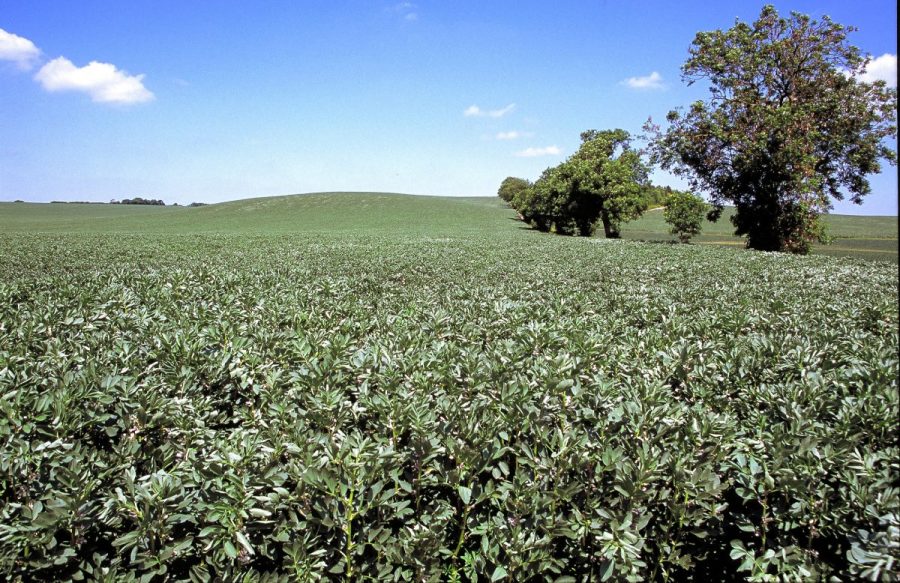
In practice, this means pulses must compete financially with cereals and oilseeds, not just environmentally. Gross margin modelling suggests that with reliable yields in the 4.5-5.5t/ha range for beans, combined with modest price premiums for specification crops, pulses can match second wheat returns on many soil types – particularly once nitrogen savings and rotational benefits are factored in. However, achieving that consistency remains the key challenge.
And that’s precisely where the project’s practical work begins to matter. That’s why the work of the NCS ‘Pulse Pioneers’ is so important, explains PGRO’s Roger Vickers. This is a group of 30 growers running structured on-farm trials – testing establishment methods, nutrition strategies, disease control and harvest management in real-world conditions.
“The focus isn’t just on headline yield, but on reducing variability,” notes Roger. “Establishment remains one of the most critical factors and trials have shown that early drilling into good soil structure, combined with accurate seed placement and robust seedbed preparation, can significantly improve plant populations and early vigour.”
Attention is also being paid to seed quality and inoculation. While most UK soils contain background rhizobia, inoculated seed has delivered more reliable nodulation in some regions, particularly on lighter land or in longer pulse rotations.
Nutrition strategies are also evolving as a result of the project. Although pulses fix nitrogen, they remain sensitive to deficiencies in phosphate, potash, sulphur and trace elements, particularly manganese and molybdenum. Targeted tissue testing has helped fine-tune programmes and reduce hidden yield losses, explains Roger.
Disease control remains another priority. Ascochyta, chocolate spot and downy mildew continue to limit performance in many crops, particularly in wetter seasons. Pioneer trials have highlighted the importance of early, preventative fungicide programmes, variety resistance ratings and canopy management.
INTEGRATED WEED CONTROL
Weed control, especially in spring beans, is also under scrutiny. Integrated approaches combining stale seedbeds, competitive varieties and timely residuals are proving more reliable than reliance on post-emergence chemistry alone.
Individually, none of these refinements is revolutionary. Taken together, however, they are steadily improving resilience. The cumulative effect isn’t necessarily dramatic yield gains in any one year, but improved consistency across seasons – which is what growers require to justify larger pulse areas, believes Roger.
While much of the early work has focused on crop performance, some of the most persuasive evidence is now emerging further down the supply chain. In mixed farming systems, pulses are already being fully integrated into home-grown feed rations. One example from the project is a beef enterprise in South Yorkshire, where home-grown faba beans have been trialled as a substitute for bought-in protein. By roasting the beans on farm, the business has improved protein availability and animal performance.
Supporting analysis shows that roasting increases bypass protein and starch availability, improving rumen efficiency. In sacco testing confirmed higher small intestine digestibility, translating into improved feed conversion.
Although processing increases feed costs per tonne, cattle achieved higher daily liveweight gains. As a result, overall production costs per kilogram of output fell, while emissions intensity also improved.
Farmer John McArthur describes it as a relatively simple change with far-reaching consequences. “Boosting productivity from home-grown feed is key to improving sustainability,” he says. “So it’s encouraging to see that a small adjustment to our routine can support both performance and profitability.”
For arable growers, this matters because once livestock performance improves, market confidence tends to follow. It demonstrates that pulses are increasingly valued not simply as a raw commodity, but as a functional ingredient, says Roger. “Their worth is being judged by how they perform in livestock systems – and that creates opportunities for growers who can supply consistent, high-quality crops.”
It also highlights the importance of physical and chemical quality. Protein content, starch availability, moisture levels and contamination thresholds are all becoming more commercially relevant, he adds.
If beef systems are helping to build confidence, perhaps the most significant breakthrough has come in poultry nutrition. Historically, poultry has been a difficult market for beans – anti-nutritional factors and high fibre content have limited digestibility, restricting inclusion rates and undermining feed efficiency.
But research led by SRUC’s Professor Jos Houdijk is suggesting otherwise. “When we feed more beans, we tend to see a dent in performance because the bird can’t digest them properly,” he explains. “But when we de-hull or de-hull and toast beans, that dent is taken away. The animal performs as if that detriment was never there.”
Trials involving whole, de-hulled and processed beans have shown that inclusion rates can be pushed far higher than previously thought possible, without compromising feed conversion ratio or output.
From a practical perspective, Jos says de-hulling has delivered the biggest gains. “The largest win is from removing the hull,” he notes. “Toasting may offer some additional benefit, but at the moment the data suggests that effect is relatively modest.”
Removing the fibrous hull increases metabolisable energy and protein availability, allowing formulators to replace more soya while maintaining ration balance. Commercial feed specialists are now translating those findings into large-scale systems, and ABN poultry nutritionist Brian Kenyon says confidence in beans is steadily growing.
“We’re getting more comfortable using higher levels,” he explains. “Even increasing inclusion from 5 to 10% has a significant impact on carbon emissions across the industry.”
Large-scale broiler trials using de-hulled beans have delivered soya reductions of up to 27%, alongside double-digit emissions savings. Layer trials have achieved similar proportional reductions, with minimal impact on egg size and quality.
One notable observation has been darker yolk pigmentation when beans are included – a trait that may carry added consumer value in some markets. For pulse growers, this is potentially transformative, notes Roger.
“Poultry feed represents a large, stable, year-round market. If processors and integrators commit to UK beans as a core ingredient, it could underpin long-term demand in a way few other outlets can.”
But unlocking that demand depends on something beyond the field. A recurring theme across livestock sectors is the importance of post-harvest processing. Whether through de-hulling, toasting, extrusion or micronisation, processing is increasingly seen as the link between crop production and feed value.
At present, processing capacity remains somewhat patchy and regionally uneven. Some growers have invested in on-farm equipment, while others rely on third-party facilities. The economics vary widely – capital investment can be significant, but scale and throughput quickly improve returns. Where processors are integrated into supply chains, growers benefit from more stable demand and clearer specifications.
As pulse markets mature, further investment in regional processing hubs is likely to be required – particularly if poultry demand expands, notes Roger.
As efforts to reduce imported soya gather pace, pulses are also becoming increasingly relevant to wider policy and sustainability debates. Reliance on imported soya carries environmental, political and economic risks, while climate change is disrupting global supply chains. Equally, carbon accounting is becoming more rigorous and farm businesses are being asked to demonstrate measurable progress on emissions.
At the conference, supply chain specialist Nicola Brennan of WWF-UK linked domestic protein production to national resilience. “Accelerating nature loss isn’t just an environmental issue,” she warned. “It’s a foundational threat to global stability and food security. The private sector has a major role to play in supporting farmers to produce food with positive environmental impacts.”
Within arable rotations, pulses offer multiple benefits: nitrogen fixation, improved soil structure, enhanced microbial activity and reduced fertiliser demand. Nitrogen savings alone can reach 30kgN/ha for following cereals, improving margins and lowering exposure to volatile fertiliser markets.
POSITIVE IMPACTS
Critically, when pulses displace imported protein in livestock diets, they also deliver system-wide emissions savings – a factor that’s increasingly reflected in corporate sustainability targets. Professor Neil Ward of the University of East Anglia believes this makes pulses central to future food policy.
“Climate change is already affecting supply chains and driving food price inflation,” he says. “Adaptation is non-negotiable. We have to think about resilience in a way we haven’t for decades.”
For all the technical progress, one question continues to surface: will the supply chain follow through?
Research can demonstrate what’s possible and farmers can show what works in practice. But scaling up requires confidence – and confidence depends on contracts, pricing and long-term commitment.
Roger believes momentum is building, but accepts collaboration remains critical. “There’s huge potential. What we’re seeing now is farmers, researchers and feed companies starting to move in the same direction. The challenge is maintaining that alignment.”
Processing capacity, logistics and quality assurance must develop in parallel; without them, inconsistent demand or short-term buying patterns quickly undermine grower confidence. Many growers remain wary of committing land without forward visibility on pricing and movement. In simple terms, pulses will only become mainstream when they are treated as such.
For arable producers, the current moment feels like a crossroads. On one side lies the familiar pattern – modest pulse areas, volatile markets and cautious adoption. On the other is the possibility of pulses becoming fully embedded in UK farming systems – linked to domestic feed supply, climate objectives and long-term resilience. The technical barriers are steadily being dismantled, agronomy is improving, processing is unlocking value and livestock sectors are engaging more seriously than ever before.
What remains is alignment, comments Roger. “If growers, processors and end users can move forward together, peas and beans could finally step out of their supporting role and become central players in profitable, climate-smart rotations.
“For many farms, that could mark the beginning of a very different relationship with pulses – one built not on obligation, but on opportunity.”
This article was taken from the latest issue of CPM. Read the article in full here.
For more articles like this, subscribe here.
Sign up for Crop Production Magazine’s FREE e-newsletter here.