
On the conservation red list in the UK since 1996, the turtle dove is a species which continues to require urgent action. CPM speaks to those behind a project which is working to boost the numbers of this iconic bird.
“Just like the grey partridge, if you manage land for turtle doves, it’ll deliver for other species too.” MARK NOWERS
By Janine Adamson
From the Twelve Days of Christmas to references in Shakespearean plays, the turtle dove (Streptopelia turtur) has long been a symbol of enduring love.
And while some growers may be more focussed on the ‘partridge in a pear tree’ aspect of the popular English carol, others have been turning their attention to the turtle dove – a species that’s found itself at risk and labelled a high conservation priority in the UK for nearly 30 years.
In fact, more than 440 UK landowners, including 266 farmers, engaged with Operation Turtle Dove last year, helping to make strides in conservation efforts by providing nesting and feeding habitats across southern and eastern England.
But how did all of this come about in the first place, and what’s required to finally cement a reverse in decline? RSPB turtle dove conservation adviser, Mark Nowers, highlights that between 1995 and 2023 there was a 98% reduction in the population.
“Turtle doves are migratory, travelling thousands of miles to reach the UK in the spring and summer. They navigate the Sahara Desert and fly through Spain, Portugal and France; they then return to Africa via a similar route in the autumn.
“While some of the population decline can be attributed to changes in agricultural practice, more recently it’s been exacerbated by unsustainable hunting along their migration flyway through south-west Europe.
“At its peak, this equated to around 1M birds each year, hence halting and reversing the decline of turtle doves is a clear priority,” he explains.
Established in 2012 with the purpose of finding ways to do just that, Operation Turtle Dove is a partnership between the RSPB, Fair to Nature, Natural England and Pensthorpe Conservation Trust. Its objective is to research the reasons behind the UK’s turtle dove decline, as well as identify and implement measures to help the bird’s recovery.
Mark says by taking this science-based approach it’s led to two overriding tactics – working with UK landowners to create environments for turtle doves to thrive, and, addressing the illegal hunting on the Continent. For the former, this has involved encouraging the provision of abundant, accessible seed-rich feeding areas; fresh water; and dense thorny scrub and hedgerows for nesting.
“These are the three ‘needs’ that turtle doves require to prosper here in the UK,” continues Mark. “Hence we’re working with farmers and landowners to implement these options without impacting the sustainability of the farm business.
“The population hot-spot is currently across Sussex, Kent, Essex, Suffolk, Norfolk and Cambridgeshire, which is where we’ve been focussing our work.”
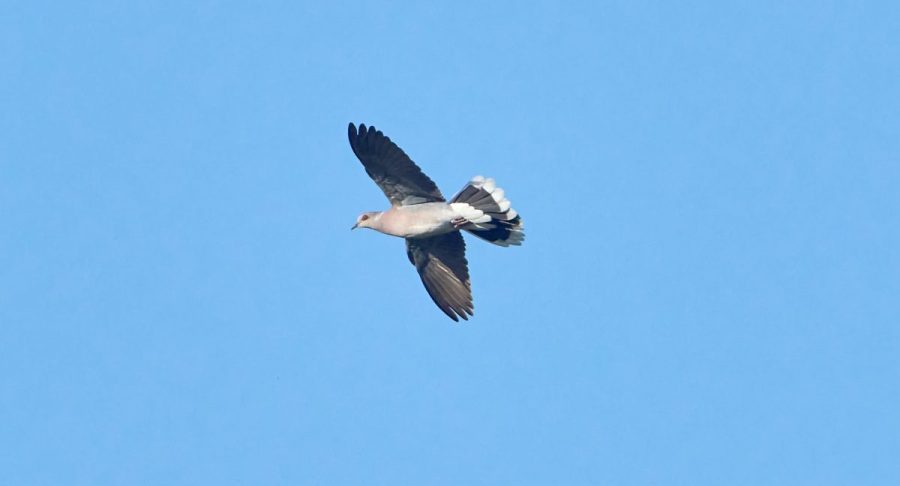
Appearance-wise, the turtle dove is smaller and darker than the collared dove, and slightly larger than a blackbird. Nests are twig-based and built in dense scrub and hedgerows in readiness for rearing young.
Mark raises that evidence suggests providing turtle doves with good breeding season habitats helps other farmland wildlife too such as nightingales, bullfinches, and warblers. “Just like the grey partridge, if you manage land for turtle doves as a flagship species, it’ll deliver for so many other species too.”
Feeding involves foraging for seeds on the ground, meaning weedy crop margins and untidy areas are ideal, he suggests. “Regarding what they actually eat, turtle doves aren’t that fussy. The seeds of arable plants such as chickweed, vetches, scarlet pimpernel and fumitory, as well as crops like oilseed rape and cereals, are all on the menu.
“Autumn-established cultivated margins and enhanced overwinter stubbles are effective stewardship options for providing accessible seed-rich habitat in the spring and early-summer. We also run a supplementary feeding programme to provide seed as a short-term measure.
“But delivering the three ‘needs’ doesn’t have to be done by one farmer alone. Working together across farming clusters is a great way to coordinate efforts – one farm provides scrub, another a pond, and so on. Turtle doves are highly mobile and will range across the landscape.”
However, getting to the crux of issues related with unsustainable hunting has taken efforts to an international level, raises Mark. “While we can do everything we can to support turtle doves when they’re in the UK, we have to work along their entire flyway, not just in isolation.
“So by collaborating with international partners, a ‘zero harvest’ was implemented in 2021-2024. This was to give the turtle dove breeding population in western Europe time to increase, and after four years, the population grew by more than 30% across the flyway.
“Now we’re working to an adaptative harvest management programme, but should the drop in population occur again, the ban will be reinstated,” he points out.
With so many farmers already invested in Operation Turtle Dove, what’s next? Mark suggests there’s plenty of space to ‘join the gang’. “Turtle doves are embedded in UK culture, they’re even mentioned in the Bible.
“With a fondness among farmers for turtle doves, the project wants to continue to provide the advice required to see the species thrive once more.”
Anthony Curwen, managing director of Quex Park in Thanet, Kent, is a firm believer in the work of Operation Turtle Dove, having been involved since 2017.
The estate’s cropping rotation includes wheat, OSR, oats, beans, potatoes and maize across 1010ha, plus an additional 100ha of rough pasture for a beef single suckler herd, and just under 100ha of environmental schemes. To help encourage turtle doves, Anthony has been ensuring their three needs are met – providing seed-rich feeding areas, fresh water and nesting habitats.
“After being approached by the project, we started supplementary feeding once a week. This then grew to include techniques such as cultivating headlands to provide a flush of arable weeds, and creating scrubland.
“Importantly, I knew nothing about turtle doves eight years ago, but being involved with the project has completely opened my eyes to what’s on the farm. It’s had an open-door effect and broken down barriers; it’s so much bigger than just turtle doves.”
Anthony believes that like him, many farmers want to do the right thing by nature, but don’t necessarily know how to achieve it. “It’s easy to become obsessed with growing the most perfect crop, but there’s an opportunity to learn to appreciate what’s around us – it all matters, even when in abundance.
“I’m 100% on board with Operation Turtle Dove and its ethos of ‘could’ not ‘should’ – working together to achieve both food production and nature recovery. It can all be joyous.”
However, he stresses that even when conditions appear perfect for turtle doves, things don’t always go to plan. “Whether it was the extremely dry summer or another factor beyond our control, this year they didn’t arrive at Quex.
“It’s the first time this has happened since we began our involvement and is disappointing, but goes to show that Mother Nature really does rule the roost.”
Further information about the project can be found at operationturtledove.org.uk
This article was taken from the latest issue of CPM. Read the article in full here.
For more articles like this, subscribe here.
Sign up for Crop Production Magazine’s FREE e-newsletter here.