
As spray windows tighten and margins narrow, growers are being asked to balance chemistry, cost and climate risk with ever greater precision. CPM explores how data, robotics and intelligent systems could redefine weed and disease control for the next decade.
“In a world of full autonomy, we’re early doors in agriculture.” KIT FRANKLIN
By Charlotte Cunningham
There’s a particular kind of tension that builds in a wet season… It starts quietly – a couple of missed spray days, a forecast that refuses to settle. Then leaf three emerges under grey skies, septoria begins its slow climb through the canopy, and suddenly the margin for error feels razor thin. Go too early and question longevity, go too late and chase disease, or wait for perfect conditions and risk missing the window entirely.
For UK arable growers, weed and disease control has always been about timing. But increasingly, it’s also about precision.
Herbicide resistance continues to test cereal systems, blackgrass populations evolve faster than programmes adapt. and fungicide strategies have to balance cost against increasingly unpredictable disease pressure. This is amid a backdrop of tightening regulatory scrutiny, and an ever-narrowing number of available actives. Then, layered over all of this is climate volatility – prolonged leaf wetness, warmer winters and compressed spray windows reshaping pathogen cycles in ways that feel anything but stable.
It’s in this context that smart technology stops sounding futuristic and starts looking like infrastructure. So what does – or could – the future look like? The recently launched UK Agri-Tech Centre report, The Future of Arable and Horticulture Innovation: Shaping the Next 10 Years, positions intelligent and data-driven systems as central to agricultural resilience during the coming decade.
While the document spans biotechnology, diversification and climate adaptation, its implications for weed and disease management are particularly striking. It believes the direction of travel is clear – away from blanket treatment and towards targeted, risk-based intervention.
For decades, crop protection has relied heavily on broadacre programmes – whole-field sprays timed around growth stages and historic threat levels. Although that approach functioned when chemistry was plentiful and seasons were more predictable, today, the margin for inefficiency has narrowed dramatically.
The report highlights how artificial intelligence, sensing technologies and predictive modelling can shift decision-making from reactive to predictive. In disease management terms, that means integrating real-time weather data, leaf wetness duration and canopy humidity into forecasting models. Rather than relying solely on growth stage triggers, septoria or rust risk can be refined according to microclimate conditions and actual infection pressure.
In practical terms, that could translate into more confident fungicide timing, fewer insurance sprays and tighter alignment between product choice and genuine threat level. In seasons where rainfall repeatedly disrupts field access, identifying a true risk window rather than a perceived one becomes commercially significant.
The same principle applies to weeds. Herbicide resistance – particularly in blackgrass-dominant regions – has forced a re-evaluation of long-standing strategies. Cultural controls have strengthened their role, but in-crop management remains critical. Here, the report’s emphasis on robotics, automation and AI-driven sensing intersects directly with one of the sector’s most persistent challenges.
Machine vision systems capable of distinguishing crop from weed at plant level are no longer confined to research plots. Whether through spot spraying or physical destruction, the principle is consistent: intervene only where intervention is required. As such, reducing blanket herbicide use can lower selection pressure and build spatial intelligence over time, reframing weed management as a data challenge as much as a chemical one.
The report also speaks to convergence – the blending of biological, digital and mechanical innovation. Resistant varieties supported by disease modelling; biological fungicides deployed with greater spatial precision; variable-rate systems refining dose according to canopy density.
The future of crop protection isn’t about abandoning chemistry, it’s about making every intervention more informed.
If the report outlines the direction of travel, Kit Franklin, senior engagement fellow at Harper Adams University brings it back to farm reality. “In a world of full autonomy, we’re early doors in agriculture,” he says. “We’re seeing some early adopters of on-farm commercial autonomous machines.”
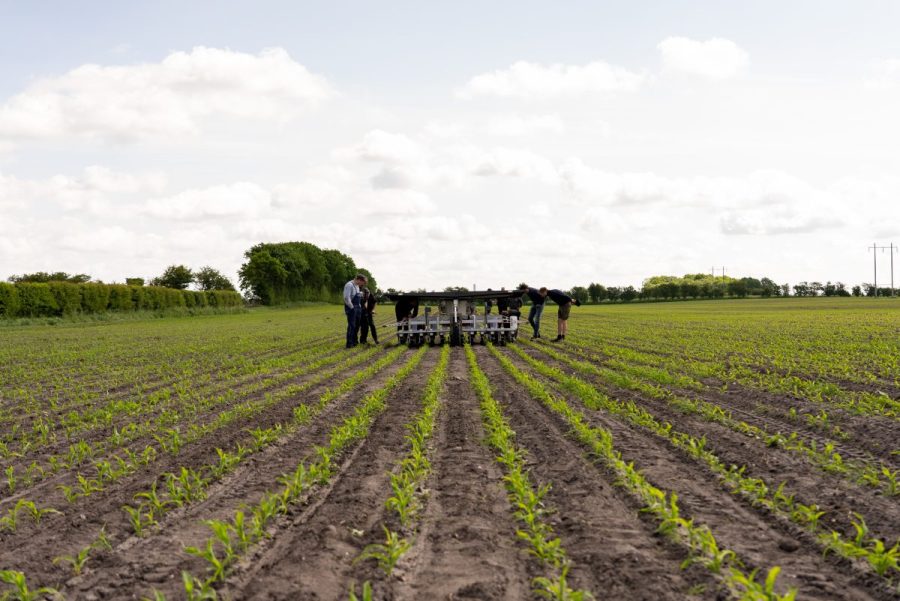
Yet weed control is one of the first areas where autonomy has delivered tangible commercial results. One example is the Danish-built FarmDroid robot, now operating on a number of UK farms, says Kit. Solar powered and operating without cameras, it drills using ultra-high-precision RTK GPS, recording the exact position of every seed as it plants. It then returns to mechanically weed between those recorded coordinates. “It’s weeding using position rather than cameras,” he explains. “It remembers where every seed is planted, and then it weeds between the location of the seed using very high precision GPS. Critically this enables pre-emergence weed control over the camera-based systems that were pioneered here in the UK.”
The distinction is important – rather than relying on machine vision to distinguish crop from weed in real time, the system operates on positional memory at centimetre accuracy. In high-value crops, that approach has proven commercially viable. “There are 18 or so machines in the UK,” he says. “And they’re starting to really add value commercially.”
Conversely, laser weeding has followed a longer path, with Kit being part of the original team at Harper Adams University that explored laser-based weed destruction more than a decade ago. “We certainly saw it was technically viable. We could kill weeds with lasers, but the main consideration was cost,” he says.
Early modelling suggested a commercially viable system would require capital investment of more than £1M – a figure that proved accurate when commercial machines such as the Carbon Robotics systems later entered the US market, he adds. “The technology works, but the pace of adoption depends on economics.
“I think ultimately, investment is always based on a business case. Farmers aren’t going to make decisions on a hunch, they’re going to do things based upon confidence that it’s going to save them time, effort or money – or at least one of the above.”
Precision agriculture has long wrestled with this challenge – year-on-year variability makes attribution difficult. Was the yield uplift due to the technology, or simply a different season? By contrast, technologies such as auto-steer and section control succeeded because the savings were tangible, notes Kit. “People see 5-10% savings on inputs, so you can easily work out a return on investment.”
The same clarity will be required for robotics and AI-led weed control – and it’s not just the big players who look set to benefit…
Published economic modelling carried out by Harper Adams University, including peer-reviewed analysis of autonomous systems in UK farming contexts, suggests there are scenarios in which smaller farms adopting automation could improve profitability by reducing labour and machinery overheads.
By substituting conventional machinery fleets and labour hours with autonomous systems, Kit says cost structures shift. “The modelling indicates that, under certain assumptions, autonomy can reduce total production costs sufficiently to offset capital investment.”
While real-world uptake will always depend on individual business structure, the research reinforces Kit’s central point – where the numbers stack up, adoption follows. But there are other barriers too, and they’re not purely technical.
Recognising that regulation could either enable or restrict progress, Kit and colleagues were involved in developing a Code of Practice for the Use of Robots in Agriculture and Horticulture – a British Standard designed to demonstrate responsible deployment of autonomous systems.
“We wanted to show that as an industry, we were going to be responsible,” he explains. “If you’re going to employ a robot, do a decent risk assessment and do some training.”
The aim was to get ahead of potential legislative barriers, because in other sectors, rapid innovation without clear standards has resulted in restrictive regulation – as seen with drones, for example. “By proactively developing guidance, the intention was to show policymakers that the sector could manage risk responsibly,” comments Kit.
Work also took place with insurers to ensure autonomous machines could be covered appropriately. “Farmers aren’t going to take on a £100,000 machine if they can’t get insurance for it,” he adds.
For growers considering automation in weed or disease management, his advice is practical – analyse your system, identify where labour is high, repetitive or physically demanding, and start where the business case is strongest.
“The long-term vision remains optimistic. It’s not taking farmers away from farming, it’s about getting bums off seats driving in straight lines and getting them digging soil pits and doing more agronomy,” argues Kit.
Weed and disease management is becoming less about blanket response and more about informed intervention, he concludes. “From AI-driven weeding systems to DNA-based pathogen detection, the tools now emerging are capable of working at plant-level rather than field-level.
This article was taken from the latest issue of CPM. Read the article in full here.
For more articles like this, subscribe here.
Sign up for Crop Production Magazine’s FREE e-newsletter here.