
A group of physicists and engineers are striving to unlock the untapped potential of autonomy in agriculture by providing the final piece of the technological jigsaw puzzle – a consistent source of energy. CPM investigates the concept of megahertz inductive power.
“How big is our imagination? That’s the question when it comes to autonomy in farming.” MIKE TAYLOR
By Janine Adamson
According to Mike Taylor, solving the problem of wirelessly charging agricultural robots all lies in the application of general physics. However, despite having a solution ready to go, he’s waiting for the industry to catch up and pay attention.
“We’ve spent 10 years developing a product and now simply need it to land,” he says. “But this isn’t about promoting me or the company, it’s about agriculture adopting the technology. After all, how big is our imagination? That’s the question when it comes to autonomy in farming.”
And, as a former research physicist for the Ministry of Defence with a PhD in plasma physics, it could be argued that Mike is well placed to comment on the subject.
With a self-confessed passion for ‘taking scientific concepts and making them work in unusual applications’, this is how his company – Inductive Power Projection – began. Specifically, exploring how megahertz (MHz) magnetic power transfer could solve some of agriculture’s most challenging conundrums.
“If you take an induction hob or heater, most of these scenarios work at a kilohertz-frequency level. However, if rather than metal you want to heat unusual material, for example, slugs, then we have to take it up a gear to MHz. Here it’s possible to kill a pest without causing damage to the growing crop,” he explains.
Having secured several rounds of Innovate UK funding to investigate the slug control concept further, Mike comments in that instance, commercialisation was too difficult. This led him to investigate applying his idea to the world of humane livestock stunning.
Again, this proved too tricky to scale up, he says. It was then that Mike and his close peers had a lightbulb moment – the true opportunity lay in wireless battery charging for agricultural autonomy, specifically, robots and drones.
“If you take away the unpredictable nature element that comes with animals or pests, we can control the whole system, making it easier to engineer and develop a valid solution,” says Mike.
He adds that for decades, wireless power developers have been attempting to progress the technology with frequencies of a few tens of kilohertz, despite mathematics indicating this is just too low for efficient power projection. “If we’re honest, the performance of wireless phone chargers isn’t very good and of course, they’re based on the same underlying technology for heating metal.”
Conversely, by taking a physics-led approach, it’s soon apparent that the key is to operate at MHz. In utilising MHz, it’s possible to achieve 99% transfer efficiency between a transmitter and receiver across far larger distances and lateral displacements, compared with when working in the kilohertz range, explains Mike.
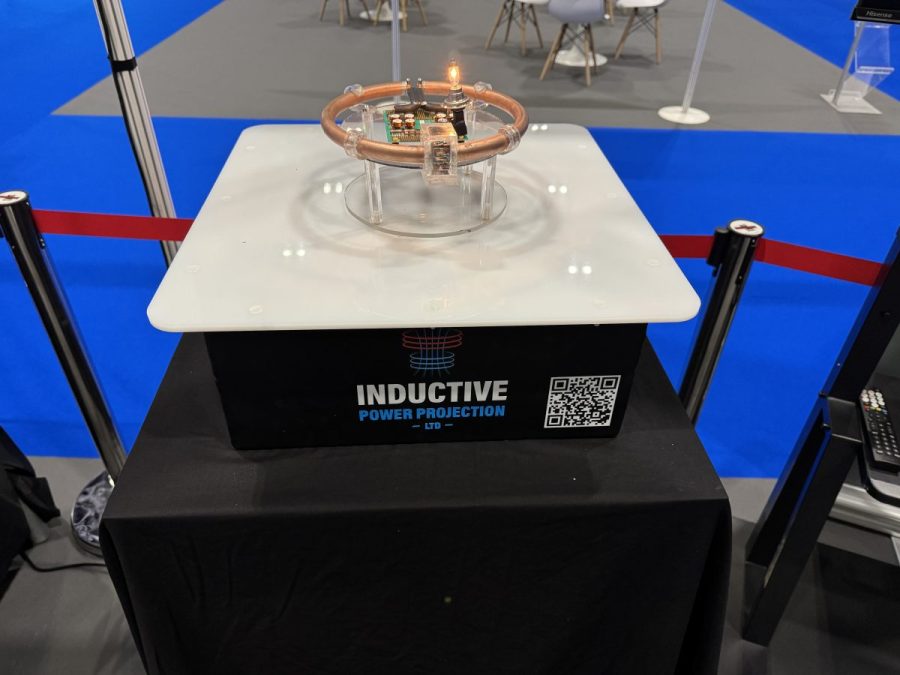
“Critically, we don’t require expensive ferrite cores vulnerable to overheating, our contactless system is air-cored and uses single-turn thin-walled copper tubes, similar to that of household plumbing. We create a transmitter of any shape – depending on the machine requiring charge – and a receiver. That’s ultimately all it takes.”
In terms of numbers, the system can currently power up to 2kW through a single lightweight receiver, with a roadmap currently laid out towards 50kW or more. Charging can also take place over distances of up to 1m.
Importantly, the solution is accessible to the farmer in the field because it’s now affordable, he stresses. “In terms of the exact use cases, we could be looking at autonomous vehicles such as inter-row weeders, or remotely-operated drones that are being used as a security measure. The direction of travel for robotics is undoubtedly autonomy, and that’s where we come in. Wherever there’s a requirement for autonomous power, we can provide it,” he says.
Taking a pragmatic view, Mike points out that there are alternatives to wireless charging, although none of these are without fault. “Plug-in is the obvious, and that’s great if you have personnel to plug it in or work in a very clean, dry environment. However, our system is terminal-free, working in both mud and water, even underground.
“Lasers and microwaves have also been shown to work, but these are inefficient, although the only options for far-field. For near-field within about a metre, then inductive, as in our solution, is clearly the way to go. We just require brave individuals – farmers or agronomists – to adopt the technology and fully embrace autonomy.”
As well as newly purchased pieces of kit, Mike’s solution can also be retrofitted to existing machines. With all of the manufacturing taking place in the UK using a trusted team of specialist scientists and engineers, he says it’s a little disappointing that so far, interest has only come from further afield such as Dubai.
“We’d love to identify some UK trial farms to test run our technology. You don’t necessarily have to own a drone or robot either, as we have partner companies who we work with in those spaces. You just have to be forward-thinking and open-minded,” he urges. “There’s even the possibility to charge robot-to-robot; we can take energy to wherever on the farm it’s required.”
Mike believes solving the problem of autonomous power is the last primary technological barrier to the growth of autonomy. “There are four legs to the autonomous chair – the vehicle or robot; the navigation system; data acquisition through sensors; and the final one – power.
“While problem solving is forever, getting that final leg correct is pretty important when it comes to adopting autonomy in agriculture, for not only productivity gains, but sustainability benefits too,” he concludes.
This article was taken from the latest issue of CPM. Read the article in full here.
For more articles like this, subscribe here.
Sign up for Crop Production Magazine’s FREE e-newsletter here.