
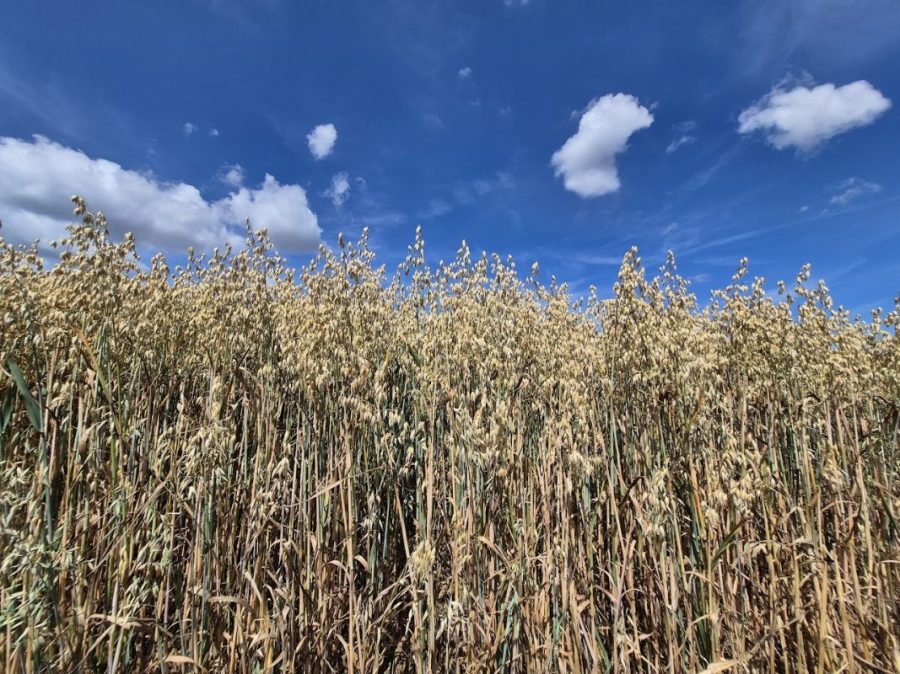
Increased plantings, renewed processor demand and better spring varieties are reshaping the role of oats in arable rotations. As growers look for flexibility and reliable margins, CPM finds out how agronomy and genetics are helping lift this ‘Cinderella crop’ into the spotlight.
“Spring oats give you a chance to reset.” BRIN HUGHES
By Charlotte Cunningham
There’s a familiar rhythm to British arable rotations: headline crops take the limelight, while others quietly earn their keep in the background.
Oats have arguably long sat in that second category – useful, perhaps less glamorous, sometimes underestimated. Yet a combination of forces is now nudging them closer to centre stage, from changing rotational pressures and policy incentives to renewed processor demand and a step-change in spring oat genetics.
Figures from AHDB suggest the UK oat area for 2025/26 is set to rise by around 15%, taking total plantings to more than 210,000ha – the highest for five years. For many businesses, oats are answering several questions at once: rotational flexibility, manageable input costs, and access to food markets that place a premium on domestic supply.
One of the defining features of the oat market is its lack of flexibility. As Jonathan Arnold of independent merchant Robin Appel puts it: “If you’re making oat products, you have to have oats.” Unlike feed markets, where commodities can often be substituted, processors producing flakes, porridge or oat drinks require a consistent flow of suitable grain, both in volume and quality.
That reality has become more important as food manufacturers place increasing emphasis on provenance. Moves by major brands to source exclusively British oats have given the domestic market renewed structural support, while more farms are developing their own oat-based products to avoid imported grain and the costs and complications that accompany it.
That said, Jonathan describes recent seasons as a ‘rollercoaster’. Poor harvests in Canada and Scandinavia boosted export demand, only for global supplies to rebound and create oversupply. With total UK demand sitting below 1M tonnes, relatively modest changes in planted area or yield can swing the market quickly, he explains.
As well as demand changes, the renewed interest in oats is grounded firmly in agronomy, too. Brin Hughes, agronomist at Richardson Milling, describes oats as a valuable ‘white straw break’ and a practical alternative where oilseed rape has fallen out of favour. But, he’s equally clear about what’s driven the move toward spring cropping.
“Blackgrass has changed everything,” he points out. “If you have blackgrass, winter oats are risky. Spring oats give you a chance to reset.”
Shaun Jenkins, senior grain manager at Richardson Milling, agrees. Historically, the company favoured winter oats – particularly long-established varieties such as Mascani – for their consistency and milling quality. However, grassweed pressure has forced many growers into spring systems. “In the past three years, we’ve gone from probably 75% winter oats to something closer to 50:50,” he explains.
For many farms, spring oats now sit neatly alongside cover crops, delayed drilling strategies and workload management, while still offering access to premium food markets.
Furthermore, oats are often described as ‘low-input’, and in one sense they are. Compared with wheat, they typically require fewer fungicides and simpler management. But that reputation carries a downside, warns Brin. “Oats are still treated like a second-class crop. People grow them the way their grandparents did.”
That legacy thinking shows up in late drilling, excessive seed rates and cautious nutrition, all of which quietly limit performance, he adds.
First and foremost, Brin argues that spring oats should be drilled as early as conditions allow, ideally from mid-February onwards. This is because yield and quality fall away rapidly once drilling slips beyond mid-March, while pushing into April almost guarantees disappointment. He stresses that oats benefit from time in the ground, with stronger rooting, better tillering and more even ripening linked to early establishment.
Seed rates are another weak point. For early drilling, Brin suggests around 200 seeds/m², rising to around 300 seeds/m² into March. Yet many crops are still drilled far more thickly, he says, producing dense canopies that struggle to tiller and fill grain properly.
Nutrition is the third pillar. Because oats are seen as low-input, they are frequently underfed, but on suitable soils and with good establishment, Brin believes nitrogen rates of 125-150kgN/ha can be justified to support both yield and consistency, despite the tension with sustainability targets.
He believes much of this caution is inherited – fears of lodging still linger from the days of tall, weak-strawed varieties. However, modern oats are shorter, better rooted and more resilient, and early drilling and sensible seed rates can do far more to reduce lodging risk than starving the crop, he states.
While growers often focus on yield and price, millers assess oats through a more complex lens. Moisture, specific weight and screenings all matter, but one of the most critical parameters is hulling loss, points out Brin. “We want the groat, not the husk. Some varieties dehull cleanly, others take more passes through the machinery.”
Against this backdrop, variety choice has become more strategic. It’s no longer about chasing headline yield alone, but about balancing output, consistency and market suitability, says Jonathan. “For years it was basically Banquo and Firth, then suddenly everything started improving,” he recalls.
One of the varieties emerging from that progress is Caledon. On the AHDB Recommended List, Caledon leads the five-year average for spring oats, achieving 104% of controls in treated trials and 97% in untreated. In the difficult 2025 season, it again topped the table, reaching 105% treated and 99% untreated.
Its breeder, Elsoms, highlights high kernel content, strong specific weight, low screenings, good disease resistance and early maturity as its key benefits.
Richardson Milling has subjected Caledon to extensive in-house testing, with Brin comparing it directly with established varieties such as Merlin and WPB Isabel. In replicated trials in 2024, Caledon produced yields of around 7t/ha in Suffolk, sitting competitively alongside Merlin and Isabel, while maintaining specific weights above 50kg/hl.
In 2025’s dry conditions, it again performed strongly, delivering some of the best yields in both Suffolk and Hampshire, he points out.
Commercial testing is now following, with Richardson Milling contracting around 1000t. “Trials are great,” he says. “But until you have lorries coming in, you don’t really know.”
What seems to be emerging from across the supply chain isn’t a story of oats becoming glamorous overnight, but of them becoming more respected. Better genetics are closing the gap with winter types, improved agronomy is lifting consistency, and processors are investing in domestic supply.
It could be argued that Caledon is part of that picture – evidence of how far spring oats have come. If growers meet oats halfway, this long-standing ‘Cinderella crop’ may finally be ready for a more central role in the rotation.
This article was taken from the latest issue of CPM. Read the article in full here.
For more articles like this, subscribe here.
Sign up for Crop Production Magazine’s FREE e-newsletter here.