
After a prolonged dry spring and summer, moisture has finally arrived which means in terms of slugs, the pest is resurfacing from its depths ready to pounce on newly emerging crops. CPM takes a look at slug behaviour and the unique benefits of a recently launched molluscicide.
By Janine Adamson
The humble slug – a tentacled pest that can severely damage crops and lead to £50-100M in losses in the UK each year. And while the past few months of extreme drought may suggest the threat posed by slugs should be minimal this coming season, experts urge this won’t necessarily be the case. CPM speaks to Fera’s James Ashton and Adama’s Catherine Whaley to understand why slugs should never be underestimated and how innovation is driving future control options.
Are all slugs the same?
James: While there are around 40 difference species of slug present in the UK, not all are major crop pests. Critically, certain slug species cause more damage in agricultural crops than others.
Arion hortensis (black garden slug) is just 1cm when constricted and can cause damage to field crops, thus is a key species used in plant protection product registration studies. In contrast, Arion vulgaris (Spanish slug) is a significant crop pest in Europe that was first identified in the UK in 2012, but is yet to become widespread.
Curiously, a species that behaves differently to others is Tandonia Budapestensis, which being subterranean, spends most of its life cycle below the soil surface. This slug is primarily a potato pest and burrows into tubers when the crop is bulking.
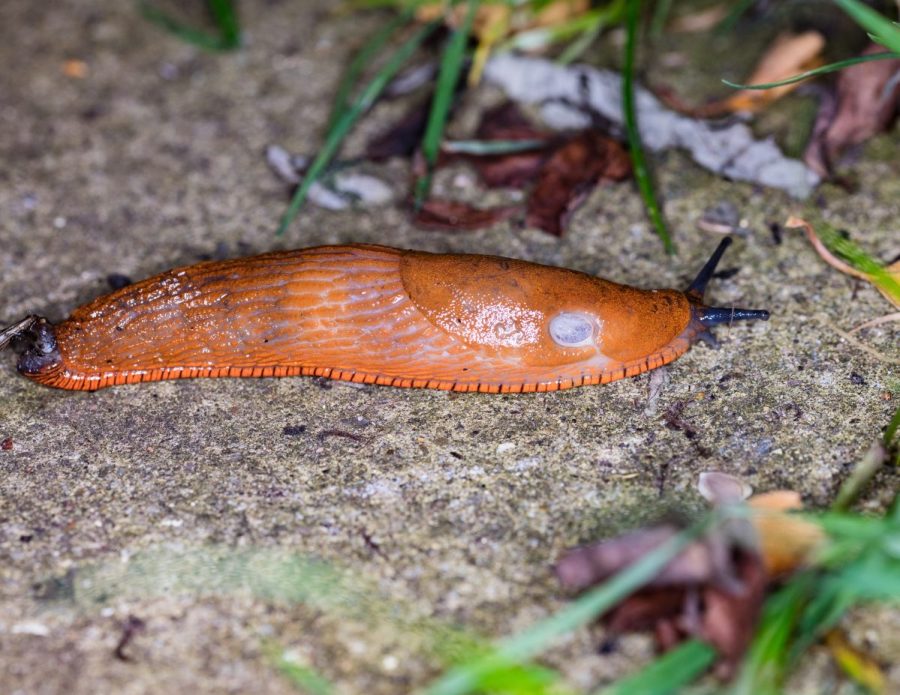
Finally, the most prolific slug pest in the UK that causes the most damage is Decoceras reticulatum (grey field slug). It’s fast for a slug, mobile and hungry. Consequently, this is the slug we mainly trial in efficacy studies.
How do slugs mostly behave?
James: This year, the spring and summer seasons have been very dry. Although growers haven’t seen slugs on the soil surface, they are still there and certainly haven’t disappeared. This is because in prolonged dry weather, slugs bury deep in the soil and wait for moisture.
As soon as moisture is detected, they move back to the surface and begin feeding which is why you want the first thing for the snail or slug to encounter to be a molluscicide pellet and not an emerging crop. Importantly, heavy dew is all it takes for slugs to detect moisture and mobilise.
Equally, when a slug is stressed it lays eggs, with one slug capable of laying up to 500 eggs. So just because it’s dry and they can’t be seen, we have to be aware of this possible building population.
Finally, slugs require food. Herbal leys, cover crops and grassland have all increased through government schemes and initiatives, and these are highly favourable to slugs. Through field margins we’re growing additional food for slugs; we’re also fostering dense rotational coverage and taller leys, creating cool and dark canopies which help to maintain slug viability and encourage egg laying.
What does effective control look like?
James: It’s actually very difficult to develop an effective molluscicide. You need the slug to encounter a pellet, decide to feed on it, continue to feed on it, ingest a lethal dose, and do all of that in one meal.
For this, the pellet must remain on the surface, be soft enough to consume but hard enough to not break down once it’s applied. It has to absorb water to be palatable without becoming mouldy, and persist for the duration of the reapplication window. It also has to be the right size to provide enough bating points across the application area.
The base of most slug pellets is a good quality wheat, dye to deter bird feeding, a central active ingredient and some other formulation components. Importantly, similar to a human, a slug doesn’t feed on just anything – it has to decide something is palatable.
However, before all of this they have to encounter a pellet, which is influenced somewhat by chance, but also by baiting point. In some instances this can be a large number of mini smaller pellets, or a smaller number of larger pellets.
Control options
James: Prior to its revocation, metaldehyde worked by effectively dehydrating slugs with rapid knockdown, while ferric phosphate functions by disrupting the digestive system of the slug so it feels unwell and feeding stops.
The latter is a completely different mode of action compared with metaldehyde, meaning the slug takes longer to die. We also don’t see deceased slugs on the soil surface because when they feel unwell and stressed, they travel deep into the soil profile and die there. Now we have a new potential option to investigate in elemental iron.
Ferrabait and elemental iron
Catherine: Ferrabait, a new molluscicide from Adama, is a complex product that contains more than 12 ingredients which all offer something unique to improve how the pellet works in the field. Among these components is elemental iron, known in this instance as Feralla, which has been proven to be a very effective molluscicide.
Once Ferrabait has been applied and ingested by the pest, a reaction takes place in the stomach of the slug due to its low pH. This causes Feralla to become bio-available in a solubised form which is quickly absorbed into the slug.
The speed of this process has been investigated in independent lab studies, which demonstrate that the fast action of Feralla is due to it being absorbed quickly. We feel it’s this speed of absorption that delivers a rapid, almost instant stop feeding effect and then mortality.
Then in addition to Feralla, Ferrabait’s formulation includes high quality wheat flours to optimise palatability, alongside humic acids which stimulate feeding and encourage ingestion. Because humic acid makes the pellet black in colour, we have to apply a blue coating over the outside of the pellet, which helps growers to know when to reapply.
Also unique to Ferrabait is Adama’s Desidro technology – a unique two-stage drying process which improves the integrity and durability of the pellet, enabling it to have robust anti-moulding properties which are important for prolonged efficacy. Ultimately, a slug won’t feed on a mouldy pellet.
Optimising application
Catherine: The maximum dose of Ferrabait is 8kg/ha in high value, high pressure situations with up to six applications per crop. However, Adama has found that 5kg/ha is sufficient for low to moderate pressure, offering 42 baiting points/m2. Applied at 7kg/ha this rises to 59 baiting points/m2.
We’ve also developed a simple spreader web-based tool for growers and contractors. This allows the user to select the type of spreader, width to spread at and product application rate. The output is the application guidance that’s required, including flute settings.
This is important to ensure the pellets are delivered in an even and accurate spreading pattern for maximum pest control.
This article was taken from the latest issue of CPM. Read the article in full here.
For more articles like this, subscribe here.
Sign up for Crop Production Magazine’s FREE e-newsletter here.