

by Guy Smith
It’s that time of year when arable farmers mull over whether it’s worth planting seed and investing in growing a crop. Someone once pointed out that farmer confidence was the best fertiliser any farm could have. The line was probably an adaption of the quote from Pliny the Elder who wrote: ‘The footprint of the farmer was the best fertiliser’.
Pliny’s point was that active fieldwalking is the basis of all good crop husbandry when it comes to the early identification of deficiencies, pests and diseases. Quite what Pliny would make of drone technology and satellite imagery I’m not quite sure, but you suspect he may have approved.
As an aside, I’ve always been curious that Pliny lived 2000 years ago, doing the rounds of Roman farms where you’d think there wasn’t much in the farmer’s toolbox to counter deficiencies, pests and diseases. But nonetheless, his wise observation holds true to this day. This enduring truism stands as testament to the fact farming is an ancient practice underpinned by lores and customs that are universal and eternal.
To return to my opening remark that farmer confidence was the best fertiliser – for fear of being a ‘Debbie downer’, you could argue that English farmers must be close to an all-time confidence low. I say ‘English’, because I’m conscious our Celtic cousins to the West and the North still get some form of the old BPS scheme, whereas in England it’s no more.
State support for agriculture has in the past underpinned farmer confidence. Rightly or wrongly, the knowledge that your business would benefit from a cash injection from the national exchequer made the perils and vicissitudes of food production easier to manage. While some might have derided this system as ‘featherbedding’, the irony is that such derision came from the mouths of the well fed who had little understanding that growing food isn’t a process based on constant certainty.
The sobering fact is that English farmers are now facing the prospect of unsupported food production for the first time since the 1930s, and anyone who knows history understands that didn’t end well by the time Adolph Hitler was blitzing the UK’s supply lines. Today, with hot and cold wars rearing their ugly heads in Europe and the Middle East, suddenly the lessons of history don’t seem just for the GCSE syllabus anymore.
Furthermore, with arable markets seemingly dependent on arbitrary decisions made by two old men, one in the Whitehouse and one in the Kremlin, you wouldn’t want to predict the wheat price this time next year when we set about selling Harvest 2017.
Another vicissitude that undermines farmer confidence is the weather, and after successive seasons of unhelpful conditions, not many of us are feeling particularly bullish. At the moment, we’re being told we face an El-Nino year which will give us difficult wet weather. With less than 2” of rain in the whole of August and September in northeast Essex, the talk of some wet weather hardly fills me with dread, but I’m mindful that one should be careful about what you wish for.
The fact we have half our arable area in CS and SFI schemes makes all this doubt and uncertainty easier to bear. But the harsh reality is, most these schemes finish at the end of 2027. Given the fiasco of the most recent round of SFI applications, I’m not exactly relishing this time next year when our renewed applications will feel like buying a lottery ticket.
So how am I feeling about arable farming at the moment? Confident? Well, not exactly. But like Pliny the Elder who chose to sail his ship towards Vesuvius as it erupted in 79 AD in the hope he might be of use, I’m currently putting seed in the ground. Give me an October morning there’s not much point in staying indoors is there?
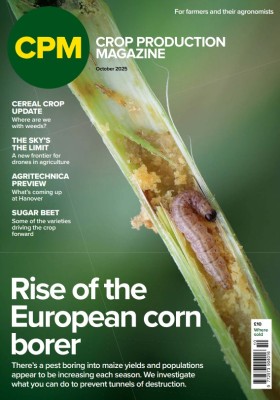
This article was taken from the latest issue of CPM. Read the article in full here.
For more articles like this, subscribe here.
Sign up for Crop Production Magazine’s FREE e-newsletter here.