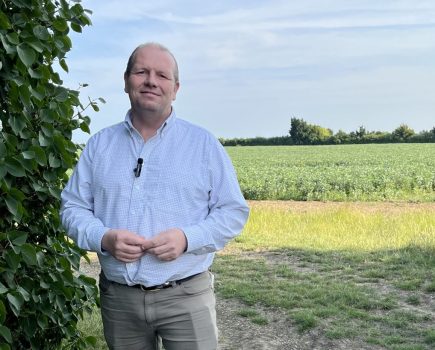


By Guy Smith
I’ll confess to having had a field or two of crops in the past that have come to very little, to the point you’d have wondered if I’d bothered to actually farm them. But, I’ve never actually had fields where I’ve decided not to bother.
However, this spring we’ve been visited by an unholy trinity of poor prices, a persistent drought and escalating input costs which have caused me to not so much shut the field gate, but to not bother to open it at all.
The plan was to sow 30ha of spring wheat; the land had been autumn cultivated ready for the drill. But as I waited for a damper forecast in mid-April, I duly heard the sound of the cuckoo. As all good farmers know, that’s the agricultural equivalent of the seven short blasts of a ship’s foghorn, signalling ‘abandon ship’.
So now in the grain store where I’d hoped 150t of top quality milling wheat might sit later this year, there’s 8t of Ladum spring wheat seed and 11t of AN fertiliser waiting for spring 2027. The only solace being at least I have some fertiliser stocked at pre-Hormuz prices.
This waving of the white flag caused me to wonder when the last time was on this farm – aside from environmental schemes – that the decision to do nothing to a field had been taken. I suspect it was probably in the 1940s when my grandfather, like many of his neighbours, occasionally opted for the a fallow rather than a crop. The motive in those days being a chance to get on top of weeds through harrowing or to build fertility by resting the land.
I have a copy of an old pre-war farm map in my office where someone has scribbled what looks like the word ‘fallow’ in a 14ac field. I doubt my grandfather had ever heard of ‘the straits of Hormuz’, let alone considered it when drawing up his cropping plans.
Given our beleaguered battle with blackgrass I’ll view this non-decision to not crop as part of a strategy to reduce the grassweed burden. Elsewhere on the farm we’re mowing our NUM3 which is full of flowering blackgrass.
As with previous years, the concern is am I mowing too early and simply encouraging the weeds to throw up more seedheads in a few weeks’ time? But, I struggle to watch viable blackgrass seeds fall to the ground to plague me another day. What I do know, is the number of blackgrass plants seems to be reducing while the amount of ryegrass seems to be increasing.
The appeal of a fallow has put into sharp perspective the fact that English agriculture is now unsupported by government. If you read your history, one of the key arguments for farm support was it encouraged farmers to take the risk of putting a seed in the ground. From the corn laws to the IACs regime a century later, these various types of support made the decision to crop less speculative.
Today in the US, state-subsidised crop assurance has the same function. Across the mid-west, cropping programmes are drawn up by farmers with this US treasury funding in mind. Meanwhile in England, there’s no notion of crop support in fact it’s the opposite – schemes that encourage arable farmers to take land out of food production. Add to this the fact that American farmers have access to cost-reducing technology such as GM as well pesticides banned here decades ago.
You can only conclude America is a much more production friendly place than my own backyard. As the Americans celebrate 250 years of ridding themselves of British government, I’m thinking of starting a campaign to make Essex the 53rd state. A scaled down version of the Statue of Liberty in the Thames estuary wouldn’t look out of place, especially if she was given a make-over of a fake tan and wore white stilettos.
This article was taken from the latest issue of CPM. Read the article in full here.
For more articles like this, subscribe here.
Sign up for Crop Production Magazine’s FREE e-newsletter here.