
by Andrew Wilson
2026 marks 100 years of the Wilson family farming on the Castle Howard Estate, which has prompted me to have a look in our archives and draw a few comparisons.
It seems there’s nothing new in farming really, bar perhaps standing power. Back in the 1960s, most cereals grown here were spring varieties, with Proctor barley hanging on right up into the 1980s when Maris Otter became more prevalent (of which Proctor is a parent). Dad persisted with Halcyon for a while but struggled to keep it standing. I remember Optic filling the malting slot for a long time in the 1990s, before Propino then Laureate took over.
In these parts, Pearl was an important winter malting barley for a good many years, then as our local markets began to favour spring varieties, our focus moved towards more modern feed varieties, though we’ve always stayed away from six-row varieties. Winter barley has stayed part of our cropping programme – in part for the early start to harvest – but also for its straw and relatively consistent performance over the years; it’s also a good opportunity to sow some cover crops before the harvest peak hits in late August.
We have two maltsters and about a dozen feed mills within an hour’s truck journey from here, so we grow what our local market requires to avoid problems at distance as far as we can.
Soft wheats tend to suit our ground better than harder varieties. In my time, Riband always excelled over Brigadier, Consort over Claire (though both soft) Robigus over Diego, and Alchemy significantly over Humber. The notable exception in the early 2000s was Napier, which did very well here as a second wheat. A prostate stance over winter is generally a very desirable trait proven over time, primarily due to the ability to harvest sunlight and suppress weeds.
What a lot of varieties have lacked and still do, is the ability to handle disease pressure, particularly yellow rust. Some only appear on the Recommended List for a very short time, which has begun to frustrate me a bit. 4t/ac was a good performance when I was a kid at school, and arguably the bar is still set at the same level, so have we moved forward?
Having looked back, with and without rose-tinted specs, the three things that stand out as most important to me are: rotation, establishment, and nutrition – the notable recent difference here being sulphur. Certain varieties suit certain slots, as they’ve always done.
We’ve farm-saved our cereal seed for a good while now and plant our spring seed cleaned only with no detriment, but I’m not yet brave enough to not dress the winter cereals. Barley also gets a manganese seed dressing, and this nutrition principle interests me as a potential biological way forward, given our success with in-furrow biostimulants in root crops. As ever, there’s always a better way to do everything, and keeping beneficial organisms alive must receive more focus.
Six years ago, I thought I’d have a go at blending varieties and observe what occurred. The main question was which specifically to blend. To me, strong traits mixed with strong traits makes stronger traits in anything in life, and vice versa, so that bases my thinking.
So, does it work? Mostly, yes. It’s important to not mix varieties with like parents, but usually my blends outyield straight varieties by between 5-10%, which more than pays for the hassle mixing the seed up to drill.
What stands clear during the years is the importance of crop rotation. It sounds obvious, but marginal gains can only be found from studying the detail. My best wheat is nearly always after my beans, then after potatoes, then oats, then the second wheats. Sometimes beans have a poor year, but they average an acceptable performance, without which the wheat average would drop.
Vigour, resilience and low input performance are chiefly what gets my attention at trial events, without which, viability becomes much more difficult. Oats and second wheats are our worst performers financially, so have both been reduced or eliminated for the time-being.
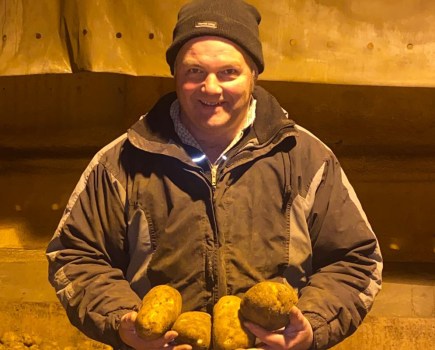
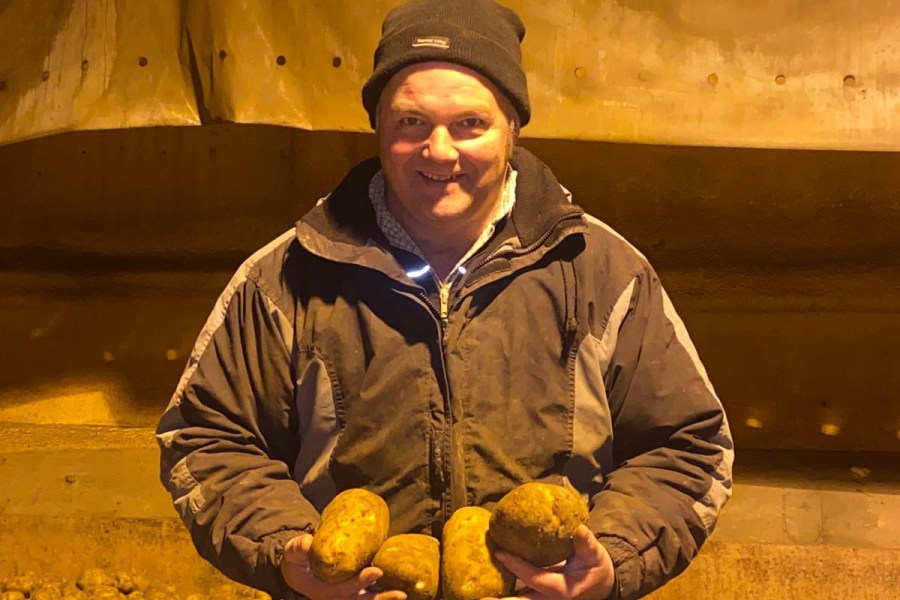
The last few weeks have held our spring cereals and sugar beet back, but potatoes planted into warm moist soils in mid-May were out in a little over a fortnight and are for the most part growing away nicely.
The sugar beet is hanging on in there, half of the hay is made, and we’re on fettling the yard up ready for a little celebration of our milestone. As I write this, we’re also in the process of setting up some recently acquired drip irrigation kit, with a view to improving our water use efficiency and hopefully produce some better crops from better timed water to boot.
Is it a better way to water? Ask me in a few months, it’s been 16 years since we last had the opportunity to hire some drip equipment, back in the day when licences weren’t required for such systems.
In the meantime, we have a little party and a farm safety event to host, so I’d better get busy with a brush!
This article was taken from the latest issue of CPM. Read the article in full here.
For more articles like this, subscribe here.
Sign up for Crop Production Magazine’s FREE e-newsletter here.