
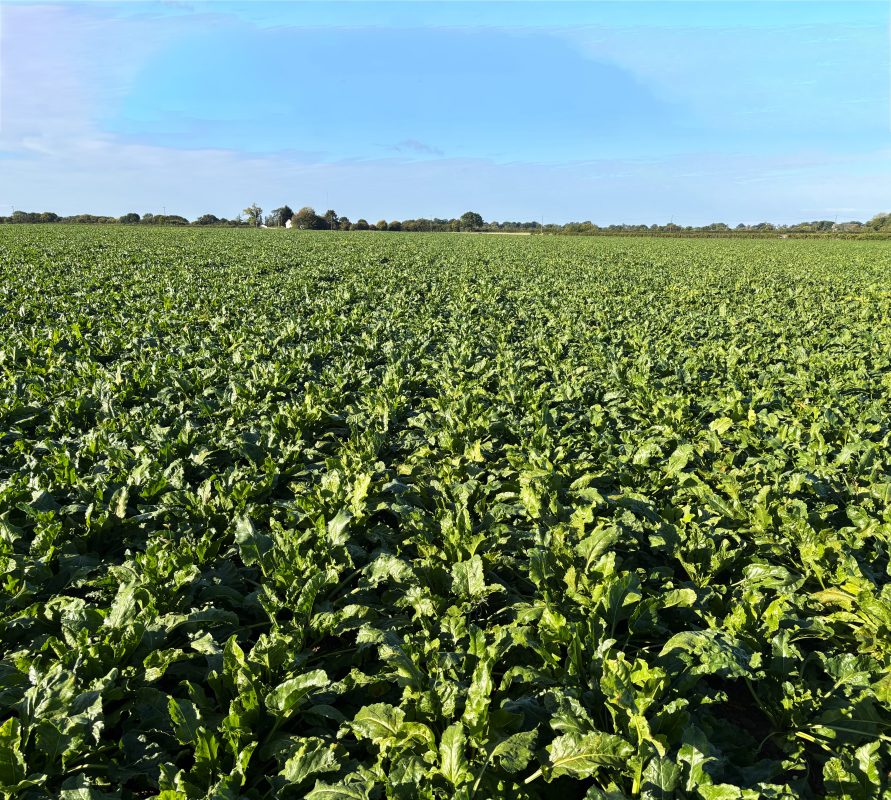
Is yield losing some of its value? As one variety remains top of the BBRO Recommended List for a sixth consecutive year, CPM asks whether the focus of breeders is changing.
“I think focus is shifting as breeders concentrate more on traits to ensure that growers can continue to deliver a crop.” PROFESSOR MARK STEVENS
By Mike Abram
Six years ago, something unusual happened in the sugar beet world – a new variety joined the BBRO Recommended List with an adjusted yield of 108.1% of the controls, a full 5% yield jump over the next best variety.
In fact, it was a yield jump that exceeded even Betaseed’s own internal predictions for BTS 1915. “It was a good variety when we looked at our internal data,” recalls Frankfurt-based Betaseed’s product manager, Dr Alexander Beesley.
“It obviously made sense to enter it into Recommended List trials. But while our breeders weren’t surprised, the leap forward in the trials was even greater than we predicted.”
The genetic basis for that performance is a closely guarded secret, with Alexander merely stating that ‘heterosis is a beautiful thing’. However, its performance hasn’t been down to one or two exceptional years, he adds. “It isn’t an accumulated average top position, every year it’s top or very nearly the highest yielding variety.”
RL trials demonstrate that it’s been the best yielding variety in four of the six individual years since 2020, while always remaining on top in the RL which is based on three years of data.
“Its yield stability over time and during a wide range of conditions and disease pressures, is one reason why it’s special, helped by its good basis for stress tolerance as seen in the untreated RL trials,” explains Alexander.
CONTINUED SUCCESS
That’s contributed to sales of more than 20,000 units per year during the past five seasons. And now, 2022 data is no longer included in the average yield in the 2027 RL table, bolstered further by an exceptionally good season in 2025 when the variety reached 107% of the controls and a 4% advantage above the next best variety for the year, KWS Chyma. This means BTS 1915 is again standing 2% ahead of its nearest competitor, ST Rotterdam in the 2027 RL.
However, BTS 1915 and Rotterdam are becoming a slightly rarer type on the list because neither have a specific trait embedded within their genetics. That could be part of the reason why BTS 1915 has remained unbeaten on adjusted yield after more than half a decade, suggests BBRO’s Professor Mark Stevens.
“BTS 1915 was, and is, an outlier of a variety in its yield performance,” he says. “But I think focus is now shifting as breeders concentrate more on traits to ensure that growers can continue to deliver a crop, rather than targeting out-and-out yield.”
Traits such as enhanced RZ2 (AYPR) rhizomania resistance, or tolerance to beet cyst nematodes (BCN), virus yellows, sulfonylurea herbicides (ALS) or cercospora, typically come with a yield penalty, at least to begin with, notes Mark.
He believes breeders concentrating on those traits is a positive. “It’s exciting for the grower base that they’re getting the tools and technologies they’ve been asking for,” adds Mark. “But, it’ll take several years for the yield drag to disappear.”
Having an outstanding yield performing variety like BTS 1915 can also mask how much yield progression is happening, he highlights. “Yield progression is happening in the traits rather than out-and-out yield; we’re not going to break yield records all the time, but genetics are helping growers to be more resilient.”
While most varieties currently have single traits, during the past two years a new variety with multiple traits has been added to the RL. Smart Nelda KWS and Smart Attala KWS both have claims for tolerance to beet cyst nematodes and ALS herbicides, with the latter variety already showing a near 2% yield improvement over its predecessor.
Even so, at 92% of the controls it’s likely to be perceived as a variety suitable for very specific circumstances. The same to a lesser extent applies to virus yellows tolerance after the introduction of ST Tweed at 99% of the controls’ adjusted yield, which brought the variety to within 2.5% of all bar BTS 1915.
That, within current production constraints, could put Tweed and other varieties with virus yellow tolerance like BTS 7870 at least in the conversation for growers. “Virus yellows is clearly an important potential yield robber in the UK,” says Richard Cogman, managing director of Strube UK, now part of RAGT. “2020 was an example of how severe it can be, in conjunction with a late cercospora attack.”
Like other breeders, Strube/RAGT’s search for virus yellows resistance began around 2015, he adds, as concerns about the future of neonicotinoids seed treatments became more acute.
Richard points out that the challenge is to find sources of resistance or tolerance to the three different viruses that make up the virus yellows complex – beet yellows virus (BYV), beet mild yellows virus (BMYV) and beet chlorosis virus (BChV). “We have two-thirds of the story with tolerance to the poleroviruses BMYV and BChV, but not the closterovirus BYV.”
SHIFTING PRESSURE
Historically, BMYV has been the most prevalent of the viruses in the UK, with BYV more sporadic, but more recent research by BBRO’s Dr Suzannah Harder suggests in 2019-2022, BChV was the most widespread.
For the work, Suzannah used a novel sequencing approach that quantifies the amount of virus genome present in virus yellows symptomatic plants. This measured incidence as either ‘high confidence’, where the vast majority of the virus genome had to be present within the plant for a ‘positive’; or ‘low confidence’, if there was simply more virus genome than any of the negative controls, she explains.
Using the high confidence threshold, the average incidence of BChV during the three years was 67%, compared with 33% for BYV and just 2% for BMYV. Using the low confidence approach, BChV incidence was 85%, BYV 39% and BMYV also 39%.
“The percentages don’t add up to 100 as some samples had more than one virus,” she notes.
In BBRO Goliath trials where every single plant is inoculated with one of the three viruses, the last year for which there is data, Tweed retained 88% of its uninoculated adjusted yield in the BChV plots and 95% in BMYV.
Typically, those two viruses can reduce yield by around 25%, while BYV is potentially more damaging with yield losses of up to 50%. In the 2024 Goliath trials, Tweed retained 63% of its yield in the 100% inoculated BYV plots.
Achieving those results in just 10 years is a good demonstration of the yield progression within the trait, points out Richard. And while the headline yield of Tweed is 4.4% lower than BTS 1915, that’s just about on the limit of what’s statistically significant, with BBRO noting on the 2027 RL that differences in adjusted tonnes of less than 4.4% should be treated with caution, he adds.
“You could argue that all of the other key decisions like selecting the correct seed spacing, drilling depth, drilling speed to maintain spacing and placement into moisture, timing and rate of nitrogen, fungicides and insecticides, and weed control management, all have a far bigger impact on final yield than one LSD on yield.”
Deciding between a virus yellows tolerant variety and a potentially higher yielding option ultimately comes down to attitude to risk, comments Richard. This is because unfortunately, within the current system, it’s virtually impossible to order a specific variety after the Rothamsted virus yellows risk forecast is made at the beginning of March. Equally, it isn’t possible to produce an accurate earlier forecast because weather data in February and March is highly variable.
While a potential option that’s been mooted is a flexible seed ordering system which allows late substitutions, this currently appears unlikely due to the logistics for suppliers holding extra quantities of seed.
That means for virus yellows tolerance to become more widely used – the area of Tweed being grown is well under 5% of the total area – the yield drag will have to be eroded further, states Dr Alistair Wright, BBRO’s head of crop protection. “Just as it’s been the case for any other specific trait such as rhizomania resistance or BCN tolerance, growers typically want a high yielding variety before they make the jump.”
More data will also help. Last year’s Goliath trials failed because of the very dry spring, which was difficult for both establishment and aphid survival, adds Alistair. “We’ve moved site to the Elveden Estate where it can be irrigated, which will keep the aphids happy, beet moths at bay, and guarantee we get some data.”
One more year of reliable data will help BBRO to provide a rating of how tolerant a variety is to each of the three viruses. “Clearly if you have a very high yielding variety that isn’t that tolerant you could be in a worse situation than growing a slightly lower yielding variety that is very tolerant,” suggests Alistair.
“Using that data, we’ll be able to provide a cost-benefit analysis and help in interpretation. It might be that these varieties are best used for later drilled crops when the virus risk is higher, or we encourage growers to order at least a third of their seed with virus yellows tolerance. There are a few scenarios we can simulate once we have a few viable options,” he concludes.
This article was taken from the latest issue of CPM. Read the article in full here.
For more articles like this, subscribe here.
Sign up for Crop Production Magazine’s FREE e-newsletter here.