
During a season of volatile input costs and extreme weather conditions, tuber and foliar diseases and virus risks increase the agronomic challenges further for potato growers. CPM provides an update on the current season.
“In blunt terms, the issues that give greatest cause for concern are black dot, alternaria, late blight and virus.” ERIC ANDERSON
By Andrew Watts
The war in Iran has led to tighter supplies of key inputs such as urea, ammonia and sulphur, and caused intense volatility in the price of oil. The result of this market turmoil has been to increase production costs, as such, the impact of higher diesel prices is being felt acutely across agriculture, compounded by the dry weather that followed planting.
Eric Anderson, Scottish Agronomy senior agronomist, notes that this season’s irrigation requirements will hit the bottom line hard. “Many growers, especially those in England, with the capacity to irrigate have had to start early as a result of below average rainfall.
“In our model farm, a seed grower using roughly 228 l/ha for irrigation, the cost increase is about £116/ha, assuming red diesel at 119p/l. A typical ware grower dependant on irrigation and consuming roughly 541 l/ha, the cost increase is about £276/ha. Then, assuming 160ha of crop producing 9000t of packing potatoes, the additional costs exceed £44,000,” he explains.
Consequently, many may desire to cut crop input costs to potentially restore profitability, but any savings may be insufficient to cover the consequences of poor disease and virus protection, he stresses. “In blunt terms, the issues that give me the greatest cause for concern are black dot, alternaria, late blight and virus.
“The larger area of Maris Piper compared with recent years is also a potential problem – it gives packers greater choice in an over-supplied market but the variety’s challenging agronomy increases the risk to the grower.”
The re-emergence of black dot (Colletotrichum coccodes) as a concern largely reflects the cultural practices favouring disease spread and the lack of fungicidal control measures. Instead, proper harvest scheduling and store management are perceived as the best means of minimising disease severity.
“The main concern with black dot is the impact on the appearance of pre-pack and salad potatoes, which are highly valued for their visual quality. It results in higher growing costs through extended rotations and more agronomy, while skin blemishes result in price deductions,” says Eric.
Managing black dot is a complicated affair, he notes. First, the sclerotia can exist in the soil for up to eight years and survives easily on seed and debris; most ware crop land is thought to be infested. Second, symptoms on the canopy aren’t always obvious, making early detection difficult. Then, black dot is often confused with other skin diseases during storage.
Variety resistance is limited with all options tending to show the same rate of disease development on below-ground stems, stolons or roots, indicating that resistance is limited to tubers.
“Wherever possible, avoid delaying harvest. Leaving tubers in the soil for three weeks or more after haulm destruction has been found to lead to increased disease development. Temperatures at store loading too are important, but this is often variety specific,” explains Eric.
At some point the season will right itself, and when it does, the crop will want to access the nutrients it requires, highlights Farmacy agronomist, John Chamberlain. “I’m not a huge believer in foliar feeds, but there are some foliar P & K products that may have a place this season. Phosphites too may warrant closer consideration, especially at tuber initiation depending on the soil texture and what nutrients are available to the plant,” he says.
“I’ve also had worthwhile experience with bittersalz – rather than straight magnesium liquid – as a stress alleviator during periods of dry weather. It may be anecdotal, but much like many have experienced with seaweed extract, crops appear to be healthier.”
The biological effects of products high in plant-based amino acids in stimulating growth and nutrient uptake aren’t fully understood, but for John they fulfil a role.
“There are questions to answer as to how we assess and manage stress in crops and whether bio-stimulants can help to alleviate these symptoms. In many cases, heat stress merely exposes an underlying issue, such as compaction or pest attack, both of which could be better managed. But, we could also do more to reduce the severity of stress through better agronomy,” he suggests.
Modelling indicates that the peach-potato aphid, the principal virus vector affecting potatoes, is expected to fly three weeks earlier in England than in a typical year. Of further concern is the confirmation from Rothamsted Research that peach-potato aphids taken from oilseed rape crops at several locations across England have been found to exhibit resistance to the neonicotinoid insecticide acetamiprid (as in InSyst).
“This is a worrying development and leaves only flonicamid (as in Teppeki) and spirotetramat (as in Movento) for control of peach-potato aphids. Both carry usage restrictions that will limit the protection growers can expect to achieve,” raises Eric.
Predictive models indicate a high risk of both potato virus y (PVY) and potato leaf roll virus (PLRV) to crops in Scotland in 2026. Both viruses are of considerable importance to seed growers, and are vectored by peach-potato aphid.
The incidence of PLRV especially is concerning, says Eric – the symptomatic expression of PLRV observed during field inspections of seed crops has more than doubled since the early 2020s. “PLRV is a threat that has to be taken seriously. Potato groundkeepers are the most likely reservoir of virus for infection, so should be controlled with ruthless determination,” he adds.
The threat posed by virus is also acknowledged by John; nor is it restricted to higher value seed crops. “I have seed crops in Essex which are an obvious concern given the number of aphid vectors and the limited means of control, but I’m also mindful that ware crops can suffer direct effects too.
“I once had a crop of Markies on the Cambridgeshire Fen that was so heavily infested with aphids that the extent of feeding affected the crop itself, so we can’t afford to think of aphids as solely a virus threat to seed crops,” urges John.
Moving to blight, reports that growers across Europe, and to a lesser extent England, are seeking to recover the costs of unsold crisping and processing crops by planting progeny tubers is likely to result in some nasty surprises, warns Eric.
“The harsh economics of potato production has forced growers to pursue extreme measures. Many take the opinion that having paid up-front for their seed and fertiliser, spend on fungicides and insecticides is discretionary.
“This attempt at cost saving manifests in several forms, including extended intervals and less robust applications. But planting infected seed is often overlooked, as is the significance of groundkeepers as a reservoir of disease.”
Of specific concern is the confirmation of EU43 in Suffolk in 2025, found on a volunteer plant that emerged from the crop harvested earlier in the year.
“The fear is that has spread within the region. As a strain, its resistant to CAA fungicides such as mandipropamid. We also have strains resistant to fluazinam and OSBPI fungicides such as oxathiapiprolin, all which serves to add further complication to programmes,” says Eric.
It’s simple, but John urges growers to remain vigilant. “The basic message is to maintain dose rates, rotate modes of action and don’t apply products solus.
“The issue facing growers and us as advisers is that there are degrees of resistance with all products and active substances. The challenge is to ensure we develop mixes that give sufficient coverage to deliver protection.
“It’s because of the necessity to steward the products we have left that we no longer make sequential applications of the same product,” he adds.
John believes the best solution is to seek a balance. “The temptation is to extend spray intervals and switch to the less expensive products, but this is misguided. Avoid sprays featuring only a single mode of action,” he says.
The arrival of strains with resistance to oxathiapiprolin means only propamocarb offers any meaningful activity as an anti-sporulant. Bayer advises a maximum propamocarb application of 6060g active substance per hectare per year. Assuming Infinito (fluopicolide+ propamocarb) is applied at the maximum individual dose rate of 1.6 l/ha, four times per crop (the maximum permitted number), this is equal to 4000g, leaving 2060g available for use as a mix partner.
“Where an anti-sporulant is required, use a tank mix partner either Axidor/Proxanil (cymoxanil+ propamocarb) or Sporax/Previcur Flex (propamocarb) along with Ranman Top (cyazofamid). Or, apply Infinito as a co-formulated product, but remember that it requires two hours drying time on the leaf after application,” explains Eric.
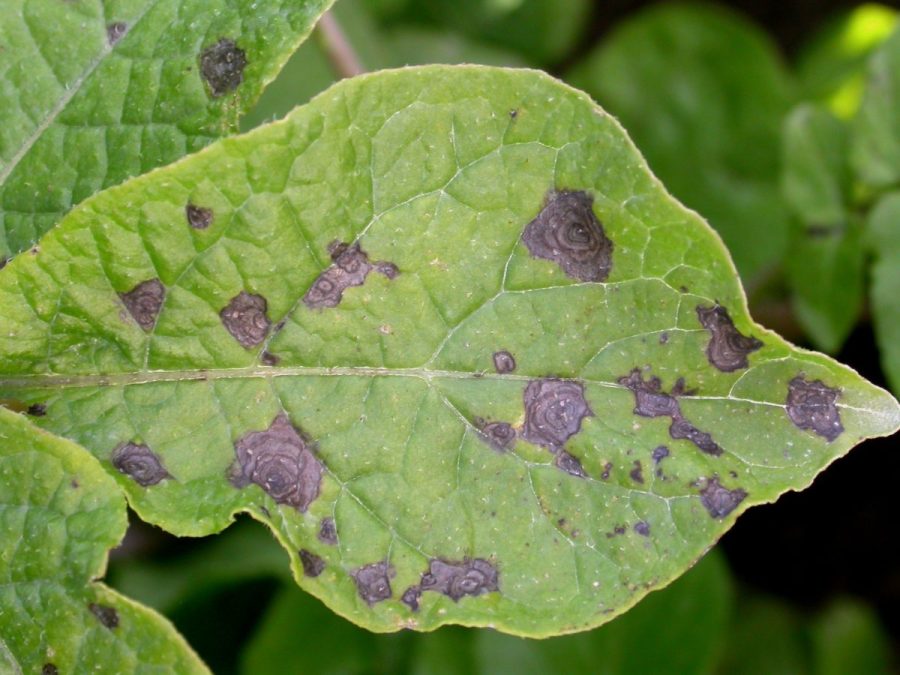
While alternaria isn’t a new disease, the loss of mancozeb and the emergence of strains resistant to certain classes of fungicide mean it represents a threat to crops, suggests John. “I fear the combination of hot weather and widespread use of irrigation will create conditions conducive to its development. Add the impact of stress – especially in unirrigated crops – in raising susceptibility, that some fields will have a history of alternaria, and that some varieties are more heavily affected, and it’s clear there’s much to consider,” he concedes.
In higher risk situations or with more susceptible varieties, a typical alternaria programme uses up to six sprays, highlights Eric. In a lower pressure situation, two sprays may suffice, however if around 10% of the canopy already shows symptoms, it’s likely too late, he says.
“Start mid- to end-of-flowering, preferably with Narita (difenconazole) or Belanty (mefentrifluconazole). Follow with Caligula (prothioconazole+ fluopyram) before alternating Caligula with products containing difenconazole at 14-day intervals. Do not cut dose rates,” stresses Eric.
As with other many other diseases that develop quickly, it’s worth noting that alternaria fungicides must be applied in a protectant manner. “I’m confident that we can keep crops clean, but I’m not being complacent,” says John.
“We have to exercise common sense – watch crops closely, be aware of what’s happening with other crops in the area, and be ready to spray as soon as necessary. However, we’re all having to learn on the job with alternaria,” he concludes.
This article was taken from the latest issue of CPM. Read the article in full here.
For more articles like this, subscribe here.
Sign up for Crop Production Magazine’s FREE e-newsletter here.