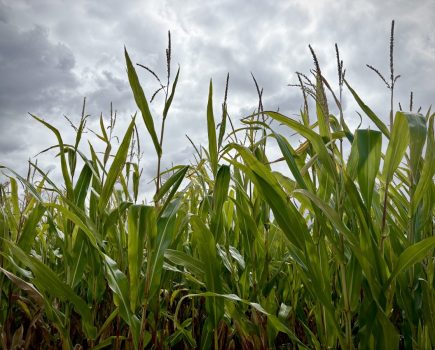


With pressure mounting on traditional break crops and margins under continued scrutiny, interest is growing in alternatives which can deliver rotational value without bringing excessive agronomic complexity. CPM finds out why for some growers, flax is beginning to tick those boxes once again.
“Once people actually grow modern flax and see how it performs, perceptions change very quickly.” ALEX BULL
By Charlotte Cunningham
For a crop once commonly associated with continental Europe more than mainstream UK arable rotations, flax is beginning to attract renewed attention on this side of the Channel. As pressure continues to build on traditional break crops and growers look to spread risk, reduce inputs and improve rotational resilience, both winter and spring flax are steadily finding their way back into the conversation…
According to the team at Premium Crops, today’s flax bears little resemblance to the varieties many growers may remember from decades ago, with modern breeding, improving agronomy support and stronger market opportunities helping to reshape perceptions of the crop.
“People shouldn’t be scared of it,” says Alex Bull of Premium Crops. “We’re growing it very similarly to linseed and so far, we haven’t had any reported harvesting issues. It’s actually proving to be a very manageable crop.”
While flax production remains far more established across continental Europe – particularly in France – UK interest is increasing as growers search for reliable alternatives to oilseed rape and look to spread workload and risk across the rotation.
INTERNATIONAL MARKETS
For Premium Crops, the current focus is largely centred around seed production for the French market, rather than fibre production, with both spring and winter options available to UK growers.
The two crop types occupy slightly different positions within the rotation. Winter flax is drilled in early September and fits broadly into the same slot as OSR, while spring flax offers growers another spring break crop option. “It’s brilliant in the rotation for the following crop,” says Alex.
“We’ve had several reports of wheats looking noticeably better after flax or linseed-type crops, and that’s likely linked to the crop’s strong AMF (arbuscular mycorrhizal fungi) relationship.”
From an establishment perspective, one of the main selling points is simplicity, continues Hannah Foxall, company agronomist. “There’s no need for specialist equipment – if you have a cereal drill, you can grow flax. The row widths are the same and it fits into standard systems very easily.”
As a small-seeded crop, attention to placement remains important, but otherwise agronomy is relatively straightforward, she adds. “As long as you don’t bury it too deeply and establish it in good conditions, you’ll be absolutely fine.”
Importantly, the crop also appears to have few geographical limitations within the UK. “As far as we’re aware, it can be grown anywhere,” says Hannah. “We haven’t yet found somewhere it can’t grow.”
That includes Scotland, where Premium Crops has deliberately tested varieties to assess winter hardiness. “We trial everything in Scotland because we get a lot of questions around hardiness,” explains Alex. “It’s effectively torture-testing the varieties. If they survive Scottish winters, that gives growers confidence in the crop.”
Although flax shares many similarities with linseed agronomically, one of the major areas of development in recent years has been crop protection approvals.
“There’s now a much better range of pre-emergence options available,” explains Hannah. “For winter flax, growers have Avadex (tri-allate) granules or liquid, while products such as Callisto (mesotrione) and Katamaran (quinmerac+ metazachlor) also offer flexibility for both grassweed and broadleaf weed control. A new addition is Emerger (aclonifen) pre-emergence for grass and broad leaf weed control.”
However post-emergence, blackgrass remains one of the key concerns raised by growers considering the crop. “Centurion Max (clethodim) gives a good option for blackgrass control,” she says. “Then products like Falcon (propaquizafop) help to tidy up volunteer cereals, wild oats and bromes.”
INCREASING TOOLBOX
Broadleaf weed control options are also improving, with products such as Eagle (amidosulfuron) for cleavers, Jubilee (metsufluron-methyl) for most things and Shield Pro (clopyralid) providing additional flexibility.
Disease management similarly mirrors linseed in many respects, although winter crops require particular attention during the autumn, advises Hannah. “One of the key diseases we watch for is pasmo,” says Hannah. “Winter crops generally require a slightly more robust fungicide programme, so we’ll often use something like difenoconazole or metconazole in the autumn.”
Metconazole also provides plant growth regulation benefits, helping to shorten the crop and improve harvestability. “That’s important because we’re growing flax for seed rather than fibre,” explains Hannah. “We’re not trying to create a large, tall fibre crop, so managing height becomes useful.”
Later in the season, focus turns to disease that affect seed quality, with alternaria being a concern post-flowering, she adds. “Not everyone fully realises how important that is in terms of maintaining seed quality.”
Nutritionally, flax is relatively modest in its requirements compared with some mainstream crops. “As long as phosphate and potash indices are sensible – around Index 2 or 2 minus – then we’re generally looking at somewhere around 40-50kg/ha with N at 100-120kgN/ha maximum,” says Hannah. “But nutrition is tailored field by field because we’re focused on achieving the required seed quality.”
In-season management is also comparatively uncomplicated. “You’re not having to constantly travel through it like you might with wheat or OSR,” points out Alex. “There are no issues like cabbage stem flea beetle to contend with and overall, it’s proving a relatively easy crop to manage.”
SEEDBED PREP
Spring flax does bring one pest consideration in the form of flax flea beetle, but unlike CSFB in OSR, growers still have workable control options available. “The key thing is achieving a good seedbed,” explains Hannah. “Where growers come unstuck is often poor establishment rather than the pest itself. If you establish the crop well, pyrethroid chemistry still provides good control.”
At harvest, management again closely resembles linseed and timing is largely dictated by seed colour rather than moisture content. “People can sometimes wait too long,” warns Hannah. “But if you focus on seed colour when deciding on desiccation timing, you’ll generally be fine.”
Winter flax is typically harvested in July or early August, while spring flax generally follows in late August or early September. Direct combining is possible and, according to the team, remains the preferred approach in most situations.
Meanwhile, storage management requires some care due to the aerodynamic nature of the seed. “You don’t want to store it too deeply because airflow becomes restricted,” explains Hannah. “Around a metre depth maximum is sensible. It’s simply about keeping air moving through the crop and looking after it properly because it’s a valuable seed crop.”
From an economic perspective, flax is naturally attracting attention. With input prices continuing to rise, growers are increasingly scrutinising crop gross margins and questioning whether high-input cereals still stack up. For Alex, that’s where flax can offer a compelling alternative.
“If nitrogen rises to £700/t again, suddenly putting 236kgN/ha onto wheat becomes a very different calculation,” he says. “Whereas if you’re growing flax on 120kgN/ha, the economics can look very attractive.”
To help reduce market volatility, Premium Crops operates buyback contracts across its flax offering. “With any minor crop, I’d always encourage growers to use a buyback contract,” advises Hannah. “It gives security and allows farmers to budget properly from the outset.”
Current spring flax contracts sit around £1200/t, although the payment structure is split to reflect seed quality standards. “There’s a fixed base payment of £650/t,” explains Hannah. “Then the balance is made up depending on meeting seed crop inspections and quality criteria.”
Looking at the wider market, Alex says appetite currently remains strong. “We’ve never had a year where we’ve said we’ve produced too much linseed,” he says. “The market is hungry for tonnage and there are more avenues opening up all of the time.”
That includes renewed interest in fibre markets, with several businesses exploring the use of flax and hemp for textiles and industrial materials. “It’s an old market, but also a very new one again,” suggests Alex. “There are definitely businesses coming through now which look more promising in terms of fibre production. That could ultimately help strengthen the whole sector because multiple market avenues help to support commercial viability.”
OUTDATED VIEWS
Despite the renewed interest, both Alex and Hannah believe one of the biggest barriers remains outdated perceptions. “A lot of growers still remember varieties from 25 years ago,” says Alex. “But breeding has moved on massively since then.”
Much of that breeding work currently originates from France, where flax production and research remain far more advanced than in the UK. Premium Crops works closely with continental breeders, extensively trialling material under UK conditions before commercial release.
“There’s a huge amount of background work that growers don’t always see,” says Alex. “A variety entering the market today may have first gone into trials 10-15 years ago.”
For Premium Crops, that ongoing development – combined with stronger agronomy support and improving market opportunities – means flax is no longer simply a niche curiosity. Instead, it’s increasingly being viewed as another realistic tool for spreading risk and improving rotational resilience.
And while the crop may still sit outside the mainstream for many UK growers, Alex believes attitudes are beginning to shift. “It’s really about farmers not being nervous to try something different,” he concludes. “Once people actually grow modern flax and see how it performs, perceptions change very quickly.”
This article was taken from the latest issue of CPM. Read the article in full here.
For more articles like this, subscribe here.
Sign up for Crop Production Magazine’s FREE e-newsletter here.