
As PGRO prepares to take ownership of the pulse YENs this autumn, focus is shifting from headline yields towards practical, field-scale performance. With new technology, streamlined reporting and a stronger emphasis on commercial relevance, CPM explores what the next chapter could mean for UK growers.
“If you’re not getting return on investment from what you’re putting into the crop, then why are you doing it?” ERIN MATLOCK
By Charlotte Cunningham
For a crop group that continues to divide opinion across UK rotations, pulses arguably punch above their weight when it comes to discussion around sustainability, home-grown protein and rotational value.
Yet despite their benefits, peas and beans have long struggled with one recurring criticism – inconsistency. Whether it’s establishment, disease pressure, bruchid beetle or simply a lack of confidence around management decisions, many growers still view pulses as crops with potential, rather than dependable performers.
That’s one reason why the pulse Yield Enhancement Networks (YENs) have become an increasingly valuable tool during recent years. Originally developed and run by ADAS, the YEN concept was designed to help growers benchmark performance, compare approaches and better understand the gap between current and achievable yields.
Now, the pea and bean YENs are entering a new chapter…
This autumn, the PGRO will officially take ownership of the pulse YENs, with ambitions not only to modernise the platform, but also to reshape what success looks like for pulse growers. And according to PGRO research agronomist Erin Matlock, the timing feels just right.
“ADAS made the decision to discontinue the YENs, but PGRO really felt there was still a lot more to learn with peas and beans,” she explains. “Previously it was already a collaboration between ADAS and PGRO so we’ve been involved with it anyway.
“These crops still have huge potential, and benchmarking is one of the best ways we have to continue learning from what growers are doing commercially.”
PERFORMANCE FOCUS
While the YEN name has become synonymous with pushing crop performance, Erin believes one of the biggest changes moving forward will be a subtle but important shift in emphasis. At Cereals this year, PGRO formally launched the rebranded Pulse Performance Network (PPN) — a move designed to reflect a broader view of crop success. “Yield remains important, but it’s really about performance,” notes Erin.
“If you’re not getting return on investment from what you’re putting into the crop, then why are you doing it?We want to move away from the idea that success is simply throwing everything at a crop to chase the highest possible yield.”
Instead, the focus is increasingly turning towards achievable, commercially relevant gains which growers can realistically implement at field scale, she adds.
That philosophy is also feeding directly into changes planned for the reporting structure itself. According to Erin, future reports will place greater emphasis on yield potential achieved rather than outright yield alone, alongside clearer benchmarking against five-year averages to help growers better contextualise seasonal performance. “There’ll be less emphasis on ‘highest yield wins’ and more focus on continuous improvement,” she explains. “The reports are also being redesigned to make them much easier to interpret at farm level.”
One of the planned additions is a front-page summary highlighting key strengths and opportunities for improvement, with concise bullet-point recommendations designed to make the findings more immediately useful for management decisions. “The aim is to make it much more grower-focused,” highlights Erin. “Instead of a scientific report, we want growers to be able to look at it and quickly understand what they’re doing well and where they might improve.”
That commercial practicality could prove important for widening participation too. Because while YEN has delivered some exceptional pulse yields during the years, there may have been a perception that entries are dominated by highly intensive systems which don’t necessarily reflect mainstream commercial farming.
However, Erin believes the new approach could help address that. “We’re looking much more at field-scale learning,” she says. “Two or three hectares managed completely differently doesn’t necessarily reflect how most growers farm commercially.
“We still want growers benchmarking themselves against the wider industry, but it’s more about optimising performance within realistic commercial systems.”
Alongside the philosophical shift comes a practical one too, with PGRO developing a dedicated app aimed at simplifying participation and reducing the administrative burden often associated with YEN entries.
The platform is expected to allow growers to input data directly from the field throughout the season, rather than retrospectively collating records months later. “Instead of sitting at a desktop in October trying to remember everything you did through the season, growers will be able to input information on their phone while they’re in the field,” says Erin. “It sounds simple, but that ease of use could make a big difference.”
PGRO demonstrated an early beta version of the app at Cereals earlier this month ahead of the first full PPN season beginning with winter bean drilling this autumn.
KEY PRIORITIES
Streamlining data capture is seen as one of the organisation’s major priorities, particularly if participation is to expand beyond the highly engaged core of current entrants. And for Erin, encouraging wider uptake is important not only for individual businesses, but for the wider pulse sector too. “The more growers we have involved, the more we learn,” she says. “Particularly with pulses, there are still so many unanswered questions compared with some of the larger combinable crops.”
That lack of historic research depth is something she believes continues to hold pulses back, but there is opportunity to improve this outlook, she suggests. “We know there are still gaps in understanding around agronomy, crop management and consistency. Benchmarking helps to identify where those opportunities are.”
The new direction for PPN also links closely with PGRO’s wider pulse research activity, including its involvement with the Nitrogen Climate Smart (NCS) project – led by the PGRO – and other initiatives focused on increasing pulse productivity and utilisation.
During recent years, those projects have begun generating greater insight into areas such as drilling date, fungicide strategy and crop management – subjects Erin says are already emerging clearly through YEN benchmarking data. “One of the biggest things we keep seeing is the importance of drilling date,” she explains. “Don’t leave peas and beans until last if conditions are suitable.
“We’re also seeing more evidence around fungicide use. Even where disease pressure might appear low, we’re often still seeing return on investment from at least one fungicide application.”
Looking ahead, PGRO is also keen to integrate more collaborative industry-led work into the network through smaller focus groups involving manufacturers, breeders and processors. Potentially, these could involve anything from variety-specific groups through to biostimulant trials or targeted management investigations, explains Erin. “We want companies to come forward with ideas. If a manufacturer wants to investigate a product properly with growers, we can build a protocol around that and then disseminate the findings afterwards.”
Importantly, she stresses the intention is for those groups to remain practical and commercially grounded rather than purely experimental.
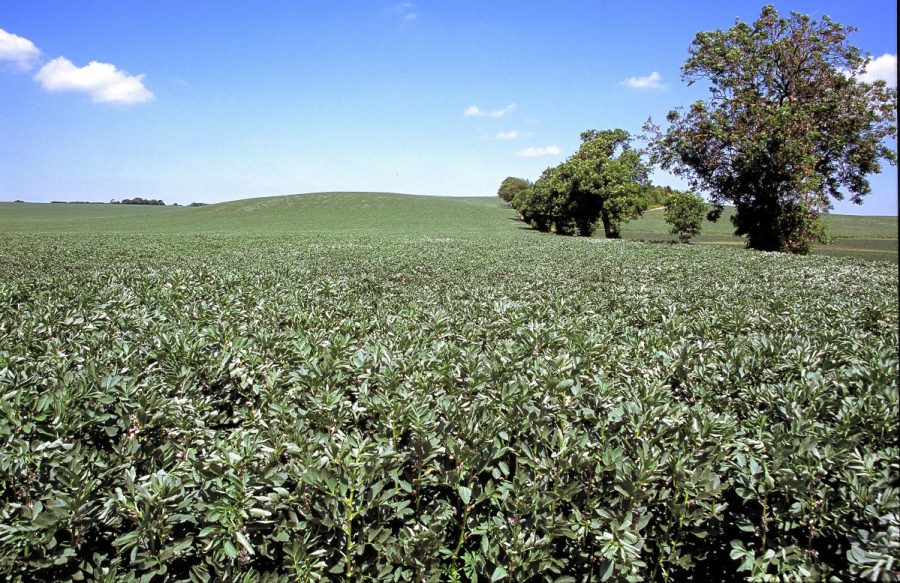
For West Sussex grower Andrew Gentle, benchmarking has already become an important management tool within the business. Farming around 890ha near Chichester, Andrew grows a range of combinable crops alongside forage maize, with beans now established as a key part of the farm’s six-year rotation.
“We used to be pea growers but consistency became more difficult – particularly with pigeon pressure,” he explains. “Eventually we started looking at beans more seriously and they just fitted the system much better.”
RELIABLE BEANS
Compared with peas, he says beans have offered greater reliability operationally as well as financially. “They’re planted earlier, harvested later and don’t clash with milling wheat harvest,” he adds. “During a five-year period, the margins were considerably better than peas.”
Importantly, Andrew says the business approaches beans as a crop worth actively managing for performance, rather than simply a useful rotational break. “We don’t really see them as a crop that just has to wash its face financially,” he comments. “We’re aiming to push yield and make them consistently profitable.”
That mindset was one reason the farm initially became involved with YEN several years ago. “I liked the benchmarking side of it straight away. It gives you an understanding of where you sit against other growers.”
But beyond the headline results, Andrew believes the real value comes from the detail within the reports themselves. “You can see how your fungicide use compares, or your insecticide strategy, or whether you’re spending more than other growers,” he explains. “In our case, we probably do spend slightly more on beans than others, but equally we’ve consistently been towards the higher end of yields, so it gives confidence in those decisions.”
The reports have also helped to prompt more strategic thinking around crop direction, too. Historically, the business targeted human consumption bean premiums, but benchmarking data helped to highlight how insecticide use against bruchid beetle compared with other growers. “That probably started the conversation around whether chasing human consumption was still worthwhile. Now we’re perhaps more relaxed about growing feed beans if that’s the better fit commercially.”
He believes that ability to challenge assumptions is in fact one of YEN’s biggest strengths. “It makes you look at your crop in a different light and sometimes it opens your eyes to things you perhaps hadn’t considered.”
And while participating does require some organisation throughout the season, he argues the workload is manageable. “Most growers are walking crops regularly anyway, and a lot of agronomists are happy to help with it,” he points out.
With PGRO now preparing to take the network forward, Andrew believes the opportunity lies in helping more growers to build confidence in pulse production through shared learning and benchmarking. “We can grow very good pulses in this country, but consistency is still probably the challenge, particularly with peas,” he concludes. “So anything which helps improve understanding and helps growers to get more from the crop has to be a good thing.
This article was taken from the latest issue of CPM. Read the article in full here.
For more articles like this, subscribe here.
Sign up for Crop Production Magazine’s FREE e-newsletter here.