
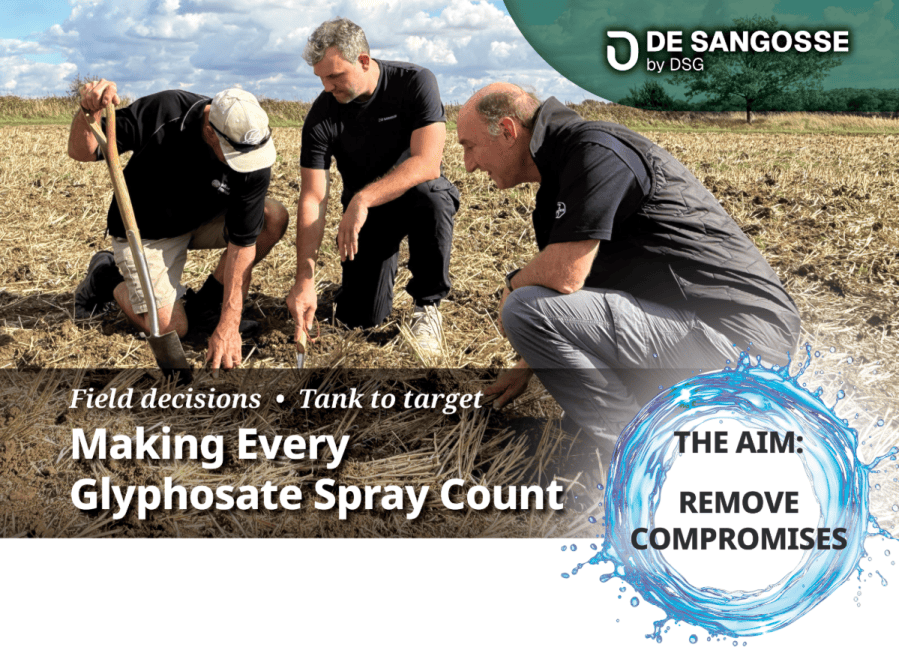
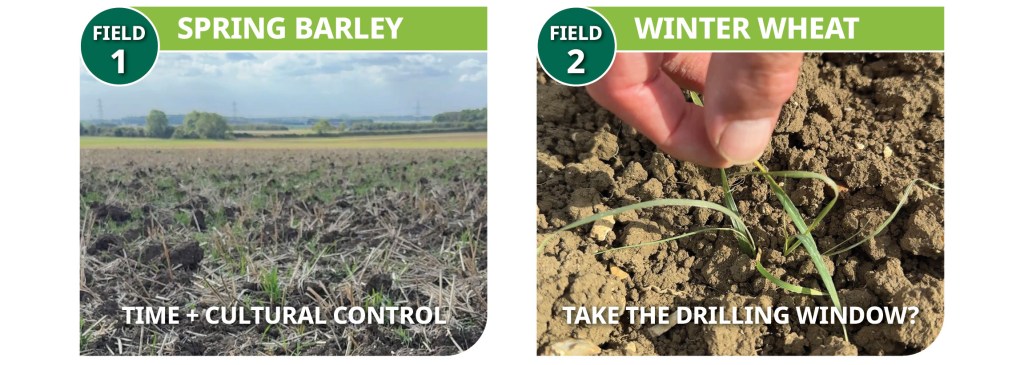
Standing in a recently cultivated field at Midloe Grange Farm in Cambridgeshire, blackgrass initially looks relatively insignificant. However, look a little closer, and considerably more plants begin to appear.
This is a useful illustration of the first challenge growers face ahead of a pre-drilling glyphosate application, suggests Bayer’s Roger Bradbury. “When you first walk into a field you can think there isn’t much there, but once you get closer, there may be a lot more than initially imagined.”
For farmer and application specialist David Felce, the field in question is destined for spring barley. While it wasn’t considered a particularly bad field, a relatively poor wheat crop the previous season left more space for weeds than he’d have liked, hence the spring cropping.

The area has already received one cultivation and David’s preference, conditions allowing, would be to cultivate again rather than immediately reach for glyphosate.“I want to get the soil right first,” he states. “Because we’re going into a spring crop, I’d prefer another cultivation under these conditions and then try to take out another flush if we get one in the autumn or early spring.”
That decision also avoids treating too early only to have further weeds emerge later – a reminder that making every glyphosate application count doesn’t necessarily mean making more applications.
“There’s no true replacement on the horizon for glyphosate,” adds Roger. “We have to use it responsibly, including considering cultivations.”
Moving to another field, this has been ploughed and left as a stale seedbed for around three weeks, with Roundup applied approximately 4-5 days prior to the time of writing. Its effects are beginning to become visible in the volunteers.
With blackgrass pressure relatively low but future conditions uncertain, David says his inclination is to drill soon, get it rolled down and apply a pre-em. “If I choose to wait for more blackgrass to come, what is the cost of that in terms of the weather and drilling conditions we might face? It’s a gamble whichever way we go.”
The contrast between the two fields is significant – one has time on its side and further cultural control opportunities; the other requires a judgement between waiting for potentially more weeds to emerge and taking advantage of good establishment conditions.
Making it count
Where glyphosate is the right intervention, weed size and species matter. In the spring barley field, much of the emerging blackgrass is still at the seedling stage – an inherently good stage for control. Roger says 540g glyphosate/ha is appropriate only for very small seedling blackgrass; then as plants move towards three leaves and begin tillering, he recommends at least 720g/ha.
However, not all annual grasses are the same, urges Roger. “Blackgrass is relatively straightforward to control compared with something like Italian ryegrass. And when we talk about tillering, a plant with one tiller is a very different prospect to something with 10. As plants become more heavily tillered, the rate has to reflect that.”
There’s also another factor to consider at Midloe Grange – phacelia from a previous legume fallow mix was growing among the emerging blackgrass and volunteers. Although glyphosate is non-selective, not all species are equally susceptible, says Roger.
“You have to consider the hardest weed or most difficult species you have in the field, because that’s what drives the dose rate,” he adds.
Performance outcome
Roger describes glyphosate performance as the outcome of multiple decisions – product choice, dose, timing, application equipment, nozzle, sprayer calibration, boom height, water volume and water quality.
Individually, each may appear a relatively small consideration. Collectively, they can determine the final level of control.
Rob Suckling, commercial technical manager at De Sangosse, describes it as starting with a theoretical potential for 100% control and then progressively eroding it. “If the dose rate is sub-optimal, the weeds are too big, the formulation isn’t appropriate, the nozzle or water volume isn’t right, each factor chips away at that performance,” he explains.

A factor that can often be unnoticed in the sprayer before the pesticide has even been added, is water. David uses mains water at Midloe Grange, stored in a plastic tank. Previous testing suggested it was around 350ppm, but a fresh sample taken during the visit provided an opportunity to check again. Using a digital TDS meter, Rob records 338ppm – confirming a hard water source.
“You can’t tell whether water is hard or soft by looking at it,” he raises. “For clean mains water, a TDS reading gives us a useful indication of water hardness.”
This is important because hard water contains dissolved positively charged ions which can interact with glyphosate. But the degree to which this affects field performance isn’t determined by hardness alone – formulation, glyphosate dose and water volume all influence the overall risk.
Roger explains that Bayer’s Roundup formulations are designed to provide greater consistency in hard water situations, although there are circumstances where water conditioning can still have a role, particularly as hardness becomes more extreme or where lower glyphosate doses are combined with higher water volumes.
Rob notes that distinction is important because water conditioning isn’t simply a binary ‘yes or no’ decision. “If you move from 100 l/ha to 200 l/ha you’re doubling the amount of hard water ions that can potentially interact with the same dose of herbicide. So formulation, dose, water volume and the actual hardness of the source all have to be considered.”
Avoiding confusion
Critically, water hardness can be confused with pH, suggests Rob. “It’s a common misconception that glyphosate is degraded in an alkaline environment through hydrolysis. That can be the case with some pesticides, but not glyphosate.
“Glyphosate itself is an effective buffering agent, so once it’s added will naturally move the spray solution towards an acidic pH.”
Consequently, acidifying spray water shouldn’t be treated as a substitute for understanding its hardness. Rob also cautions against strongly acidifying glyphosate spray solutions unnecessarily. The objective where hard-water antagonism is identified is to deal with the ions responsible for that interaction rather than simply chasing a lower pH.
Application matters
The final part of the jigsaw is connecting what’s in the tank with whatever the target is in the field, notes David. Furthermore, the 1-2-leaf blackgrass plants observed during the field walk present a different application challenge to a large, developed weed canopy. For small, exposed grassweeds, David favours around 100 l/ha, provided the application conditions and product label permit it.
With less water carrying the glyphosate, concentration is increased, but crucially the spray still has to intercept and remain on a very small, upright leaf. This means boom height, forward speed, nozzle size, pressure and droplet characteristics therefore have to work together.
David advocates maintaining the boom at around 50cm above the target – effectively the ground where weeds are very small – and avoiding excessive forward speed. “If you can travel at 10km/hr, good. If you have a nice smooth seedbed, 12km/hr can be okay, but where it’s rough, coming down to around 8-10km/hr will generally give a better result through improved boom stability and reduced turbulence.”
Nozzle selection then has to reflect both target and conditions. A fine-to-medium spray may provide greater opportunity to intercept small exposed grassweeds, whereas a larger target or canopy can accommodate larger droplets and greater drift reduction.
As the target becomes larger and more complex, David says water volume may also need to increase. “The important thing is to get the speed, pressure and water volume right, which determines the nozzle size, and then decide the appropriate nozzle type.”
Don’t accept less
Because glyphosate remains fundamental to many weed control strategies and there’s no equivalent replacement, plus the confirmation of glyphosate resistance UK Italian ryegrass populations, this makes protecting its effectiveness increasingly important.

Roger stresses that resistance isn’t ‘created’ in an individual plant by a poor application. Instead, repeated selection allows naturally less-sensitive individuals to survive, reproduce and gradually become a greater proportion of the population.
“Using sub-optimal dose rates, poor application practice or the wrong timing increases the risk of individual plants surviving,” he explains. “If those plants aren’t controlled by another method and go on to set seed, they represent a resistance risk.”
Further information can be found here