
From helping to shape sprayer standards to developing a solution for pesticide waste that would ultimately travel around the world, Ken Hiscock’s career has spanned almost six decades of change in agricultural engineering. CPM traces the journey which led to the formation of WMEC.
“Ultimately, there’ll always be waste to get rid of.” KEN HISCOCK
By Charlotte Cunningham
Spend almost 60 years working in agricultural engineering and it’s perhaps inevitable that you’ll witness a fair amount of change. For Ken Hiscock though, a career which began in the late 1960s has meant doing rather more than simply watching it happen…
From the development of international spray nozzle colour coding and the early thinking behind routine sprayer testing, to finding practical ways of dealing with pesticide-contaminated wastewater, Ken’s working life has run alongside an enormous shift in how the industry approaches crop protection.
Today, accurate application, equipment testing and environmental stewardship are ingrained in professional spraying practice. But if you wind the clock back to the beginning of Ken’s career, much of that framework was still being built.
It’s a journey which has taken him from agricultural engineering college to pesticide application machinery – from training sprayer operators around the world to establishing a business whose wastewater treatment systems can now be found in more than 70 countries.
And while the scale of that journey might sound carefully mapped out in hindsight, its beginnings were considerably simpler, recalls Ken, fondly. “I come from a farming background; my father worked on farms, and that’s why I’ve always had an interest in farming and agriculture.”
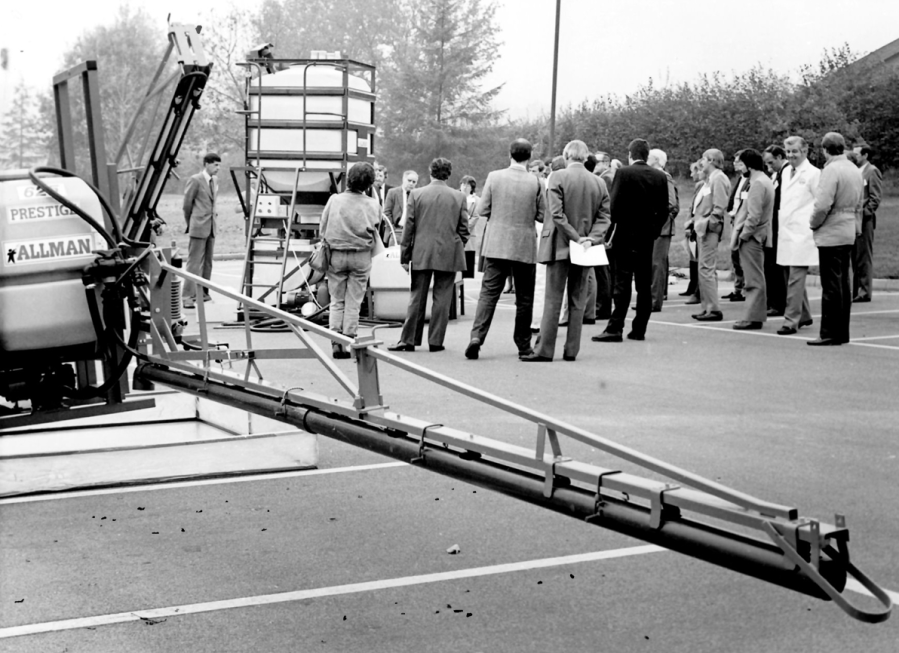
That early connection led him to study agricultural engineering at Rycotewood College, alongside an apprenticeship with SCATS, before eventually joining Chichester-based agricultural engineering company E. Allman & Co in the late 1960s. It was there that his career became closely entwined with pesticide application, initially in the UK and later internationally.
“I worked in various countries around the world, selling pesticide machines and training operatives on how to use them properly,” he says. “We also worked for a number of big chemical companies, making machines for them and training their operatives to make sure that the product was applied properly.”
As Ken’s experience grew, so too did his involvement in the wider industry, eventually becoming chairman of the Agricultural Engineers Association’s Pesticide Application Committee. The role connected UK manufacturers with work on European and international standards through BSI and ISO. Among the developments Ken was involved with was international colour coding for spray nozzles – something now so embedded in spraying practice it barely warrants a second thought.
Another was the principle of routinely testing sprayers. “I felt that as an industry we needed to make sure the machines being used on farms were being used correctly and were working properly,” he says.
The idea was essentially an ‘MOT’ for sprayers. Although not universally welcomed at the time, the principle eventually developed into the National Sprayer Testing Scheme. Long before environmental stewardship became the familiar phrase it is today, Ken’s work was therefore already centred on ensuring crop protection products were handled accurately and responsibly.
However, by the late 1980s, another question was beginning to emerge. If increasingly close attention was being paid to how pesticides were applied, what happened to the contaminated water left behind when the machinery was washed out?
For one farmer in East Anglia, whose land sat below sea level close to the Wash, it was a particularly pressing problem. Each time his crop sprayers were cleaned, the resulting washings presented a potential risk to the surrounding environment – and at the time there was no straightforward means of treating them on site, notes Ken.
Through ADAS and ICI Agrochemicals, Ken became involved in finding an answer. And despite the years of engineering expertise which had brought him to that point, the experiment which would eventually lead to the next chapter of his career started with something remarkably unsophisticated – a bucket. “The chemist who I grew to know very well always said that if it didn’t work in a bucket, it wouldn’t work on a farm,” recalls Ken. “So he took a bucket along, figured it out and it worked.”
SIMPLE BUT EFFECTIVE
The contaminated water was treated and the sample returned for analysis, confirming the chemistry had done its job. Further polishing with carbon could then bring the water back to a sufficiently high quality. It was a simple experiment, but one which would ultimately provide the foundations for the Sentinel treatment system and, several years later, Ken’s own company WMEC.
Turning that bucket experiment into something capable of working reliably on farms was, unsurprisingly, rather more involved. Allman built several trial machines to turn the chemistry into a practical treatment system. What followed was around three years of testing and regulatory scrutiny. “We ran trials and they said, ‘No, we want to run some more trials,’ so we did,” says Ken.
Then the regulatory landscape changed, requiring another round of hoops to be jumped through. But eventually the trials generated a substantial bank of data demonstrating that the process could reliably treat dilute pesticide waste, he says.
Testing extended internationally through ICI’s links, with work carried out in the US, Germany, Switzerland, Holland and India. For Ken, it prompted a significant career shift and he moved away from pesticide application machinery and into developing, manufacturing and marketing the technology which became known as Sentinel.
Its purpose was straightforward – rather than transporting large quantities of contaminated water elsewhere, treat the waste at source, remove the contaminants and minimise the volume of concentrated residue requiring specialist disposal.
By the early 1990s, the owners of Allman decided to sell the part of the business in which Ken worked. Rather than walk away from what had been developed, he and a small group joined forces to take it forward themselves and as a result, WMEC was formed in 1994.
Ken soon discovered selling wastewater treatment equipment was rather different to buying a conventional item. “If you want to buy a washing machine, you can look at three or four, say ‘I’ll buy that one’ and take it home,” he says. “If you want to buy a machine for treating waste, you have to go through a number of hoops.”
Environmental permissions and requirements surrounding the resulting water meant a sale could take a year or even 18 months. What’s more, the UK interpretation of regulation also made the mobile treatment model Ken envisaged difficult to establish, despite it gaining traction elsewhere. “For example, in Belgium and Holland, co-operatives bought machines which travelled between farms and contractor sites treating waste,” he explains.
Closer to home, momentum built through research organisations undertaking pesticide trials, including ADAS facilities and the John Innes Centre, which required a means of dealing safely with waste containing mixtures of experimental and existing chemistry. From there, the technology travelled further afield, into research facilities, agrochemical businesses and plant production sites in countries including Kenya, Ethiopia, Pakistan, India and the US.
In some cases, sites were alongside natural water sources, meaning treatment could allow contaminated water to be cleaned and reused rather than risking its return to the wider environment, notes Ken.
Applications broadened too, including work in French vineyards and the Champagne industry, and eventually into sectors including food production, laboratories and heavy industry.
But Ken’s daughter, Nicola Hiscock, says the agricultural market itself took longer to catch up with the technology. “We’ve always been told we were about 25 years too early with the Sentinel,” she says. “Everyone knew it worked and that it was the right thing to do, but it was difficult to get everybody on board to invest in it. But now, times are changing and legislation is tightening.”
For Nicola, agriculture and wastewater treatment had been part of family life long before she officially joined WMEC. “I grew up going to the Allman factory with Dad as a nipper, so I grew up around the sprayer industry,” she says.
Her childhood also included watching sheep dip waste being treated on farms – and the occasional sample making its way home. “I spent a lot of time watching sheep being dipped and then having waste tested on the kitchen table,” she laughs.
Despite initially choosing a completely different career, Nicola eventually found herself drawn back to the environmental work she’d grown up around. She studied environmental sciences and joined WMEC in 2002, initially in administration before progressing through the company, which she now leads.
Today, some of the earliest Sentinel systems remain operational and WMEC says it has more than 1000 systems installed across more than 70 countries, collectively treating in excess of 1Bn litres of contaminated wastewater.
For a technology which began with a bucket, the scale is considerable and the type of waste being treated hasn’t stood still either. One significant change Ken has witnessed is the evolution of pesticide formulation, with lower quantities of active ingredient accompanied by increasingly sophisticated surfactants, adjuvants and other components. “The chemistry has become better and better,” he says. “Now we get less active ingredient and more secondary product – like adjuvants – than we did 10 years ago.”
Although beneficial from an application perspective, those components still have to be dealt with when machinery is washed down. WMEC has therefore adapted its processes to handle changing waste streams, including high levels of surfactants and adjuvants.
CONCENTRATING CONTAMINANTS
Depending on the application, the Sentinel system can achieve removal efficiencies of up to 99.99%, concentrating contaminants into a much smaller volume for specialist disposal while allowing the majority of treated water to be managed on site and, where appropriate, reused. The same treatment experience is now being applied to emerging contaminants such as PFAS, with trials underway to understand how the technology can tackle an area attracting increasing scrutiny.
Yet despite enormous advances in application – from lower doses to precision and spot spraying – Nicola believes one basic fact remains. “Ultimately, there’ll always be waste to get rid of,” she says. “Farmers are going to become smarter in the way they work. There’ll be more automation and they’ll have to be more careful and savvy about the products they use, but they’ll also have to be more careful and savvy about how they get rid of them.”
Even highly targeted spraying leaves residues on sprayers and machinery which eventually have to go somewhere, and with analytical techniques becoming increasingly capable of detecting contaminants in water, Ken believes scrutiny of those pathways will only increase. “We’re better – we’re realising that this water is contaminated and there’s some organic waste from pesticides appearing in rivers. This will need looking at.”
One possible solution brings Ken’s thinking almost full circle. He says that mobile Sentinel systems could allow groups of farmers to share the capital cost, with each retaining the necessary infrastructure while a treatment unit travels between sites.
It’s another practical answer to a practical problem – and perhaps that best sums up the thread running through Ken’s career. Across almost six decades, the technology, chemistry and legislation surrounding crop protection have changed enormously. Yet the starting point has remained remarkably consistent – identify what isn’t working, understand why and engineer a solution capable of functioning in the real world.
Today, WMEC remains in Chichester, where its systems are designed and manufactured, with Nicola leading the business and Ken having seen ideas once considered ahead of their time become part of an industry increasingly focused on demonstrating responsible pesticide use and disposal.
However, at 79, his attention doesn’t appear to be solely fixed on what has already been achieved. There are new contaminants to understand, changing waste streams to tackle and further questions around water quality still to answer, he concludes. “That’s what keeps me going. After all, there’s always another problem waiting to be solved.”
This article was taken from the latest issue of CPM. Read the article in full here.
For more articles like this, subscribe here.
Sign up for Crop Production Magazine’s FREE e-newsletter here.