
Once maize reaches full height, getting back into the crop with conventional machinery becomes increasingly difficult. But could drones provide a means of extending the application window, while opening the door to entirely new agronomic opportunities? CPM attended Hutchinsons’ maize day in Leicestershire to find out.
“A huge amount of the nutrition required by maize is required after tasselling, so the drone gives you a great opportunity to apply it at that much later stage.” – GREG HOPKINSON
By Charlotte Cunningham
For more than a decade, drones have been touted as one of the technologies likely to change the way growers manage crops. Much of that conversation has centred around what they might see from above – mapping fields, assessing crop performance and gathering imagery to help inform management decisions. But while the technology’s ability to observe crops has continued to develop, perhaps the more interesting question now is what drones can actually do to them.
And in maize, where the sheer physical size of the crop can quickly close the door on conventional machinery, that could present some particularly interesting opportunities…
Speaking at Hutchinsons’ maize day in Leicestershire in September, arable agronomist Greg Hopkinson said drone technology was beginning to move beyond the role many in the industry had originally envisaged for it. “For the past 10-15 years, we’ve all been thinking that drones are going to be flying around assessing crops for us, or providing us with imagery which helps us make more informed management decisions. Now we are looking at a new way of utilising drones for applying crop inputs.”
FOLIAR NUTRITION
One area Hutchinsons has been investigating is the application of foliar nutrition later in the maize crop’s development – something Greg says could have particular merit given the crop’s nutrient demand. “A huge amount of the nutrition required by maize is required after tasselling, so the drone gives you a great opportunity to apply it at that much later stage.”
There’s also the issue of increasingly challenging application windows, he continued. Hot conditions can make timing foliar nutrition particularly difficult, while crop height itself restricts when conventional sprayers can travel through maize. “Application windows for sprayers are getting more and more limited with very hot conditions when you’re trying to apply foliar nutrition to maize.
“So having that flexibility where you can come back with a drone over a wider window is great in terms of applying those nutrients.”
Importantly though, Hutchinsons is also looking at whether that additional flexibility can translate into a worthwhile return for growers. Early assessments from this season’s trial have been particularly encouraging, although Greg stressed that the figures discussed at the event were based on small-scale yield assessments, with full harvest and laboratory analysis still to come.
“What we found this year is that with the drone applications of the foliar nutrition, we saw a significant response based on our small yield assessments. We’re still waiting to get the full harvest lab analysis data back, but it looks promising.”
The drone application itself costs around £35/ha, he explained. Once the foliar nutrition products used in the trial – Endurance and Peloton – are included, the total treatment cost comes to approximately £115/ha.
Against that, preliminary assessments suggested around a 10t/ha increase in freshweight maize yield. “If you work that out at roughly £40/t for maize, you’re looking at a potential £400 increase in output for a cost of £115/ha.
“That’s what we’re looking for as agronomists – to give advice on things that are giving real return on investment.”
UNDER-SOWING
While further analysis will determine just how significant that response proves to be, applying nutrition isn’t the only potential role Hutchinsons sees for drones in maize. The next area Greg is keen to investigate is seed application – specifically establishing cover crops and grass seed beneath standing maize.
In a typical season, the timing of maize harvest can leave a relatively narrow opportunity to establish something behind it. Broadcasting seed into the standing crop before harvest could offer a way around that, he suggested.
“With a drone application that can apply the cover crop seed directly into the standing maize crop, you can create a cover underneath the maize canopy.
“You take the maize off, the cover crop is already established, and that’s where you can look at the benefits – not just in terms of providing some soil cover and reducing soil erosion, but potentially some livestock grazing opportunities if you were putting in a suitable mix.”
There could also be an economic incentive where the practice meets the requirements of environmental schemes, he added. Using indicative figures of around £45/ha for seed and £30/ha for drone application, Greg said the establishment cost could potentially be offset against available payments for overwinter cover crops in environmental schemes such as SFI.
For businesses that encompass livestock, another option could be establishing grass beneath the crop. It’s something Hutchinsons has already explored at its Carlisle maize trial site, where grass seed has been applied into standing maize with the aim of having an established sward ready once the maize is harvested. “Not only does that provide soil cover and prevent that soil erosion, but people are then taking an early cut of silage in the following spring.
“In terms of overall output on that area of land, combining that silage output and the maize output, you’re getting huge benefits compared with if you took the maize off and drilled it with grass the following spring.”
Both cover crop and grass seed applications are areas Greg says Hutchinsons intends to investigate further in future trials, alongside additional foliar nutrition work.
Of course, broadcasting seed or applying nutrition above a mature maize crop raises an obvious question – how effectively can material applied several metres above the ground actually penetrate a dense canopy?
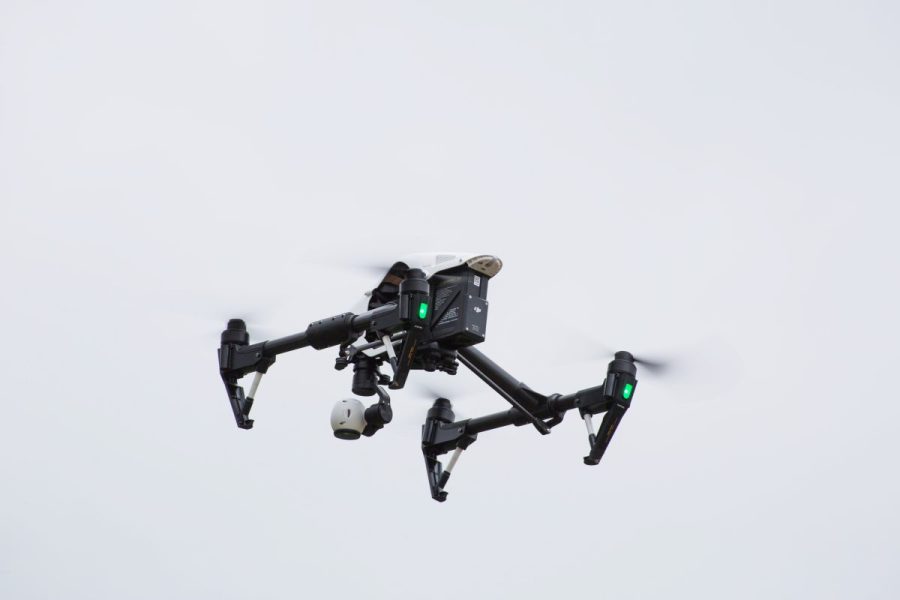
For James Poynyon of SAS Agri Drones, the answer lies partly in the airflow generated by the aircraft itself.
Having launched his business in May as part of a national drone operator network, he has already undertaken ryegrass applications into standing maize. “One of the big questions was, how on earth do you get all of that seed right down there? Is it going to get caught up in all of the stalks and the rest of it?
“Well, the drone creates this vortex and it swirls air down, so you get very good, even coverage at the base of the maize.”
It means standing crops are particularly interesting candidates for the technology, he believes. “Maize is probably one of the worst you can imagine, but with the vortex of the drone you get movement coming down from it.”
The drone demonstrated at the event can both spray liquids and spread seed, with a 40-litre liquid tank and capacity for around 50kg when spreading. At present, one of the main limitations when spraying maize is water volume, explained James. “We’re spraying at 100 litres/ha volume, so we’ve reduced that from 200 litres with conventional sprayers. It worked very well here, and my colleagues have been doing it nationally for the past three years.”
However, reducing that volume further could significantly increase work rates and bring down application costs. “We’re working with a lot of different companies now trying to reduce the volume, in fact we’ve been trialling a product at 30 l/ha.
“This will speed up the job and obviously it’ll bring down our costs to you as well, so it’ll make it more economical.”
ENSURING FINESSE
Droplet size also has to be matched carefully to conditions. On the relatively breezy day of CPM’s visit, James had opted for a heavier droplet than would ordinarily be preferred for foliar applications. “Normally I’d say we’ll come back another day and do this if I was spraying foliar nutrition. At a push you can increase your droplet size, but you don’t get as good coverage.
“The finer droplet size you get, the more even the coverage and the more effectively the plant will absorb it.”
For seed applications, payload becomes less of a constraint where relatively low seed rates are required. With the spreading unit holding around 50kg, James said cover crop mixes applied at around 5kg/ha allow several hectares to be covered from each load.
Accuracy is another important part of the equation. Fields can be mapped digitally before an application begins, with obstacles such as trees incorporated into the flight plan. James said mapping the field used for the Leicestershire demonstration would take only a matter of minutes. “You map it out and if you have obstacles or trees close to the margins, you just map around them on your programmer.
“For safety reasons, we’d set out the whole field, go up and down it, and then do a margin run all the way around the edge.”
However, there are restrictions governing where drones can operate – with separation distances required from uninvolved people, properties and roads. James said operators have worked extensively with the Civil Aviation Authority to gain the necessary authorisations and ensure applications can be undertaken safely.
Yet perhaps the most interesting prospect isn’t simply whether a drone can replicate a job already undertaken by a conventional sprayer or spreader.
Instead, in a crop such as maize, its value may lie in providing access at precisely the point when other machinery no longer can – whether that’s applying nutrition after tasselling or putting the next crop in place before the current one has even left the field.
As Greg concluded, that leaves plenty still to investigate. “We’re really interested in looking at new things like the cover crops, grass seeds and other foliar nutrition trials going forward.”
For more coverage following Hutchinsons’ maize open day, refer to page 29 of this month’s issue.
This article was taken from the latest issue of CPM. Read the article in full here.
For more articles like this, subscribe here.
Sign up for Crop Production Magazine’s FREE e-newsletter here.