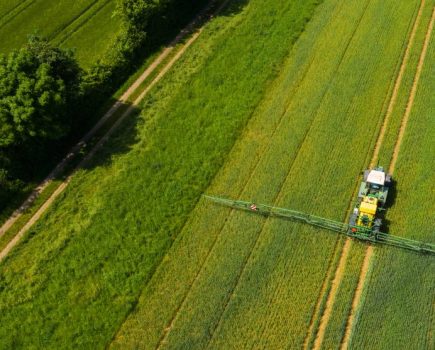


Features of precision agriculture tool, Contour, should help growers to harness potential working windows better and make more of opportunities to get ahead in the field. CPM investigates the platform’s weather analysis and prediction model.
“We have to shift from simply reacting to the weather to proactively using data to make better decisions.” SAM FORDHAM
By Janine Adamson
The weather – wholly beyond anyone’s control and hugely variable particularly in the UK, yet successful crop production relies heavily on it providing adequate rain and sunshine in a timely manner. In fact, it’s one of the most common topics of conversations, irrespective of whether discussions are related to agriculture or not.
In the past there was a mostly manageable rhythm, meaning seasons were relatively easy to predict, from classic April showers to pleasantly warm summers. Extreme or outlying years were just that – occasional.
Fast forward to 2026 and UK weather patterns are increasingly erratic and unpredictable, meaning the demand for actionable weather data has never been more pressing.
According to Agrii’s technical seeds manager, John Miles, weather is often cited as the most significant factor influencing farm yield, yet remains one of the most underutilised sources of data. “Farmers are often preoccupied with the weather but most don’t harness the full potential of the data available.
“Yes, weather impacts everything from crop yield to plant protection product applications, but unless you have a comprehensive system to analyse it, the data tends to be used reactively rather than proactively,” he says.
John points out that traditionally, weather stations have provided vital real-time data to farmers, but can often be overlooked in the broader strategic planning of farm management.
“Agrii’s weather station network, for example, has been collecting data for years. Although many growers log into its weather stations each day, they often do so in isolation. As such, they react to immediate conditions without linking them to the broader picture, long-term weather patterns or potential risks.”
However, technology is advancing at a record pace, including the revolutionary introduction of AI into all of society’s lives. This means the development of high-spec weather-based solutions, or the upgrade of existing tools, to help support growers in their quest for deeper insights.
A current tool available to growers is the weather system within the Contour platform – Agrii’s established precision agriculture tool. This provides the opportunity to evaluate broader weather trends more accurately and predict potential seasonal climate impacts more efficiently.
Sam Fordham, head of technical for Agrii’s Rhiza system, of which the Contour weather system is a key element, says although knowing daily rainfall is important, it’s long-term trends that truly matter. “We have to shift from simply reacting to the weather to proactively using these data to make better decisions,” he comments.
One of the core innovations in Contour is its ability to analyse historical weather data and identify emerging patterns, says Sam, yet this has been under-utilised. “We may not be able to predict the exact weather for the next season, but using Contour we can anticipate patterns based on what has happened in similar years.”
For example, growers can look at specific weather windows, such as the rainy period of autumn or spring, and assess how it compares with previous years, he adds.
“By understanding that four out of five years saw significant rainfall during a specific period, we can make an educated assumption there’s an 80% chance the same thing might happen again. This gives farmers the foresight to adjust their strategies accordingly.”
Of course, forecasting long-term weather accurately remains elusive, but historical data insights such as these can provide a strong foundation for planning, he urges. “This helps agronomists and farmers to make informed decisions regarding the timing of drilling, fertiliser applications, and even crop variety selection. It’s about making the best decisions with the data we have, even if we can’t control the weather itself,” says Sam.
He hopes that by improving understanding of the benefits of Contour, its features will be utilised more. In particular, one aspect that Sam believes may have been previously overlooked, is that the system uses machine learning and crowdsourced weather data.
Furthermore, by partnering with global weather data distributor, DTN, Agrii has developed a ‘virtual weather’ system that triangulates weather information from multiple sources to provide farm-specific insights.
“The virtual weather system is powered by crowdsourced data from a range of weather stations and sources, all integrated into a machine learning system. This predicts weather trends based on historical data and current conditions, providing an incredibly detailed and accurate view of what’s happening on a farm,” explains Sam.
Although this can’t be as precise as having a weather station in every grower’s field it should offer a more granular level of insight compared with general forecasting services, he adds.
“It’s not perfect, but it’s far better than relying on a Met Office forecast. For agronomists, this system can be used as a tool to start conversations about the trends they’re seeing, particularly in relation to temperature, soil conditions, rainfall, and wind speed.”
Another important aspect of the Contour platform is its unique ClearSky technology, which provides users with cloud-free satellite imagery for a timely picture of what’s happening in crops throughout the season. This essentially ‘weatherproofs’ Contour, enabling it to see through cloud cover and better inform variable rate applications, explains Ben Foster, Rhiza product manager.
He says traditional optical satellite imagery, such as normalised difference vegetation index (NDVI), requires an unobstructed view of the field to provide reliable and regular imagery, and as such, the UK’s cloudy weather can prove challenging. If there’s a sustained period of unsettled weather, it’s not unknown to wait three months for a usable satellite image, suggests Ben.
“Most digital farming platforms use the last cloud-free, clear image available to model and then predict how that crop will have changed over time. The problem with that is, in a cloudy season, where there’s no clear imagery feeding into the prediction, it can become unreliable over time.
“In some seasons, the provider may have to stop supplying images all together, which is far from ideal if you’re relying on this for variable rate applications,” he explains.
According to Ben, Contour is unique because it has access to ClearSky, which uses a combination of SAR (synthetic aperture radar), optical imagery and machine learning to build a consistent picture of crop health even in cloudy conditions.
“In basic terms, a satellite sends a radar signal to earth and measures how it interacts with the crop canopy before reflecting back to the sensor on the satellite.
“This is an excellent alternative for effectively determining biomass. Working with our partner Aspia, the radar data is then model into an optical image (NDVI) and utilised through Contour.The ClearSky technology means farmers can have confidence in the crop imagery they see when making nitrogen plans, regardless of the weather throughout the season.”
To ensure ClearSky is delivering optimum insights, the model is retrained annually by Aspia – the latest resulting in a 13% increase in accuracy compared with its previous iteration. Sam says this involved removing irrelevant noise such as roads, trees, buildings and non-agricultural land to only analyse known cropping areas that are within Contour. “Having now retrained ClearSky, it’s more accurate than ever before,” he comments.
Better access to weather data and analysis is just one of the many benefits of Contour, believes Yorkshire-based grower, Henry Sweeting. By working with his Agrii agronomist Simon Pilling, and the RHIZA soil sampling team, the entire farm has been sampled during the past year.
According to Henry, his primary driver for using Contour was to help deliver SFI actions such as CSAM1 (soil management plan) and PRF1 (variable rate application). However, Contour soon became a key tool in the farm’s overall management.
“Although we’ve had an N-sensor on our sprayer for the past 15 years, we’ve never done variable rate using soil mapping, which is one of the reasons why we first explored Contour. The platform’s weather data has proven a nice added extra too,” he says.
With the farm’s silty clay soils prone to low pH, Henry has used Contour to apply lime. “We limed the whole farm after the last harvest using maps produced in Contour from the RHIZA soil sampling. These were given to the contractor as the basis for the spreading.”
In addition to income generated by SFI, Henry commends the benefits of applying nutrients more efficiently. “Have we used what we apply better? Yes, definitely, which has had a positive impact on margins. The digital technology goes hand-in-hand with better sprayers and spreaders.
“Also, the amount of lodging in crops has reduced with improved uniformity. Contour makes everything much more efficient,” he concludes.
This article was taken from the latest issue of CPM. Read the article in full here.
For more articles like this, subscribe here.
Sign up for Crop Production Magazine’s FREE e-newsletter here.