
AI-driven wildlife sensors are helping growers to quantify on-farm biodiversity and evidence positive landscape-level changes. CPM learns more about Wilder Sensing.
“The goal is to support growers to increase their awareness of the services that nature may be providing.” GEORGE CATERER
By Janine Adamson
With increasing onus on what agriculture can deliver for nature, quantifying the true benefits of environmentally-focused actions could soon become a part of daily farm business for UK growers.
And rather than manual surveys by ecologists, a solution for continuous data capture and interpretation now exists, meaning full-scale biodiversity monitoring is just a few sensors away from becoming reality.
“Growers are fully accustomed to collecting data across the farm, yet until now, biodiversity has found itself left behind, or isn’t regularly updated,” comments Wilder Sensing’s George Caterer. “But by utilising bioacoustic technology, we can begin to understand what’s happening at a landscape-level, evidence biodiversity and measure the impact of specific actions,” he adds.
The concept began four years ago as a post-lockdown notion, recalls George. “The goal was to find a way to quantify biodiversity and improve data capture as interest was increasing in monetisation, similar to carbon credits.
“This meant finding an appropriate, accurate, scalable technology that could deliver what we required, which ultimately led us to bioacoustics – using sound technology to record, store and analyse large collections of animal communication data.”
The starting point for this was birds, he adds. “They’re quite an emotive taxa and appeal to much of the general public. They’re also a fantastic reference for the health of an ecosystem because they cover all levels of the food chain.”
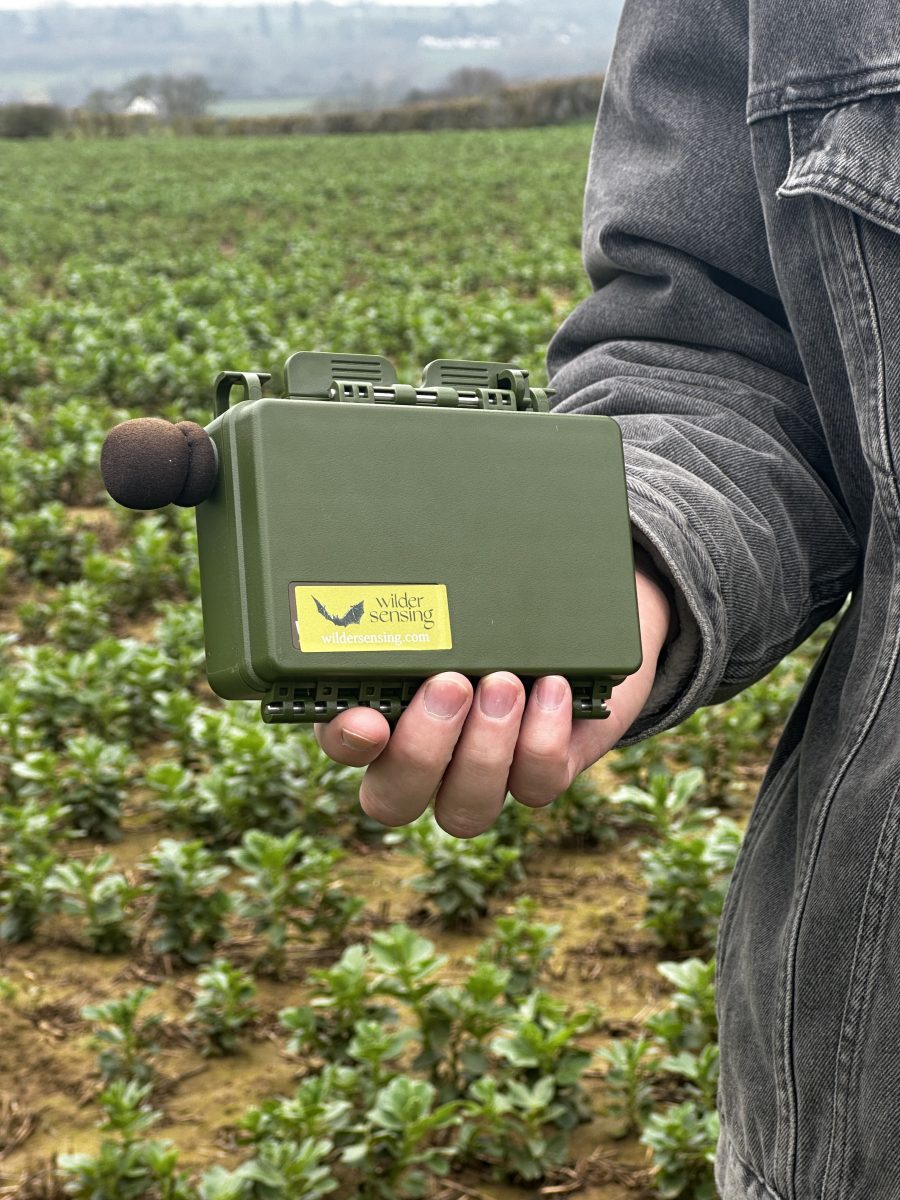
Now known as BirdSense, the system is data-based, where growers utilise an off-the-shelf recording device and an SD card. Recordings are then uploaded to the cloud which are interpreted by Wilder Sensing within 48 hours, using AI to identify different species and their activity levels. Growers can then view, explore and download their high-resolution results from the same portal.
Because Wilder Sensing licenses the BirdNET database – an open-source research project developed by Cornell Lab of Ornithology – it can tap into a reliable reference recording for every UK bird species.
George highlights that without AI, it’d be near-on impossible to fully process the recordings. “That’s been the barrier for this type of work so far. But now, because it’s much easier, it’s opened up the opportunity to truly understand activity levels and compare these across sites or timeframes.”
The technology has continued to develop too, he notes, with the launch of BatSense, which works to similar principles. The team has also recently introduced MothSense, although this is image-based, says George.
“MothSense operates using a solar-powered camera and a UV light to attract species to a base plate. A photograph is taken every two minutes and then similar to our other systems, AI analyses the data for automated identification of around 275 macro moth species.
“While they’re often downplayed, moths are a nocturnal pollinator and therefore have the potential to be an important species for arable growers.”
Critically, by utlising all three systems, it’s possible to assess impact cross-taxa, raises George. “For example, we can measure how moth populations may impact bird life, and so on. To look at this in more detail, we’re launching the collaborative WildSense pilot project this summer, which will run across seven UK sites.
“The overall goal is to support growers to increase their awareness of the services that nature may be providing,” he urges.
Agrii agronomist and Agri-TechE Ambassador, Todd Jex, has been exploring Wilder Sensing’s technology on one of his customer’s farms. He says the aim was to use recorded bird song to quantify biodiversity across two contrasting farming systems.
With a mix of regenerative and conventional tillage systems at Barton Farm in Dorset, this provided an ideal opportunity to gather comparative data, says grower, Oli Harris.
“Originally, we adopted no-till regenerative farming practices for financial reasons to scale up the business. Contractors were doing much of the work, and it was a way to bring all operations back on the farm and take control of arable production.
“Very quickly, it became a passion to see the environmental benefits the new system was having,” he explains.
Overseen by Todd, two recording devices were set up at the farm for a six-day trial, tallying around 20,000 bird calls. Looking at the data in more detail, the conventional field was dominated by corvid and generalist urban birds, while at the regenerative field, there were more insectivorous and seed-eating birds. George highlights that one of the starkest comparisons was between skylark calls: the regen location had more than 4000 while the conventional had just 11.
Commenting on the monitoring, Todd says recording baseline data is a critical first step. “You require the baseline at the point of change to see what’s happening for good or bad. You can then make appropriate recommendations if things aren’t evolving the way we want them to,” he explains.
“The soil analysis we do is very in-depth; but biodiversity is the part we aren’t very good at capturing at the moment, and it’s such a massive part of it.”
Having conducted the trial, Oli says its reaffirming to see they’re doing the right things. “We’re tenant farmers and our landowners are keen to see us improve the environment. This data puts us in very good standing with them – it’s a great way to demonstrate that we farm sensitively to the environment,” he comments.
The trial at Oli’s farm was originally instigated by Agri-TechE. Director Belinda Clarke says they’re delighted with the success of the collaboration. “This kind of collaboration is what Agri-TechE is all about – bringing people together to test and develop new technology in real world situations.
“It’s discussed at our events time and time again how researchers and tech developers don’t have enough opportunities to apply their research or technology on farms. On the flip side, farmers are reluctant to give up their valuable time to beta-test something that may not have a value to them yet.”
As for the investment required to install Wilder Sensing technology, each system operates through an initial hardware cost from £150 per device, plus an annual subscription fee. George says he hopes by providing accessible technology, more growers will engage with biodiversity monitoring.
“However, this isn’t to replace traditional methods, it’s about supplementing existing ecological monitoring to empower growers and agronomists with actionable insights.”
This article was taken from the latest issue of CPM. Read the article in full here.
For more articles like this, subscribe here.
Sign up for Crop Production Magazine’s FREE e-newsletter here.