
With autumn comes an urgency to talk all things grassweed control. CPM reports on some of the latest research and advice to bolster existing knowledge about this pivotal aspect of cereal crop management.
“By working at multiple sites of action it makes resistance harder to evolve, which may explain why after 60 years, tri-allate hasn’t failed.” DR DANA MACGREGOR
By Janine Adamson and Rob Jones
For some, it may feel like there’s little new to report on how to manage grassweeds in cereal crops. And while on the face of it, the fundamentals indeed remain the same, nuances about how best to use certain products and processes are continuing to come to light.
For one, work has been taking place by Rothamsted Research to better understand the role of Avadex (tri-allate) and its mode of action. This was initiated after the Herbicide Resistance Action Committee (HRAC) placed tri-allate in Group 15 alongside flufenacet, prosulfocarb and ethofumesate, as part of a classification overhaul in 2020.
Naturally, this has raised questions whether these active ingredients should be used together in herbicide programmes, given increasing concerns regarding resistance management. However, while Group 15 herbicides are based on physiological action – whereby they inhibit very long chain fatty acid synthesis – Avadex manufacturer Gowan believed there were differences between the Group 15 molecules.
“We required clarity to understand if they shouldn’t be used together anymore,” says global herbicide asset manager for Gowan, Laurent Cornette.
To undertake this critical work, Rothamsted Research’s Dr Dana MacGregor conducted initial experiments in a controlled environment to compare the effects of flufenacet, tri-allate and a third active, EPTC (not registered in the UK) on blackgrass development. Critically, it found that tri-allate and EPTC impacted shoot growth in contrast with flufenacet, that altered both root and shoot growth.
“Following application, the plant grows in a different way – its biology is impacted,” highlights Dana. “This shows that even with the Group 15 active ingredients, the biological effects are different depending on the specific herbicide being used.
“To investigate further, we then took this beyond ‘dead versus alive plant’, to look deep into the weed’s biology to know exactly what pathway tri-allate is affecting, and why it’s having this different effect.”
To achieve this, researchers used biochemical techniques to understand what was happening at the tissue and cellular levels in the plant. They found that tri-allate inhibits fatty acid synthesis – crucial for building cellular structures and enabling plant growth – but at two different places and stages, early in the chloroplast and later in the endoplasmic reticulum.
Conversely, flufenacet and EPTC affect only the latter part of the pathway that happens in the endoplasmic reticulum.
“This makes tri-allate unique,” raises Dana. “And in working at multiple sites of action, this makes resistance harder to evolve, which may explain why after 60 years, the chemistry hasn’t failed.
“Furthermore, while the HRAC system is useful guidance, this work does highlight that there’s further complex biology underpinning Group 15.”
Laurent adds that Gowan had always suspected Avadex was particularly robust, delivering added staying power. “We’ve never known any single-site resistance to occur and we now know why – tri-allate offers multi-site activity.”
While these results are clear, this critical research must continue, urges Dana. “The experiment focussed on application of the actives at pre-emergence stage, but new questions have arisen as the work progressed. For the future, we may also investigate the impact on ryegrass, although we’re relatively confident it’ll have a similar action to what we’ve seen in blackgrass.”
MULTI-SITE ACTION
Gowan’s UK country manager, Hank King, believes the new research should influence how farmers and agronomists perceive tri-allate. “Growers often rely on a single active to do the bulk of the heavy lifting for autumn grassweed control. In those cases, that active has to be protected, which can be achieved by using tri-allate as a robust parter that acts at multiple target sites in the weed,” he says.
“It’s so important to be informed by robust scientific evidence. As such, Gowan is continuing the research with Rothamsted Research to ensure messaging is justified and backed up.”
Looking at this season in particular, Hank adds that when considering Avadex Excel (granule) versus Avadex Factor (liquid), it’s all about timing. “Avadex Excel performs best in drier, warmer conditions, aligning with an application earlier in the season. In contrast, we see Avadex Factor is more suited to cooler situations where there’s more moisture present.
“Timing is key – a well-timed application of Avadex Factor can offer better results than a poorly-timed application of granular tri-allate. Either way don’t hesitate, it still delivers the same mode of action effect.”
Choosing tactics based on conditions is also critical for ADAS’ John Cussans. He says research has shown that if seedbeds are dry, it’s best to leave weed seeds on the surface. “This is critical to manage newly-shed seeds post-harvest because predation occurs as well as direct mortality.
“If growers are drilling cereals particularly, then doing nothing in that instance would benefit weed management considerably, while cultivation consistently increases the germination of freshly-shed blackgrass seeds.”
He notes that work undertaken by Jasper Kanomanyanga, as part of his PhD studies, has compared weed seed predation in no-till versus cultivated situations. “The predation in no-till is astonishing, with nearly 100% predation rates in blackgrass by carabid beetles and small mammals.”
John further urges growers to hold their nerve this season, particularly if grassweeds are a reoccurring issue. “As well as delayed drilling decreasing grassweed densities, we also understand that it can have a positive effect on pre-emergence herbicide efficacy. Ultimately, herbicide effectiveness improves and the chance of requiring a top-up is reduced. This will not change.
“Everyone is feeling the pressure to adapt, but when it comes to grassweed management, nothing has changed. Remember the basics, consider each field, and don’t kid yourself that the weeds are changing because they aren’t,” he stresses.
Despite this strong message, he notes that one aspect has shifted during recent years – herbicide resistance. “We’re working harder to achieve the same goal and using more pre-ems to compensate for a lack of activity in spring contact herbicides. Complicated pre-em stacks do incur selectivity risk; complex mixes mean additional interactions,” he warns.
For North Lincolnshire grower Pat Thornton, this coming season the challenge will be ensuring every input delivers on ROI to help fill an impending financial void post-BPS. He says the farm grows continuous cereals including spring barley, and blackgrass is the main weed challenge.
“Autumn 2025 we did drill in early October, which was probably 10 days early, purely due to temptation. But ordinarily, we’d delay drilling and use spring cropping as part of our core cultural control methods.
“Understanding the fundamentals and established research is helpful in tackling problem weeds, and really, herbicides are the last step. In terms of product choice, it’s actually knowing the value it offers rather than what it costs,” he explains.
Noting the farm’s blackgrass problem, Pat says Luxinum (cinmethylin) forms the base of pre-em applications, as part of a strategy of using both the best quality practices, and best quality chemistry. “We’re always looking for that additional 1% control, so everything requires that level of detail to step up to the challenge of current finances,” he explains.
“Subsequently, blackgrass populations are decreasing considerably and we’re making improvements. However, you just can’t take the risk, so it’s a no brainer to always do the best you can.”
RYEGRASS
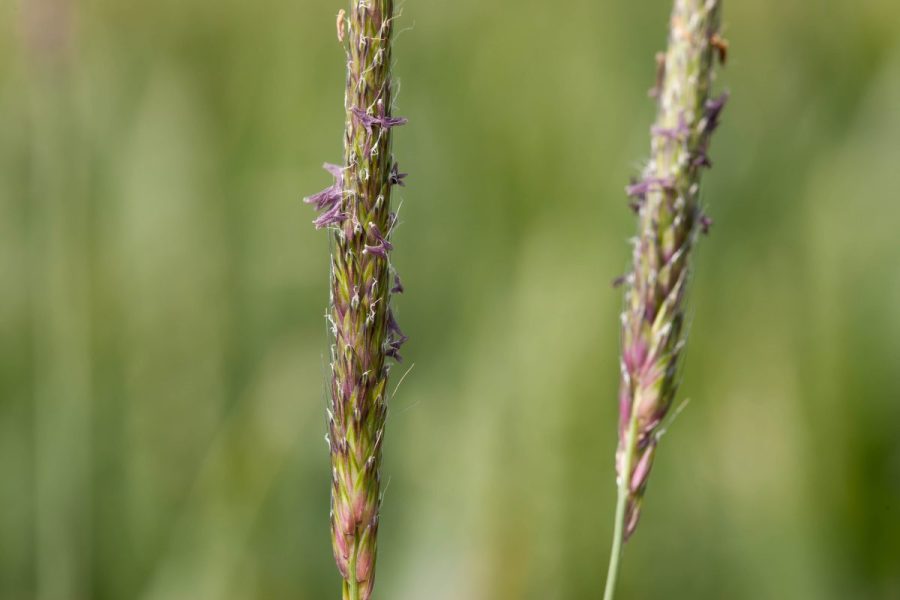
Of course, when it comes to winning the grassweed war, it isn’t all about blackgrass. Italian ryegrass is becoming increasingly troubling due to its evolving herbicide resistance status and extended, sporadic germination.
As such, spring cropping isn’t a robust tool, highlights John. “Unlike blackgrass, ryegrass plants that emerge in the spring can set seeds profusely. So sometimes, spring cropping isn’t quite so effective, whereas for blackgrass you always have that spring crop backstop.”
Ryegrass also has a prolonged germination pattern, meaning herbicide sequencing and multiple application timings generally provide the best level of control, while the weed has an innate ability to develop resistance to herbicides, he adds.
Resistance to post-emergence chemistry is becoming more widespread in ryegrass populations, significantly reducing the reliability of contact herbicides. In some situations, growers are also beginning to see reduced performance from residual programmes.
John notes that despite this, new herbicide release Fundatis (bixlozone (Isoflex active)+ beflubutamid) could be a useful option. Furthermore, rather than simply rotating herbicide groups between seasons, he says the priority should be maximising diversity within individual programmes.
“Options like cinmethylin offer very good activity, but we’d rather growers didn’t rely on it too heavily. The objective is to build programmes with multiple modes of action applied at different timings.
“Fundatis is different because it has some foliar uptake on cotyledons. It also has more persistency and should remain active for a long period of time. Because of the foliar uptake as well as root uptake, it performs better pre-em, although also has good activity relatively speaking early post-em.
“It’s a different mode of action so all of these elements combined make it quite a contrasting option. Rather than putting on more similar herbicide, applying a contrasting option on is always best advice.”
Fundatis can be used at pre- and peri-emergence in winter wheat, and pre-emergence in winter barley.
Beyond specific product choices, John warns that growers should adopt a zero-tolerance approach to ryegrass as soon as it appears. “That initial stage where ryegrass has escaped from cultivated ryegrass, or come in on a baler, is a vital stage to take the problem seriously and address it before it becomes established.
“There are so many farms with a story of how ryegrass appeared in a gateway one year and a few years later it’s across the whole farm and costing a fortune. They wish they had a time machine and had done something about it.
“The challenge with ryegrass, even more than blackgrass, is that it’ll move around the country with straw residues and harvest equipment. And because you don’t know where it was last, you don’t really know what’s come onto the farm.”
His universal advice is to have a zero tolerance approach from the outset. “Other people’s ryegrass could be very problematic compared with the ryegrass you’re used to. You’ll save so much effort and expense in the long run if you just destroy the crop as soon as you see the problem come onto the farm – it’s really that important,” stresses John.
This article was taken from the latest issue of CPM. Read the article in full here.
For more articles like this, subscribe here.
Sign up for Crop Production Magazine’s FREE e-newsletter here.