

For those with a zero tolerance approach to grassweeds, Fundatis is beginning to find its place in hard-hitting pre-emergence sprays. CPM explores why and where growers are including the herbicide in their weed control programmes.
“In situations where I’ve used Fundatis plus cinmethylin we seem to have achieved an improvement in control compared with the previous year.” LUCY TAGGER
By Janine Adamson
It’s nearly a year since Fundatis, powered by Isoflex active, was first unveiled to the GB market. And now, with some user experience under its belt, its true benefits are coming to light.
In fact, reports suggest it’s performing even better than initially anticipated, reveals FMC senior commercial technical manager, Mat Hutchings. “Particularly for blackgrass control, growers have shared that it’s exceeded their expectations.
“We know that it performs well on ryegrass too, where it brings even more activity, which is especially useful in winter barley where there are fewer registered herbicide options available,” he says.
Fundatis contains bixlozone (Isoflex active) and beflubutamid, and at the point of launch, both were new active ingredients for the GB market. As well as offering good activity against blackgrass and ryegrass, Fundatis also targets a range of broadleaf weeds including groundsel, mayweeds, red-dead nettle and speedwells.
In terms of application timing, it can be applied to winter wheat at both pre- and post-emergence, as well as pre-emergence in winter barley.
Where it appears to be finding a niche is in scenarios where grassweed burdens are high and the appetite for risk is low, notes Frontier Agriculture’s Mark Lancaster. Mark, an agronomist who advises across Berkshire and southeast Oxfordshire, says this is the case for quite a few of his farms.
“We have some serious blackgrass and ryegrass issues in this area, meaning we have to go all-in with robust pre-emergence sprays. Growers require the reassurance that if they can’t return through the crop with a peri- or post-em – which isn’t guaranteed – then they’ll be adequately covered until the spring.”
Following the launch of Fundatis, Mark adds that he was keen to explore whether it poses a valid alternative to tri-allate, when mixed with cinmethylin. “Every penny counts and exchanging for Fundatis not only offers a small cost benefit to the grower due to potential contractor savings, but it’s also tank-mixable so convenient compared with the granular variant of tri-allate.”
Having used the product last autumn, he believes in blackgrass situations, crops appear visually clean, even where wheat was drilled early. “I also used a Fundatis plus cinmethylin pre-em at one farm with high ryegrass pressure. The land is heavy and it’s too much of a gamble to risk relying on a post-em top-up.
“While the crop certainly isn’t clean, I believe the pre-em combo has reduced the pressure to a more manageable population that won’t impact yield as severely,” he explains.
Hitting grassweeds hard at pre-emergence is also a primary tactic for Doncaster arable farmer, Alan Bold. Similar to Mark’s growers, he says going back a step with blackgrass simply isn’t an option.
“Getting pre-ems on in a timely and well-applied fashion is a priority, otherwise, blackgrass will soon be out of control. We’re on strong land here and it’s very unforgiving, you have to be firm. It’s like a naughty child – you can’t take your eye off it; it’s a daily job,” he laughs.
Farming just over 80ha of winter wheat, winter barley, spring barley and grassland, Alan recognises that much of the farm’s grassweed pressure is driven by soil type and topography. “There’s a lot of blackgrass in the local area it seems, it thrives in low, wet pockets of ground. Last year with the dry spring, there were notably less weeds across the farm.
“Equally, because we’re on low-lying land, we can have some keen frosts which means getting spring-applied contact herbicides on can be difficult. With wind, frost, heavy rain and then hot temperatures – sometimes all in one week – there can be few spray days.
“Therefore we find pre-emergence chemistry delivers a lot more for us than contact-based products,” he explains.
Working with his agronomist Lucy Tagger from Frontier Agriculture, Alan also used a Fundatis plus cinmethylin combo across his crops last autumn, again in a bid to reduce contractor costs. This was followed by Incelo (mesosulfuron-methyl+ thiencarbazone-methyl) in the spring. “It appeared to work well,” he says. “I think the conditions worked in our favour – seedbed moisture in the autumn helped with the uptake of the chemistry.”
However, while the farm is open to trying new herbicide options, Alan recognises the importance of a rotation-wide approach to weed control. For one, having noted his neighbours’ varying successes with min-till, Alan says he continues to plough to bury the blackgrass seed-bank, as well as mole drain every three years.
“Then, we try to delay drilling until early October, although being on heavy land that can be a bit of a gamble,” he comments. “But we drill as late as we can push it, to allow a decent stale seedbed before spraying the weed flush off with glyphosate.
“We also switched over to hybrid 6-row winter barley for its vigour and competitiveness. It smothers the weeds out,” explains Alan.
While weed control is currently looking good at the farm, he acknowledges that it doesn’t take much for the situation to change. “You think you’re on-top of it all and then you get a wet year and blackgrass is back. It can be really disheartening when you try to do it all by the book yet it comes back to bite you. We just have to keep going and persevere,” he says.
Lucy agrees that even with minimal weed counts, action has to be taken. “I don’t think you can ever over-react with blackgrass,” she suggests. “But in situations where I’ve used Fundatis plus cinmethylin, even in high pressure areas, we seem to have achieved an improvement in control compared with the previous year.”
As well as advising in west Yorkshire, Lucy also looks after farms across the Yorkshire Wolds. She adds that in the Wolds, broadleaf weeds can be problematic, therefore gaining Fundatis in the toolbox is useful. “While it’s not the primary aim of the product, having this additional activity has the potential to reduce reliance on spring herbicide clean-up sprays,” she notes.
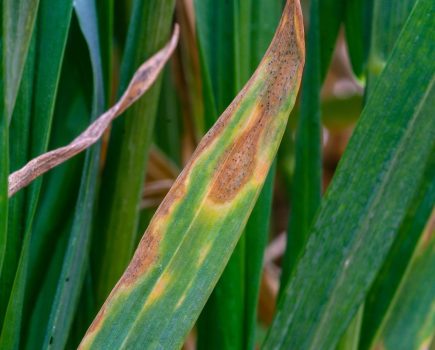
Having used the product for a year and received positive feedback from her growers, Lucy says she now has more confidence in Fundatis, particularly given initial concerns regarding its mode of action. This is because Isoflex active inhibits susceptible plants from producing carotenoids – pigments that are essential to light energy capture and photoprotection of chloroplasts during photosynthesis, ensuring normal plant growth. Subsequently, due to lack of chlorophyl production, susceptible plants may show chlorosis and/or bleaching and ultimately die off.
“I’ve seen minimal crop damage from bleaching, and where there have been crop effects, plants have soon bounced back,” she highlights. “I’m confident to integrate Fundatis into upcoming programmes this coming season; it’s a step-up in control compared with what we had before.”
While much focus this year has been on what Fundatis offers blackgrass management, Mat believes this coming season, Fundatis will come into its own with ryegrass. “It does a really good job at combatting ryegrass in wheat, and we expect the product to find its place in those situations, as well as in barley.
“We’ve also received anecdotal reports that Fundatis appears to work well in dry conditions, compared with other leading herbicides. The actives within Fundatis have moderate to good solubility and primary uptake of the product is through the developing root of the weed. “We’re investigating further, but on-farm user experience is important evidence to support its use,” he says.
According to Mat, the product’s label is about to improve too. “We were able to submit further supporting data, so now more weed species will be on the label for this coming season.
“We’re also relaxing the voluntary buffer zones that were initially advised for vineyards, orchards and ornamental crops. Our advice to still exercise a sensible level of caution and follow the label guidance, but we hope this not only helps growers with those crops, but demonstrates our confidence in the safety of Fundatis.”
Furthermore, FMC has received no significant incidents of crop effects other than transient bleaching, he raises. “It’s all a positive story for the product and its stewardship. We’re also hopeful to achieve registration for its use in rye and triticale, likely due in 2027,” concludes Mat.
This article was taken from the latest issue of CPM. Read the article in full here.
For more articles like this, subscribe here.
Sign up for Crop Production Magazine’s FREE e-newsletter here.