
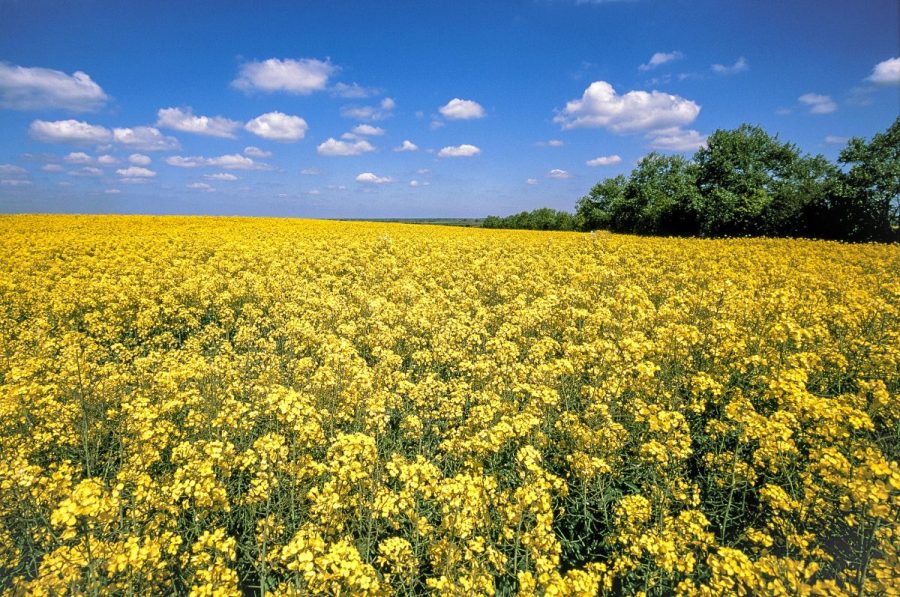
Despite largely disappointing harvest for many on the back of a prolonged drought, oilseed rape has emerged as a star performer the second season running. CPM speaks to farmers across the UK about harvest results and the plans for next season.
“If we can grow it well, it does leave a good margin behind it.” DAVID BRISTOW
By Charlotte Cunningham
After several years in which conversations around oilseed rape have been dominated by crop failures, cabbage stem flea beetle and growers questioning whether the risk was still worth taking, the mood appears to be shifting…
Because while Harvest 2026 has delivered plenty of disappointment elsewhere in the rotation, OSR has once again emerged as something of a top performer.
United Oilseeds is forecasting average UK yields could exceed 4t/ha for the first time, comfortably ahead of the long-term picture. For context, AHDB figures put the UK 10-year average at around 3.3t/ha, while last season’s national average of 3.7t/ha was already one of the strongest performances since 2017. It means two successive seasons of encouraging results are beginning to rebuild confidence in a crop which, only a few years ago, many growers had all but written off.
DEEP ROOTING
Perhaps most strikingly, that performance this season has come against the backdrop of prolonged drought across large parts of the country. While the same dry conditions have taken their toll on other crops, OSR’s deeper rooting appears to have helped it access moisture further down the soil profile and maintain yield.
But weather is only part of the explanation. Improved genetics, greater understanding of CSFB and – perhaps most importantly – more flexible approach to establishment are all beginning to change the odds in growers’ favour, and although experiences vary considerably from north to south, those factors are evident across farms reporting some of their strongest OSR results for years.
For Northumberland grower Andrew Reed, OSR has proven one of the standout performers, with this year’s crop yielding close to 5.5t/ha.
Farming 800ha of mixed arable cropping near Berwick-upon-Tweed, Andrew grows OSR around one year in seven at East Anscroft Farm, and although he admits growers further south would probably ‘snap his hand off’ for the harvest they’ve had in the north east, OSR in particular has given little cause for complaint.
STRONG ESTABLISHMENT
Drilled between 15-20 August last year, with LG Adapt replacing previously-grown Aurelia, good establishment set the crop on its way, notes Andrew. The crop was drilled using a seeder mounted on a Simba SL 400, alongside liquid starter fertiliser and slug pellets, before Cambridge rolling. “The weather was good last August, so we drilled the OSR into good conditions and establishment was fantastic,” he recalls. “We applied the autumn sprays, and the crop came through the winter very well, without much pigeon damage.”
That latter point is significant in this part of the country, where Andrew says pigeons can pose as much – if not more – of a threat to establishing OSR than CSFB.
He says that from there, the crop continued to thrive. A total of 245kgN/ha was applied across three splits, alongside variable-rate phosphate and potash, while spring fungicide applications targeted stem extension and flowering. “Fertiliser and spray applications all went on at the right timings, and the crop looked absolutely superb at flowering,” he adds. “It flowered for a long time because there was no significant rainfall to knock the petals off or any wind.”
The final hurdle was navigating what Andrew describes as the crop’s customary ’white knuckle ride’ through to harvest, with the threat of hail and strong winds particularly pertinent on the farm’s relatively exposed ground. But patience paid off, with combining completed safely on 2 August and yields estimated at around 5.4-5.5t/ha. “It’s been a fantastic crop throughout, holding up to the weather conditions and delivering the kind of performance that we’d hoped for.”
With OSR continuing to earn its place as a valuable break crop in the rotation, attention has already turned to Harvest 2027. Recent rain in the region means conditions are markedly different to those facing many growers further south, and half of the farm’s next OSR crop is already in the ground. “We’ve had quite a lot of rain this last fortnight, so half of it is already drilled and we’ll get back to the other half once we’ve finished cutting the rest of the crops,” he concludes. “Fingers crossed there’s no flea beetle.”
Further south, the story is less about OSR maintaining its place, and more about earning it back. For Lincolnshire grower David Bristow, this year’s crop represents more than a respectable 4.04t/ha yield – it marks a successful return to something which had become increasingly difficult to justify.
Farming 650ha at Stourton Estate on the edge of the Lincolnshire Wolds, David stopped growing OSR in 2022 after CSFB pressure culminated in the failure of an entire field. “It just became harder and harder to grow until it culminated in a failed crop, and we decided then to take a break for a while.”
But finding a replacement proved equally challenging. Linseed was trialled for a period, while oats and a small area of beans remain in the rotation, alongside grass following the introduction of cattle – yet the loss of a profitable break crop was noticeable.
Seeing successful OSR crops locally during Harvest 2024 helped to give David the confidence to try again, with 52ha of LG Avenger subsequently grown for harvest 2025. The crop yielded 4.04t/ha and, while slightly below expectations, strong oil content brought additional bonuses. “I was slightly disappointed in the yield, but it was still quite good. The oil was very good, so there were quite a few bonuses to be had there once you had it analysed.”
Varietal improvements have played a part in rebuilding that confidence, particularly vigorous autumn growth and greater resilience to CSFB. But David believes establishment decisions are just as important. Last year’s crop followed winter barley and was drilled with a Horsch Avatar during the final week of August, following low-disturbance subsoiling. Crucially, drilling was held back until there was sufficient moisture, helping the crop to establish quickly and evenly.
RINSE AND REPEAT
That same principle is guiding this autumn’s decisions, he explains. “Wait until we’ve had rain, or at least it’s forecast and there’s a substantial amount – that’s what I’m going off. If there was rain earlier in the year I was ready to drill it earlier, it just didn’t come in any amount.”
For David, having OSR back in the rotation also matters financially. With uncertainty surrounding future farm support, crops increasingly have to justify their place on their own merit. “If we can grow it well, it does leave a good margin behind it. It’s not that expensive to grow, albeit it’s all front-loaded.”
And while CSFB means there are no guarantees, he believes growers are becoming better at managing that establishment risk. “The varieties have a big part to play – that really rapid growth in the autumn to get away from adult damage. New varieties are starting to help, and I think we’re just getting slightly better at managing expectations.”
That willingness to wait for the right conditions is also central to the approach taken by Herefordshire grower Edward Godsall – although unlike David, OSR never quite disappeared from his rotation.
Edward farms around 350ha of predominantly arable cropping near Ledbury, growing cereals alongside herbage and vining pea seed crops. Despite the combined challenges of CSFB and increasingly unpredictable weather, he’s continued growing the crop throughout. “We’ve always grown it, even during the super challenging years. There were times where it was very close, but we just valued it as a very good break crop around here.”
CONDITIONS FIRST
CSFB pressure has noticeably eased during the past couple of seasons, although Edward isn’t taking its absence for granted. Instead, his establishment strategy has gradually shifted later, with conditions taking precedence over conventional drilling dates. “I’m never really one to worry too much about calendar dates. It’s the old classic, conditions over calendar. I’m happy to keep planting up until mid-September around here, and that’s what we’ve edged towards during the past few years – we’ve actually gone later and later, rather than earlier and earlier.”
Last autumn, most of the crop was drilled around 16 September. Despite some flea beetle activity in a couple of fields, the crop quickly outgrew the damage and entered winter in good shape without becoming excessively forward – another advantage Edward sees from holding back drilling on the farm’s heavy clay soils.
The strategy ultimately delivered, with LG Adapt and LG Armada grown this season and Adapt proving the stronger of the two. Harvest arrived unusually early in mid-July, with the crop averaging around 4.2t/ha against a five-year farm average of about 3.7t/ha. “The Adapt was probably our leading light of the two. There wasn’t a lot to choose from between them, and we would have averaged about 4.2t/ha, which for us is pretty good. And to average that as well, that’s not me just finding the best parts.”
Of course, two good harvests don’t mean CSFB has disappeared. Instead, the argument from United Oilseeds is that growers now have a broader range of tools with which to manage the pest and, importantly, establishment risk as a whole.
Alongside drilling into adequate moisture and improvements in autumn vigour from newer genetics, research continues to explore additional approaches, too.
One currently attracting attention is shallow post-harvest cultivation. Work through the four-and-a-half-year CSFB Research+ project, led by Colin Peters and the Niab team, is investigating whether light cultivation immediately after harvest can disrupt flea beetle populations developing in the soil. Early findings suggest reductions in emerging adults of 50-80%. However, in this season’s exceptionally dry conditions, experts say creating a shallow tilth may offer an additional benefit by helping rainfall infiltrate rather than running from hard, capped surfaces.
It all points towards establishment becoming less about finding one silver bullet and more about stacking small advantages in the crop’s favour – from soil moisture and drilling date to genetics and cultivation strategy. That flexibility is particularly evident on Edward’s farm. At the end of August, he was still ’literally waiting for the rain’, confident that his usual September drilling window gives him room to respond when conditions improve.
Looking ahead, if the national average does break the 4t/ha barrier, it’ll undoubtedly provide another confidence boost and on farm, Andrew already has half of next year’s crop drilled, David has committed to growing OSR again, and Edward remains prepared to wait into September for the conditions he wants. So it appears the question for autumn 2026 is increasingly not whether to grow it – but how best to give it the start required to deliver again…
Variety choice across these case studies is coincidental.
This article was taken from the latest issue of CPM. Read the article in full here.
For more articles like this, subscribe here.
Sign up for Crop Production Magazine’s FREE e-newsletter here.