
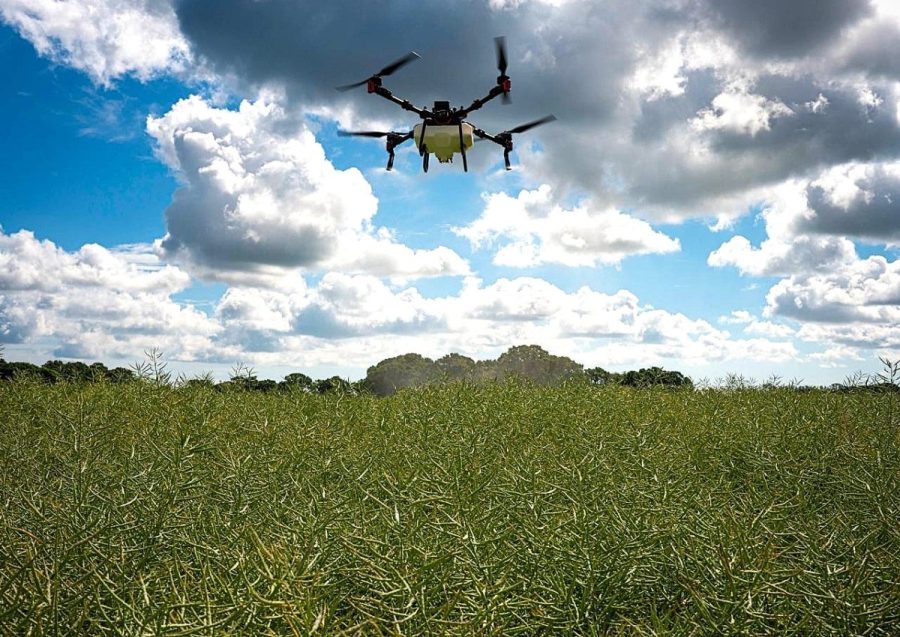
Thanks to advances in technology and creative thinking, applying certain crop management products by drone is beginning to become a reality for UK farmers. CPM explores how a chance prize win enabled one Norfolk oilseed rape grower to explore the concept further.
“If it helps you to get the timing right and protect the crop without damage, then it’s worth considering.” JOE MITCHELL
By Janine Adamson
Winning a drone application of pod sealant at Lamma show wasn’t just a chance for Norfolk grower Joe Mitchell to play with some new technology. Instead, it was an opportunity to see if the concept actually works in practice, in a real-farm situation.
In a pivotal moment for all involved, Pod-Stik was applied from the skies to a field of oilseed rape at High House Farm near Great Yarmouth – a 225ha mixed enterprise comprising 150ha of arable cropping, a large free-range poultry unit, beef cattle and sheep.
Having growing OSR for around a decade, Joe says the endeavour involved his ‘best OSR crop for many years’ – a stand of LG Academic drilled in early September 2025. He mainly puts its performance down to a focus on establishment.
“Establishment is everything – if you don’t get the plant numbers right, you won’t get the yield,” he says.
This year, he says the stars aligned, having drilled the crop into favourable conditions following an application of poultry manure. “We’re trying to give it the best start possible – good moisture, the right seed rate, and getting it away quickly.
“It’s probably the best OSR we’ve had for a long time. It’s thick, even and it’s podded all the way through.”
However, with that potential comes increased risk, he notes. “By this stage, a lot of the yield is already there. Then it’s about protecting what you’ve built.”
Technical business manager for De Sangosse, Stuart Sutherland, says this final phase remains one of the most vulnerable points in OSR’s lifecycle. “It’s inherently at risk right up until harvest,” he continues. “Pod shatter is one of the primary causes of pre-harvest loss.”
“Environmental stress plays a central role, with wetting and drying cycles, wind and crop movement all placing pressure on the pod seam. But once pods begin to split, losses can escalate very quickly – and that yield is unrecoverable,” stresses Stuart.
This is something that Joe has experienced first-hand. “You only need a bit of wind or movement through the crop and it can start to go. And once it starts, you can’t stop it,” he comments.
Already familiar with Pod-Stik, the product has been part of Joe’s OSR programme since he began growing the crop. Initially recommended to him by neighbouring farmers and his agronomist, Joe believes its role is becoming more important.
“With the uncertainty around the future of pre-harvest glyphosate and how crops are managed before harvest, there’s a chance they’ll be standing longer. That means more exposure to the weather and greater risk.
“We had a crop that didn’t get desiccated and it stood much longer than expected. It wasn’t combined until mid-August and that’s a long time for pods to be exposed,” he explains.
From a technical perspective, Pod-Stik works by forming a flexible polymer film across the pod surface, reinforcing the pod seam (dehiscence zone) – the point where pods naturally split.
“By strengthening that weak point, you reduce the likelihood of the pod opening under stress,” adds Stuart. “In OSR, we’re targeting crops at BBCH 80-82 when pods are fully formed, green and bendy. That allows you to protect yield before the main stress period begins.”
Pod-Stik can be applied either as a standalone treatment or alongside glyphosate within a desiccation programme, although earlier standalone application is often preferred.
“I used to apply it with glyphosate, but I now think that’s too late,” highlights Joe. “If you want to protect what you’ve grown, you have to be ahead of that timing in an ideal world.”
However, drone application introduces an opportunity to apply the product without driving through the crop. “Because glyphosate isn’t currently approved for application by drone, pod sealants have to be applied as a standalone treatment,” reminds Stuart.
Broadly speaking, plant protection products aren’t currently approved for use via drone under UK regulation, however, applications such as pod sealants, nutritionals and biostimulants are permitted. This means as challenges increase around the application of pod sealants in OSR – particularly in relation to high-biomass crops – application by drone could address a significant production conundrum.
“The crop last year was more than 5ft (1.5m) tall, and we ended up dragging the boom through it and damaging the sprayer,” explains Joe. “That’s the last thing you want to be doing when pods are vulnerable.”
Stuart says enabling real on-farm use will be key in the adoption of the drone application technology. “It’s about developing approaches growers and agronomists can use with confidence,” he comments.
The drone application at Joe’s was undertaken by Rural Drone Services, part of the AutoSpray Systems Pilot Network of CAA-certified drone pilots. Using RTK-guided mapping, the 8.3ha field was treated in approximately one hour, applying 1.0 l/ha Pod-Stik in 50 l/ha water at a flight height of around 3m and a forward speed of 11m/s.
The key is balancing all of those factors, notes Stuart. “Pod sealants rely on forming a robust film – effectively a row of staples down the pod seam. So achieving good, even coverage is critical.”
While the endeavour was successful and undoubtedly exciting, Joe believes it won’t replace conventional spraying, rather add flexibility where required. “If conditions are right, you’ll still use the sprayer. Then if it turns wet, or you have areas you don’t want to travel on, then this makes sense. Why make ruts that last for months if you don’t have to?”
His pragmatism continues: “It’s very easy to fall in love with the technology, but you have to ask – is it actually the right solution?
“If it helps you to get the timing right and protect the crop without damage, then it’s worth considering,” he says.
With this laying solid foundations for the future, Stuart believes there’s potential beyond OSR. “In beans, the opportunity could be even greater. Pods mature from the bottom up, and the earliest pods are the most exposed to stress and shatter risk. That creates a wider window of vulnerability; you effectively have part of the crop at risk while the rest is still maturing,” he explains.
According to Stuart, what this demonstration shows is that drone application is beginning to move beyond concept, offering a practical way to overcome limitations around access, timing and crop damage at a critical stage.
As for Joe, his approach remains simple: “If you can protect the crop at the right moment, that’s what makes the difference,” he concludes.
Growers interested in pod sealant use or drone application options can contact De Sangosse for further technical guidance, or visit the AutoSpray Pilot Network on the AutoSpray Systems website.
This article was taken from the latest issue of CPM. Read the article in full here.
For more articles like this, subscribe here.
Sign up for Crop Production Magazine’s FREE e-newsletter here.