
What happens when you take a television-come-farming star, Cotswold Brash land, a load of trade stands, some seminar sessions and a raft of agricultural enthusiasts? The answer it seems, is a very successful Cereals Event. CPM reports…
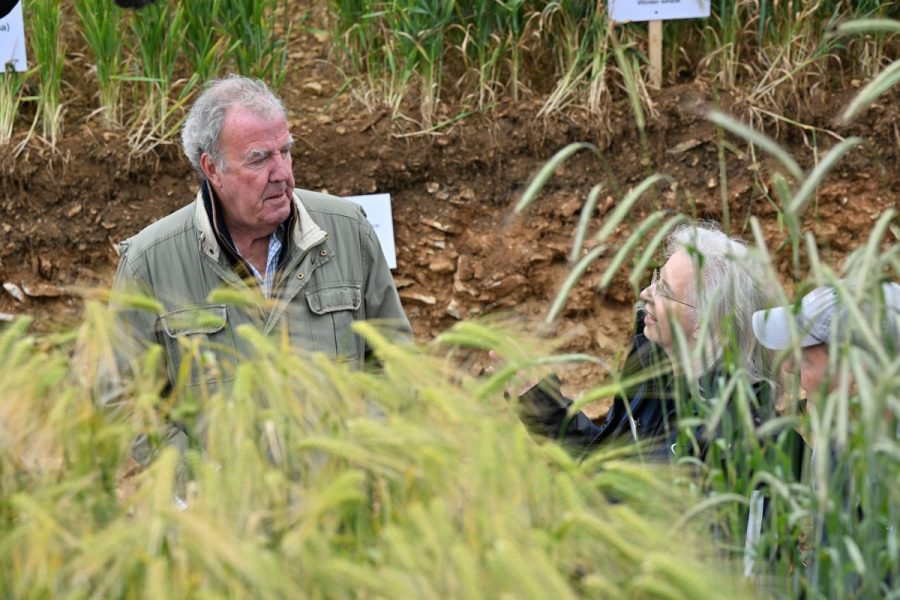
“It was an absolute honour for us all at Diddly Squat to be chosen as the host.” JEREMY CLARKSON
By Janine Adamson
With an honest and fair eye, despite its many years of success, Cereals had become a little stale of late for both exhibitors and visiting punters. One by one, ‘big’ players pulled out, seminar talks scaled back, and the overall vibe had become somewhat muted.
Many said it required a complete shake-up – an injection of life. Then, just when it was teetering on breaking point, along came Clarkson’s Farm and its polarising host, Jeremy.
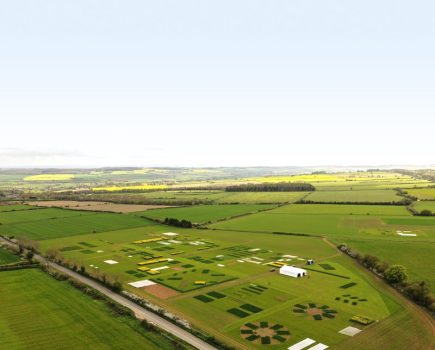
And just like Jezza, the decision to host Cereals at Diddly Squat in Oxfordshire – renowned for its unforgiving Cotswold Brash land – didn’t come without criticism. However, for all its faults, it seems the decision to set up shop there was in fact a triumphant one…
Whether it was sheer blind faith or a queasy sense of FOMO (fear of missing out), industry flocked to Diddly, which in turn, offered the 25,000 reported visitors a cacophony of crop plots, new products, shiny machinery releases, and experts ready to talk nitty gritty farming.
Speaking on his Instagram account, Jeremy said he’d loved every minute and it was a delight to see so many people turn up. “My profound thanks to everyone involved. It was an absolute honour for us all at Diddly Squat to be chosen as the host.”
One exhibitor that was hard to miss was KWS, which not only had its own large trade stand and array of crop plots, but also sponsored the ‘seed to shelf’ mainstage. Speaking at the show, the team provided a market overview, with their expectation that winter wheat should maintain its cropping area next season as long as autumn conditions allow.
They said they could see growers exploring alternative varieties which offer end market flexibility due to continued pressure on profitability and milling wheat premiums. They suggested it’s likely the milling hectarage specifically will decrease due to depressed premiums.
Then, taking a look at some of KWS’ latest varietal introductions, Matt Bull said KWS Aintree is one to watch. “It’s unrivalled for yield, offering stability across different regions, soil types and drilling windows.
“It has huge yield potential, therefore offering growers the opportunity to push forward their feed wheat profitability. Although it requires proactive yellow rust management, done well, it will deliver.”
He also highlighted KWS Fowlmere as another new variety which brings a unique balance of yield and early maturity.“Fowlmere is the earliest variety on the Recommended List by a significant margin, making it ideal for growers looking to spread harvest workload or seeking an alternative entry for OSR.
“It’s well-suited to lighter land, with taller straw and excellent grain quality. It also has the added benefit of being suitable for export,” he said.
Commenting on winter barley, Kate Cobbold added that although economics surrounding the crop have been challenging, there are some exciting varieties coming through which add value for UK growers. For one, KWS’ second hybrid introduction – Idrys. “A candidate variety, this is our next release to follow Inys. Quality is the stand-out feature of Idrys, particularly specific weight.
“We also have two new 2-row barley varieties coming through the pipeline, KWS Lemuris and KWS Blis. They are particularly interesting as they bring BYDV tolerance without a penalty on yield or grain quality, so watch this space,” she advised.
Over at RAGT, Tracy Creasy highlighted SY Arrow – a spring malting barley that recently achieved full approval for malt distilling, and provisional approval for brewing. “This is an exciting introduction,” she said. “It’s similar to Laureate in its adaptability and consistency – Arrow is a consistent performer across all trials.”
She noted that with outstanding quality and early maturity, it should be ideal for Scottish growers, but equally, will be launched across the globe. “Arrow comes from the Syngenta breeding programme, which was recently acquired by RAGT.
“We really believe it’ll be the next Laureate, while offering genetic diversity to meet the demands of maltsters who are looking for something different.”
RAGT is also adding to its BVDY-resistant varieties, noted the firm’s Ed Stanford. “While RGT Guardsman broke the yield barrier for varieties with BYDV resistance, our latest suite of options not only have BYDV resistance and strong yields, but also offer orange wheat blossom midge resistance too.
“As far as we’re concerned, there are no longer any obvious penalties from including BYDV resistance in a variety,” he said. “We’re adding value beyond just the BYDV trait.”
With candidate BYDV varieties RGT Gorgon and RGT Griffin in the pipeline, Andrew Creasy raised that this year has been the perfect opportunity to test their performance. “This season, conditions have been really conducive to aphids and BYDV transmission, so in trials we’ve been able to showcase what these new varieties are truly capable of.”
Also sharing new varieties was DSV, with its headline high yielding Group 1, Arlington. Sarah Hawthorne explained that perhaps unusually, Arlington combines the Pch1 eyespot resistance gene with Sm1 resistance to orange blossom midge, plus good agronomic scores for a robust all-round package.
“With a low vernalisation requirement, Arlington can be sown later, comparable with Skyfall,” she added. “If you’re familiar with Skyfall, Arlington’s management should be very similar.”
At FMC, Geoffrey Bastard highlighted that Cereals was the first time the company had brought its own R&D product to the show circuit, rather than chemistry gained through acquisitions or legacy companies.
“In its first year, Fundatis (bixlozone(Isoflex active)+ beflubutamid) has performed well in all field-scale scenarios, and we now have real evidence beyond just plot scale trials. In particular, we’re observing exceptional activity on ryegrass and broadleaf weeds like groundsel.”
He pointed out that as the herbicide market shifts with potential change looming on the horizon, for managing a broad range of weeds, Fundatis should prove a compelling solution. “It’s a wide offer, and critically, contributes positively to resistance management.”
Also tackling the notion of wider industry concerns was De Sangosse, which launched a phosphate stewardship guide developed in collaboration with ADAS. The guide brings together research, field data and practical agronomy to address the challenge of how to improve delivery of phosphorus to crops.
Speaking on the stand was Dr Christina Baxter, who said evidence from the Yield Enhancement Network (YEN) had shown a significant variation in grain phosphorous content, despite soils containing sufficient reserves.
“There can be large pools of phosphorus in the soil but often, only a small amount is crop-available because a lot can be stored in inorganic and organic forms or fixed to soil particles. This means the crop struggles to access that nutrition.”
She added that the guide had been developed to hopefully raise awareness around poor phosphate efficiency, and that there are ways to address it, depending on the situation. “For high P indices, this means improving the access to that nutrition. Conversely, for low P indices and maintenance scenarios, the solution is to better protect what’s being applied.”
The catchphrase for the guide is ‘Protect it. Place it. Unlock it.’, which Christina hopes will have a positive impact on the stewardship’s adoption. “It’s important because of the impact of legacy P in soils and its potential to be lost through run-off, erosion or drainage pathways.
“Phosphate is an environmental concern as well as agronomic, and should be tackled head-on rather than simply accepted.”
Over at Agrii, it was all about technology, as it launched its new ‘smart connected farm’ initiative. Centred around the recently announced integration of Contour with Telus, the aim is to develop a ‘top-drawer’ agronomy tool, explained Ben Foster.
“It’s our new approach to agronomic advice where we combine drones, sensors and any data generating technology, alongside intelligence from our R&D, and feed that into Contour. This information is then analysed by Agrii before being used to create actionable insights for the grower. Essentially, it’s digital farming made simple.”
Agrii’s Dr Ruth Mann added that the goal is to provide agronomists with tools for impact, but critically, it’s grower focussed too. “We’re building a jigsaw to pick and choose from, where the agronomist can customise the data and information on a per-farm basis.
“Information from our trial sites and Digital Technology Farm (DTF) network will all feed into the smart connected farm.”
For something different, Premium Crops (part of Cefetra), demonstrated the benefits of targeted pollination on borage yields. This is because typically, there aren’t enough background pollinators to deliver the optimum seed yields for the crop.
However, working with the Bee Farmers Association, Premium Crops has been able to show that by placing two bee colonies per hectare of borage, growers can achieve a 20-25% yield uplift.
“If 1t of borage seed equates to £4000, it makes maximising pollinators well worthwhile,” said Paul Barton of the Bee Farmers Association.
As for machinery, Kverneland used Cereals to introduce a new fertiliser spreader to the UK market. Called Alentix, the all-new twin-disc machine boasts enhanced technology and greater spreading performance.
Said to be the flagship of Kverneland’s spreader portfolio, Alentix sits above the Exacta TL, and provides another option for those seeking the high accuracy and efficiency with bagged fertiliser. It has a 4700 litre hopper capacity and a spread width of up to 54m.
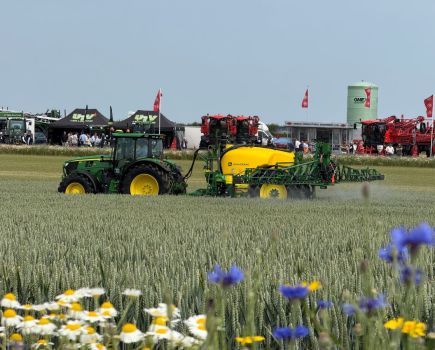
Then over at John Deere, the firm revealed it had expanded its 500R sprayer range for model year 2027 (MY27), with larger tank capacity and advanced boom technology.
Designed for large arable farms and professional spraying operations, the MY27 500R series builds on the established front-cab, rear-engine concept and enters a higher productivity segment while maintaining a compact transport width of just 2.55m.
Among this, the headline addition is the new John Deere 560R, expanding the 500R range into the 6000-litre class. The larger tank is aimed at operators working during tight application windows who need to cover more hectares per day with fewer refilling stops, particularly in cereals, OSR and other high-input crops.
Undoubtedly, this year’s show will be a hard act to follow, however for 2027, the event will return to Andrew Ward’s farm in Lincolnshire on 9-10 June.
This article was taken from the latest issue of CPM. Read the article in full here.
For more articles like this, subscribe here.
Sign up for Crop Production Magazine’s FREE e-newsletter here.